






















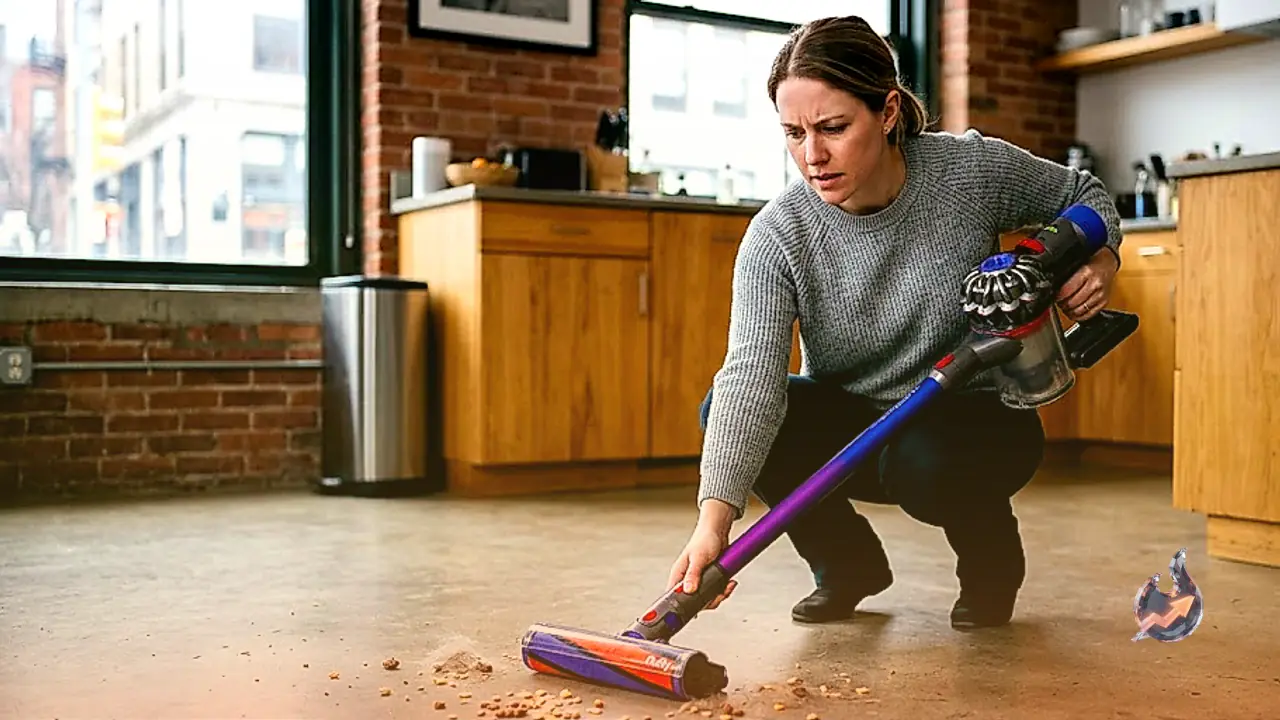

Engineered exclusively for hard floors, the Dyson PencilVac Fluffycones arrives as an ultra-slim, cordless stick vacuum that discards conventional design choices. Rather than featuring a standard bulky handle, it maintains a streamlined silhouette that keeps the overall build under four pounds. Its cleaning head completely omits traditional bristled brushrolls, opting instead for four cone-shaped soft rollers organized into two counter-rotating pairs. A small integrated display on the grip keeps users updated on remaining battery runtime in real time. For above-floor cleaning, the machine ships with a single versatile attachment that toggles between a crevice nozzle and a soft dusting brush for furniture. The vacuum recharges vertically on a magnetic dock that also houses the accessory, and the removable battery architecture allows for quick swaps if an extra pack is purchased separately.
Struggles Beyond Brief Touch-Ups in Full Homes
Attempting to clean an entire residence with this vacuum reveals clear operational hurdles. The internal battery does not last long enough to service every room, meaning larger homes will demand either a secondary battery on standby or frequent interruptions for recharging. While the concept focuses on grab-and-go convenience across bare surfaces, the machine exhibits noticeable trouble gathering debris reliably. The physical construction holds up well against normal usage routines, though the dust container itself feels somewhat fragile. On the positive side, the exhaust does not spew dust back into living spaces during operation, keeping room air relatively undisturbed while the rollers work.
Everyday Utility Across Apartments and Staircases
In smaller living environments like compact apartments, the vacuum finds a more sensible role thanks to its minimal footprint. Its slender profile and upright magnetic stand nestle neatly into narrow corners where storage space is at a premium. Being bagless and cordless removes much of the friction associated with everyday upkeep. Navigating staircases is similarly straightforward, as the sub-four-pound weight allows users to step up and down without fatigue. The untethered design lets you move freely along the entire flight without hunting for wall sockets. However, the recurring issue remains basic pickup: whether moving across bare steps or small flat surfaces, it regularly leaves dirt behind.
Car Limitations and Weak Performance on Bare Floors
Taking this machine out to clean vehicle interiors is not a suitable use case. More critically, the vacuum struggles at its primary advertised specialty: cleaning bare floors. Despite being engineered exclusively for hard materials, it consistently leaves particles behind after a single pass, forcing users to repeatedly go over the same spots. The twin pairs of rollers fail to dig out dirt sitting inside tile grout lines or the seams between floorboards, allowing debris trapped in cracks to remain largely untouched.
Complete Incompatibility With Carpets and Pet Hair
Fabrics and carpeted surfaces present a near-total barrier for this cleaner. It fails to lift dirt from low-pile and high-pile carpets alike because its soft rolling cones lack stiff bristles to agitate embedded grime out of carpet fibers. On thicker plush carpets, the head tends to catch on surface debris and stall, requiring manual intervention to clear the jam and resume spinning. Anyone with fitted carpets or area rugs must rely on an alternative vacuum. Pet owners face similar shortcomings on both floors and upholstery. The vacuum leaves sizable clumps of pet fur behind, dragging strands across the floor rather than inhaling them. Furthermore, the single included multi-tool lacks the suction strength and specialized design needed to lift pet hair from sofas or chairs.
Particle Filtration Versus Dustbin Emptying Drawbacks
The internal filtration mechanism performs reliably when it comes to preserving indoor air quality. It seals in fine particulate matter, preventing exhaust air from circulating dust back into the room. A minor drawback occurs at the floor head itself, where the spinning cones can scatter some loose dust before it enters the suction path. The far greater annoyance lies in dumping the collected refuse. Because the dustbin has a small capacity, it requires frequent emptying, and opening the latch inevitably expels a noticeable dust cloud into the room. Users sensitive to airborne allergens or asthma triggers are better off stepping outside to empty the canister.