





















Every morning, millions of people experience a subtle surge of annoyance as their kitchen microwave heralds the completion of reheating with a shrill, piercing beep. The unpleasantness of this sound has trained many users, through operant conditioning, to rush across the room and open the appliance door at T-minus 1 second just to prevent the grating tone from sounding. However, a pair of audio engineers has discovered a remarkably simple solution that requires zero hardware modifications and preserves manufacturing margins, transforming the acoustic environment of modern kitchens through a few lines of code.
The Psychology and Annoyance of Household Bleeps
The repetitive high-pitched tones emitted by modern domestic electronics frequently trigger micro-stress responses in consumers. Microwave beeps stand out as particularly abrasive because they rely on sustained, single-frequency pulses designed to cut through ambient background noise. Over time, this daily acoustic intrusion creates a heightened state of alert, causing users to actively monitor the countdown timer and interrupt the appliance right before the cycle completes. This widespread phenomenon highlights how unrefined product sounds can negatively affect daily human interaction with standard home appliances.
A Five-Decade Legacy: The Origin of the Piezoelectric Buzzer
The ubiquity of electronic beeps is a relatively recent historical development. The term "beep" was first used to describe a short, high-pitched electronic tone in Arthur C. Clarke's 1951 science fiction novel, The Sands of Mars, prior to which the word primarily referenced automotive horns. In the 1970s, Japanese manufacturers commercialized the passive piezoelectric buzzer. This component consists of a simple ceramic membrane that vibrates when an electrical charge is applied, generating a rudimentary acoustic signal.
Because passive piezoelectric buzzers cost only a few cents per unit and feature no moving mechanical parts, they quickly became the standard sound generator across consumer electronics. Smoke detectors, alarm clocks, digital multimeters, wristwatches, electronic toys, and microwaves all adopted the inexpensive component. Despite severe technical constraints that limit outputs to basic frequencies and durations, the underlying piezoelectric technology has remained largely unchanged in household white goods for over fifty years.
Why Appliance Makers Stick to Piercing Pings
While appliance manufacturers could theoretically install full-range dynamic speakers to produce richer soundscapes, intense cost competition in the consumer white goods market suppresses hardware upgrades. Profit margins on standard kitchen appliances are exceptionally thin, discouraging companies from replacing cheap, reliable components with more expensive audio hardware.
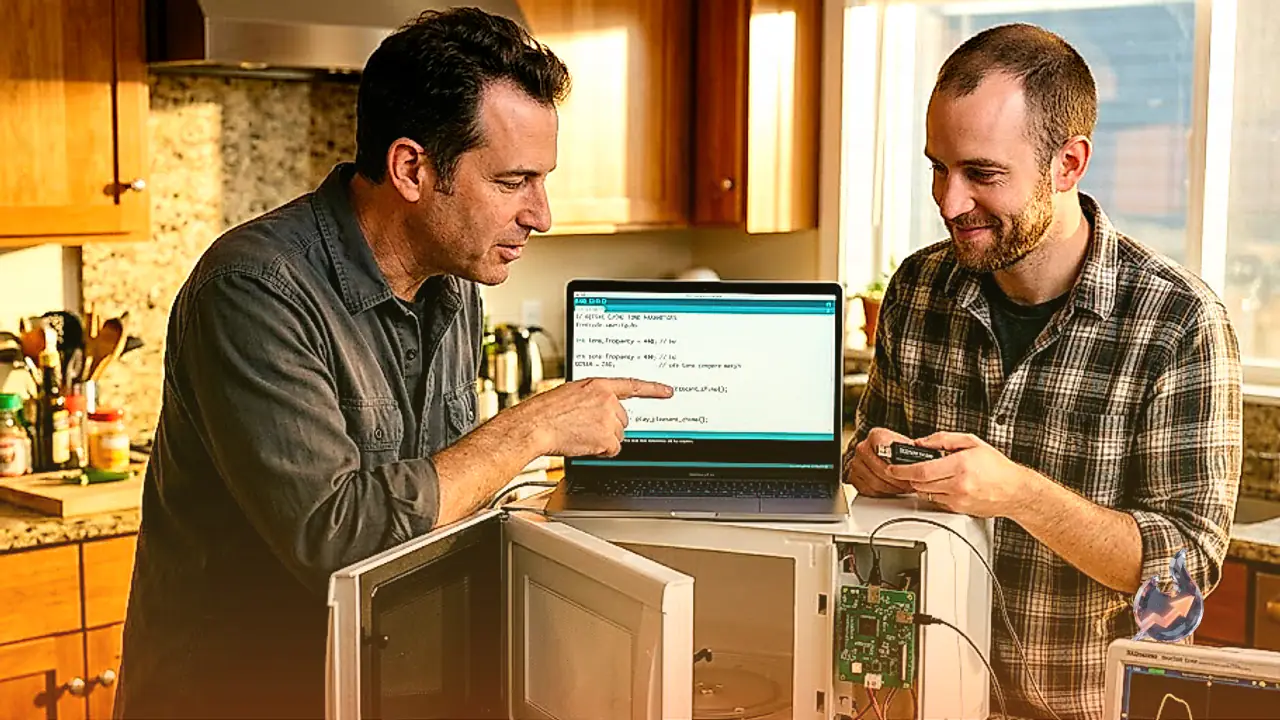
This economic reality prompted sound designers Joel Corelitz and Colin Coogan, founders of the two-person audio consultancy Starling, to approach the problem differently. Having previously developed sound strategies for Ford's vehicle lineup and created audio assets for Sony, Microsoft, Netflix, and Sega, the duo set out to overhaul microwave acoustics using only existing hardware. Driven by Corelitz's personal frustration with his own appliance, their goal was to generate sophisticated audio profiles relying strictly on custom C++ software running on standard internal microcontrollers.
The Code-Only Revolution: Starling's Engineering Hack
According to Corelitz, virtually any embedded microcontroller capable of running C++ code can be programmed to output complex acoustic patterns through a standard piezo buzzer. Since modern microwaves already contain microcontrollers connected to buzzers, software reprogramming represents the only missing element. Using custom laptop software named Microwave Sound Bench, Starling recreated standard microwave beeps alongside a library of alternative audio profiles.
The alternative sounds developed by Starling include rapid multi-note trills, frequency sweeps reminiscent of cartoon sound effects, musical arpeggios, and structured event sequences similar to video game audio. None of these profiles resemble traditional microwave pings, successfully eliminating the harsh morning tones without requiring manufacturers to alter their supply chains or hardware bill of materials.
Inside the Test Bench: Simulating Dynamics and Soft Clicks
To demonstrate their concept, Corelitz constructed a minimal test rig featuring an Arduino UNO R4 Minima microcontroller connected to a breadboard with three distinct piezoelectric buzzers. Two buzzers were mounted directly to the breadboard, while a third bare buzzer was attached to a sheet of paper to enhance acoustic resonance. Because piezoelectric buzzers lack native volume control, Corelitz utilized frequency manipulation to simulate dynamic sound levels.
By sweeping rapidly across different frequency ranges, the designers identified specific resonant bands where the physical buzzer naturally outputs higher sound pressure levels. By leveraging these resonant sweet spots, Starling created audio patterns that perceive as expanding and contracting in volume, despite the hardware operating at a constant output state. Furthermore, they replaced the harsh button-press feedback with a soft 4,000-Hz tone lasting just 1 millisecond, replicating the tactile, premium click feel of modern smartphone touchscreens.
Market Demand and Industry Insider Perspectives
Coogan noted that working within severe hardware constraints presented a compelling creative challenge, while public reception indicated strong consumer desire for better acoustic design. Social media responses on Instagram revealed numerous users asserting they would willingly pay a $50 premium for a microwave equipped with pleasing sound aesthetics.
Industry experts corroborate the potential for audio innovation in white goods. Richard Hughes, currently the design lead for digital user experiences at Volvo in North America and previously the principal UX designer at Whirlpool for 15 years, explained that appliance manufacturers rarely employ dedicated sound design specialists. While companies invest heavily in noise engineering to suppress motor and fan sounds, tone design is frequently neglected. Hughes recalled an initiative at Whirlpool where connecting piezos to an Arduino yielded a soft, refined tone for the KitchenAid Pro Line toaster, which consumers praised for sounding like a flight attendant call chime.
The Future of Kitchen Acoustics and Home Automation
Hughes noted that microwave audio remained unpleasant for decades because manufacturers habitually carried over internal technical behavior specifications from older models, updating only exterior cosmetic designs. However, acoustic design priorities are beginning to cascade down from high-margin luxury product lines into standard home appliances as manufacturers realize that subtle experiential details drive consumer purchasing decisions.
Starling remains open to collaborating with major appliance manufacturers such as Panasonic or Samsung, though the founders express no concern if companies choose to adapt the code-based audio approach independently in-house. Corelitz and Coogan view their primary role as audio consultants dedicated to removing irritating, uninformative noises from daily life, with plans to extend their C++ sound redesign methodology to additional domestic appliances.