






















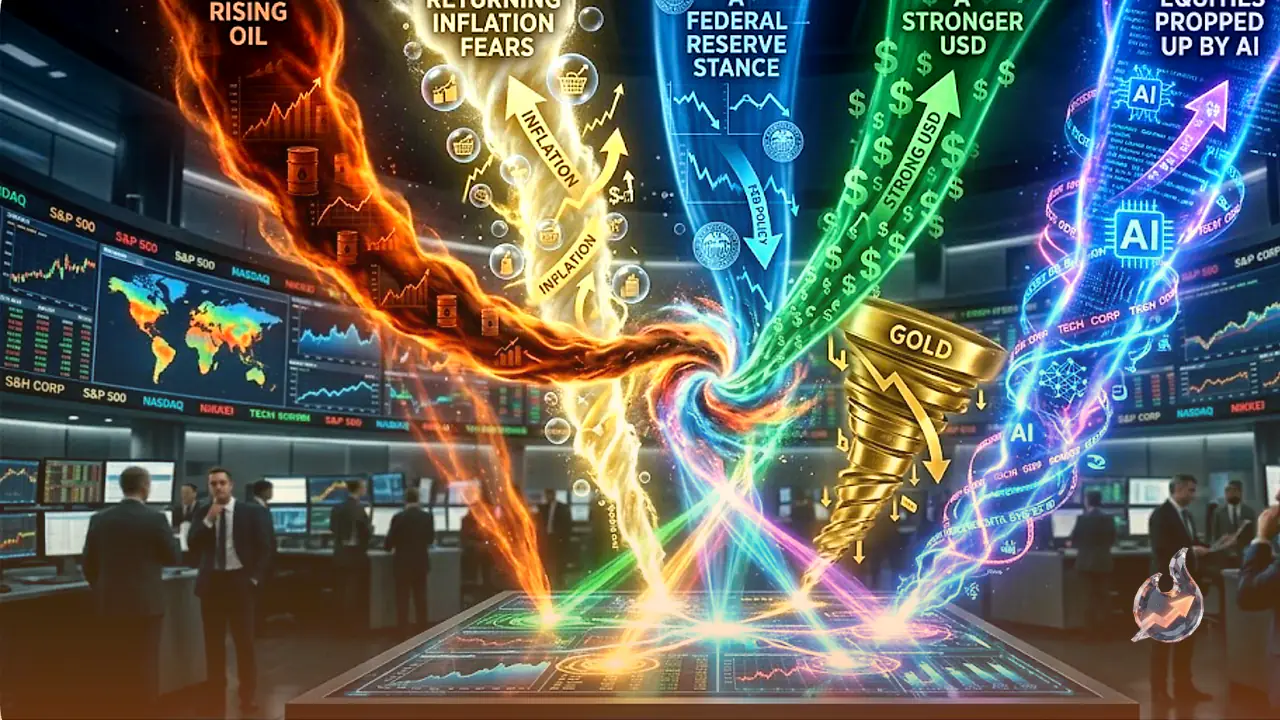

Financial markets are once again entering a phase where traders and investors have to look past any single price move. What is happening now is not being driven by one asset class, one economic reading, or one central bank statement. It is being driven by several powerful forces working together: higher oil prices, renewed inflation worries, changing expectations about Federal Reserve policy, a stronger U.S. dollar, equity markets held up by artificial intelligence, pressure on gold, and a crypto market that is still sensitive to liquidity and risk appetite. This is not an ordinary trading backdrop. This is a market that is repricing the future.
Global markets have moved higher recently, but the optimism is fragile. Oil prices have climbed amid uncertainty around U.S.-Iran talks and worries about the Strait of Hormuz, the U.S. dollar is sitting near a six-week high, and investors are once again weighing the chance of Federal Reserve rate hikes rather than cuts.
That leaves traders and investors with one essential question: are markets rising because the future looks better, or because investors are being forced to reprice risk? The answer may well be both. And that is exactly why this environment demands deeper interpretation.
Oil is no longer just a commodity story
Oil has become one of the most important macroeconomic signals in the market today. When oil rises, the effect does not stay inside the energy market. It spreads into inflation expectations, bond yields, central bank policy, currencies, equities, commodities and even cryptocurrencies.
Brent crude has recently traded around $105 per barrel, supported by geopolitical uncertainty and concerns about energy supply routes. Barclays has kept its 2026 Brent forecast at $100 per barrel while warning that the risks are skewed to the upside.
This matters because oil is one of the quickest ways inflation can push its way back into the market narrative. Higher energy prices raise transportation costs, production costs and consumer pressure. They can erode purchasing power and force central banks to stay cautious. For traders, oil is no longer just a directional trade. It is a macro trigger.
- A rise in oil can support inflation expectations.
- Higher inflation expectations can lift bond yields.
- Higher yields can support the dollar.
- A stronger dollar can pressure gold, commodities and emerging markets.
- Tighter financial conditions can drain risk appetite from equities and crypto.
This chain reaction is now one of the most important forces sitting behind the market.
The Federal Reserve narrative is shifting
For months, investors were fixated on when the Federal Reserve would cut interest rates. That story is now being challenged. Nomura has stepped away from expecting Fed rate cuts in 2026, pointing to persistent inflation and geopolitical risks. Other major institutions, including Morgan Stanley and Barclays, have also turned more cautious on rate cuts this year. Markets are now pricing in a meaningful probability of at least one 25-basis-point Fed rate hike by year-end.
This is a major shift. If traders had positioned themselves for rate cuts, softer inflation and easier liquidity, the market may now be forcing them to think again. The question is no longer simply when interest rates will fall. The sharper question is what happens if rates stay higher for longer, or even climb again.
That question changes the valuation of almost every asset class. It affects equities, bonds, currencies, gold, commodities and crypto. It also changes investor psychology, because markets that expect liquidity support behave very differently from markets that fear tighter policy.
The U.S. dollar is becoming the center of the map
The U.S. dollar is currently held up by two powerful forces: yield expectations and safe-haven demand. When the market prices in higher interest rates, the dollar can benefit. When geopolitical risk rises, the dollar can also benefit as investors reach for safety. That combination explains why the dollar has stayed close to a six-week high, even as some equity markets have kept climbing.
For forex traders, this is critical. The dollar should not be read only as a currency. It should be read as a reflection of three questions: what is the market pricing about U.S. rates, how strong is global risk aversion, and is inflation pushing investors back into dollar assets?
If all three support the dollar, its strength can persist. But if geopolitical tension eases and oil prices fall, part of the dollar's safe-haven premium could vanish quickly. That is why traders must avoid simplistic conclusions. A strong dollar is not always the same story. Sometimes it reflects U.S. economic strength, sometimes it reflects fear, and sometimes it reflects monetary policy. Today it may reflect all three at once.
Gold is trapped between fear and higher yields
Gold is one of the most interesting assets in this environment, because it is being pulled in opposite directions. On one side, geopolitical uncertainty and inflation concerns should support gold. On the other side, a stronger dollar and higher rate expectations reduce its appeal, because gold does not pay interest.
That explains why gold has come under pressure despite an uncertain global backdrop. Gold slipped as a stronger dollar and Fed rate-hike expectations weighed on the metal. The lesson for traders is important: gold does not rise automatically just because there is fear in the market. Gold rises when fear is stronger than the pressure coming from yields and the dollar. If yields keep climbing and the dollar stays strong, gold may struggle even in a volatile geopolitical environment. So gold traders should not watch geopolitical headlines alone. They must also watch Treasury yields, the dollar index and Fed expectations.
Equities are resilient, but the rally is selective
Equity markets are showing resilience, largely because artificial intelligence continues to support investor confidence. UBS Global Wealth Management has raised its 2026 year-end target for the S&P 500 to 7,900, pointing to strong consumer spending and strong demand for AI-related data center infrastructure.
This is one of the key contradictions in the current market. On one side, inflation and oil prices are creating pressure. On the other side, AI keeps offering a powerful growth story. Investors are willing to back companies tied to productivity, automation, semiconductors, cloud infrastructure and data centers.
That means the equity market is neither simply bullish nor simply bearish. It is selective. Companies linked to structural growth may keep pulling in capital. But companies that lean heavily on lower interest rates, weak inflation or cheap financing may become vulnerable. For investors, the message is clear: do not mistake index strength for broad market safety. A rising market can still hide serious weakness underneath.
Crypto is still a macro-sensitive asset
Cryptocurrencies still represent innovation, decentralization and the future of digital finance. In the short term, however, crypto remains highly sensitive to liquidity, leverage, risk appetite and the dollar. Bitcoin and Ethereum have shown only limited upward momentum recently, with BTC trading near $77,700 and ETH near $2,130.
This does not weaken the long-term crypto story. But it reminds traders that digital assets are not isolated from the macro environment. When the dollar strengthens, yields rise and liquidity expectations turn less supportive, crypto can struggle. When risk appetite improves and liquidity expectations rise, crypto can recover quickly. So crypto traders have to understand that they are not just trading blockchain adoption. They are also trading global liquidity conditions.
This market needs interpretation, not reaction
The biggest mistake traders and investors can make today is to react to each asset class in isolation. Oil is not only oil. The dollar is not only forex. Gold is not only a safe haven. Equities are not only earnings. Crypto is not only technology. Rates are not only central bank policy. Everything is tied together through inflation, liquidity and risk appetite.
The real question is which force is dominant right now. If inflation dominates, yields and the dollar may rise. If geopolitical fear dominates, safe havens may benefit. If AI optimism dominates, equities may keep climbing. If liquidity fear dominates, crypto and high-growth assets may face pressure. If oil falls sharply, the market may swing back to a more optimistic rate-cut narrative. This is why traders and investors have to think in regimes, not just in price levels.
The market is testing discipline
This market is not sending one simple message. It is sending several at the same time. Oil is warning about inflation. The Fed narrative is warning about higher-for-longer rates. The dollar is warning about global risk and yield support. Gold is warning that safe-haven assets can still fall when yields rise. Equities are showing that AI remains a powerful investment theme. Crypto is showing that innovation still depends on liquidity conditions.
This is a market that rewards interpretation and punishes emotional reaction. The practical lesson for traders and investors is clear. Before asking what should I buy or sell, they should ask what regime the market is pricing. Is inflation stronger than growth optimism? Is the dollar rising because of strength or fear? Is oil delivering a temporary shock or a structural inflation problem? Is the equity rally broad, or concentrated in AI-related sectors? Is crypto supported by liquidity, or pressured by macro conditions?
The market is not just moving. It is repricing the future. And in an environment like this, the best traders and investors will not be the ones who react fastest. They will be the ones who understand the structure behind the movement.