























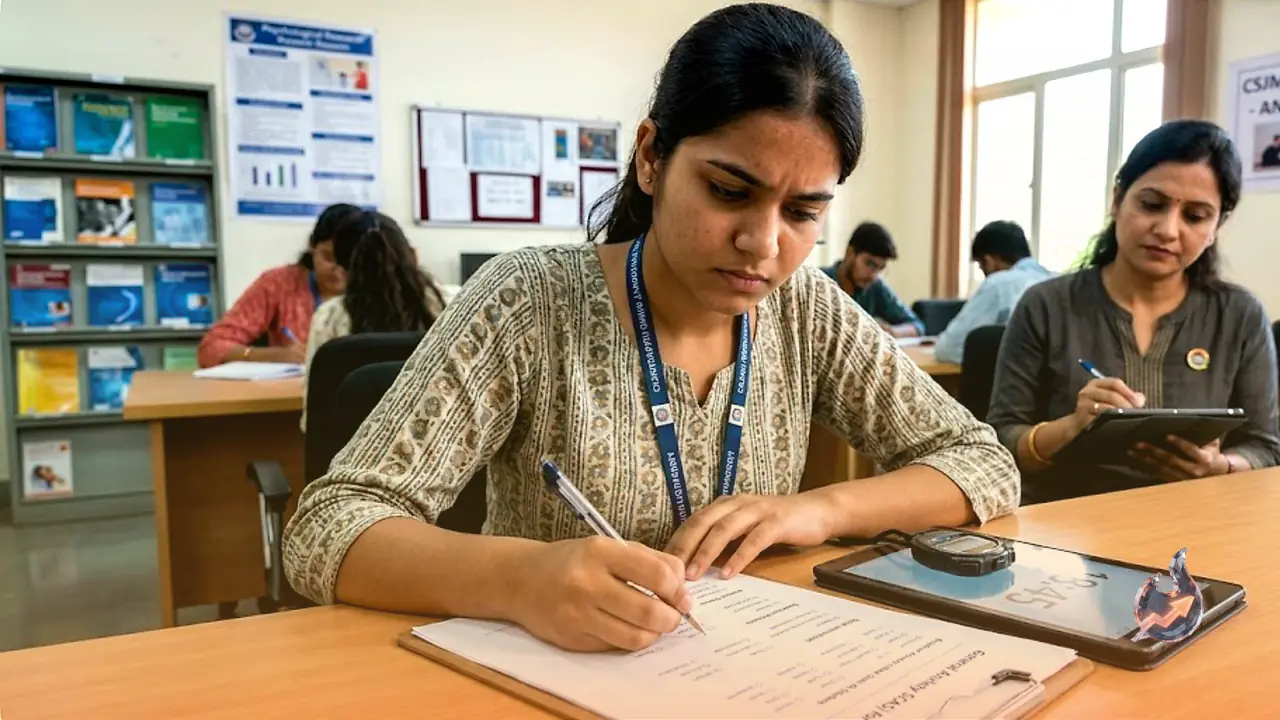

Mounting academic pressure, the grind of competitive exam preparation, career worries and uncertainty about the future have pushed a large number of young people towards stress and anxiety. Many students are unable to share what they are going through with anyone, and that mental burden keeps building quietly inside them. Researchers at Chhatrapati Shahu Ji Maharaj University (CSJMU) in Kanpur have now built a scientific scale that can reveal, within minutes, exactly what kind of anxiety a student is dealing with.
A team effort behind the new anxiety scale
Under the guidance of Vice Chancellor Prof. Vinay Kumar Pathak, the scale was developed jointly by Dr. Vimal Singh, Assistant Professor in the Department of Education, research scholar Shubhi Rastogi, ICSSR fellow Desh Deepak, and Dr. Divya R Panjwani, Assistant Professor at Integral University, Lucknow. Named the General Anxiety Scale, it has been designed specifically for young people aged 17 to 25, the age bracket in which most students move from school to college and then step into their careers. What sets this scale apart is that it does not merely flag whether a student is stressed. It also identifies whether the anxiety stems from academics, emotions, the social environment, a tendency to overthink, or worries about the future, giving teachers and counsellors a way to get to the root of the problem instead of just noting that a student is troubled.
From 65 questions to 35, tested on 800 students
Before finalising the scale, the researchers had originally drafted 65 questions. On expert advice, this list was trimmed down to 35 questions to make it simpler and more practical for students to answer. It was then tested on 800 undergraduate students across Uttar Pradesh. The scale is built on a five-point Likert format, where students choose from options ranging from strongly agree to strongly disagree for each statement. Notably, it takes only about 18 to 20 minutes to complete, and it can be administered just as easily to a single student or to an entire group at once, making it practical for schools and colleges to use at scale.
A reliability score of 0.94, cross-checked against GAD-7
According to Dr. Vimal Singh, the scale carries a reliability score of 0.94, which makes it an extremely dependable tool. It was also validated against the internationally used GAD-7 scale, and the results matched up well. On the strength of this reliability, the scale has been published by Prasad Psycho Private Limited, a well-regarded name in the field, lending it further credibility in academic and psychological circles.
Faster help for students who need it
With this scale in place, teachers, counsellors and psychologists will be able to quickly understand exactly what kind of difficulty a particular student is facing the most. Based on that, timely counselling and mental health support can be arranged as needed. The researchers believe this could help many young people get support before their struggles escalate into serious mental health issues, since the sooner a problem is identified, the more effective the help that follows.
Vice Chancellor calls it a major milestone
Vice Chancellor Prof. Vinay Kumar Pathak said that CSJMU has always stayed ahead in research and innovation. He added that this is an important achievement in strengthening the mental health of young people, and that its benefits will reach educational institutions and lakhs of students across the country in the times ahead.