
























Young men and boys across Western societies are grappling with profound economic restructuring, marked by the steady decline of manual factory labor and traditional blue-collar occupations that historically provided generations of working-class men with identity, purpose, and community standing. This disruption has left a substantial demographic feeling abandoned, economically stranded, and susceptible to psychological manipulation. Exploiting this vulnerability, an opportunistic ecosystem of online personalities has emerged, twisting concepts from evolutionary biology to promote toxic and rigid dogmas. Through endless smartphone feeds, these figures amplify reactionary slogans telling men that modern life has softened them, that their masculinity is under assault, and that ruthlessness is the only path forward.
Such narratives, however, run entirely counter to observable biological reality. Across the entire tree of life, whether examining subterranean fungal networks trading vital nutrients across plant root systems or human astronauts cooperating to maintain basic sanitation routines on the International Space Station, organisms survive by navigating an ongoing equilibrium between competition and cooperation. Deep observations from animal behavior show that genuine cooperative behavior does not compromise masculine strength. In reality, dominant male primates wield their authority with patience and restraint, relying on reciprocal male friendships characterized by mutual grooming, soothing touch, and genuine vulnerability to build lasting social harmony. The brutal caricature promoted by online influencers crumbles as soon as one examines the authentic fabric of social life among wild primates.
The Myth of the Lone Despot and Primate Alliance Dynamics
The concept of the dominant alpha male occupies center stage in modern masculine rhetoric, championed by commentators and self-styled mentors who fundamentally misunderstand the function of social hierarchies in nature. In their worldview, personal ascent requires the exploitation of peers, and empathy is framed as an inherent weakness. Yet among our closest living relatives, high-ranking male primates act with measured care, recognizing that sheer intimidation cannot sustain authority. While male chimpanzees do structure their communities around recognizable linear dominance rankings where individuals submit to higher-ranking peers, and while status competition can certainly escalate into physical violence, dominance is never maintained through brute force alone.
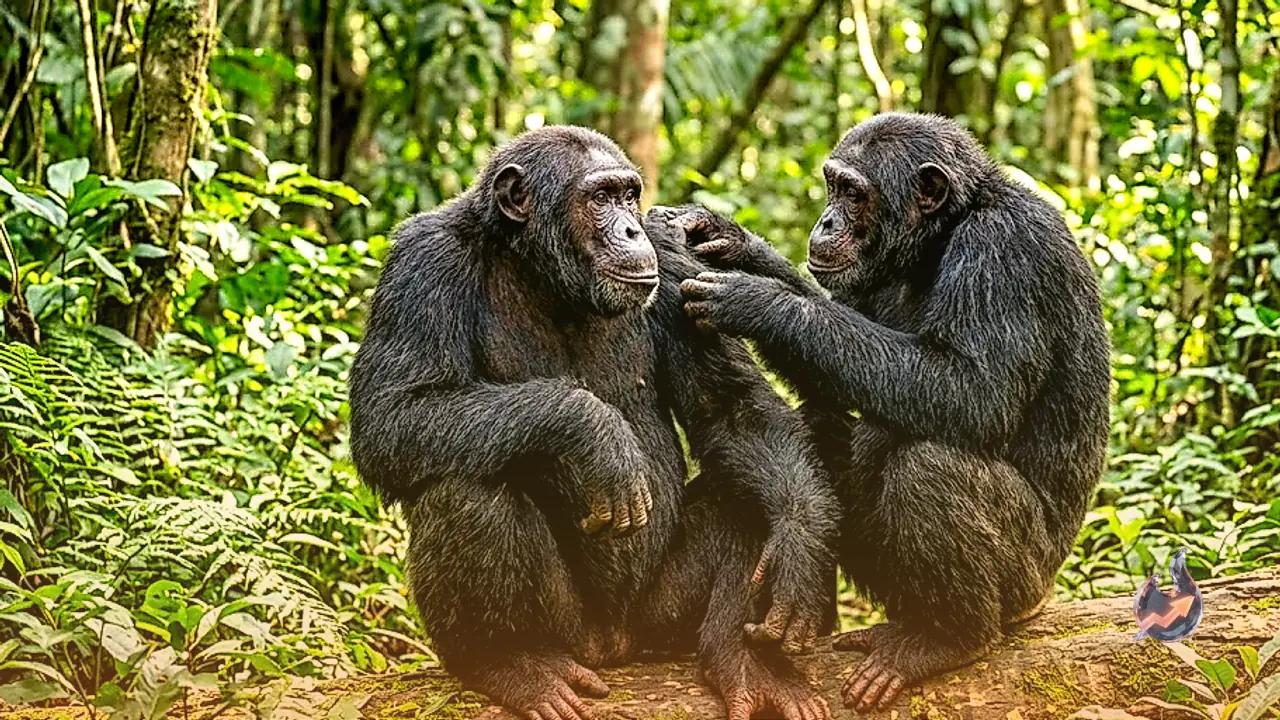
Behind the visible competition lies an intricate architecture of trust, tactile reassurance, and enduring male camaraderie. The vast majority of daily tensions within a chimpanzee community never develop into open warfare because underlying alliances continually absorb the friction. Male allies sit together for hours engrossed in meticulous mutual grooming. In the wake of heated friction, they seek each other out for reconciliatory embraces, and prior to potential confrontations, they gently kiss the shoulders and arms of trusted companions to defuse anxiety. When preparing for perilous perimeter patrols along territorial borders where hostile encounters with foreign bands are a distinct reality, males frequently hold one another's genitals as an ultimate gesture of mutual trust. Long-term behavioral records spanning nearly three decades at Gombe demonstrate that males enjoying close bonds with the community alpha sired significantly more progeny than isolated peers, as did males possessing broad coalitions of reliable partners, regardless of whether they ever ascended the dominance ladder themselves. The individuals who support community coherence are the ones who ultimately flourish.
The protective value of these mutual bonds becomes glaringly evident whenever social rank is destabilized. In Côte d'Ivoire's Taï National Park, Anna Preis and her research collaborators analyzed urinary cortisol levels across wild chimpanzee groups navigating both calm and contested dominance transitions. Their findings revealed that physiological stress surged across every single adult male during unstable phases, completely irrespective of individual social rank. Intriguingly, overt intra-group aggression manifested in the opposite direction, peaking during predictable, peaceful windows when the risk of community collapse was minimal. When the danger of widespread escalation became acute, males deliberately curbed aggressive displays. Group preservation takes precedence over personal disputes, as an internally fractured community cannot effectively defend its territory against external rivals.
Even the historical lineage of the term alpha reveals deep scientific misunderstanding. The label originally gained traction during mid-twentieth-century behavioral studies conducted on captive wolves confined within unnaturally cramped enclosures with zero avenues for avoidance. Under such artificial stressors, almost any social animal, including humans, will resort to despotic and defensive behavior. When field biologists subsequently shifted their focus to wild wolf populations roaming natural habitats, they discovered that natural wolf packs are essentially cohesive family units consisting of a breeding parental pair and their developing offspring. Biologist L. David Mech, who initially popularized the alpha wolf construct in early publications, has spent more than twenty years urging educators and the broader public to abandon the terminology entirely. Despite his extensive efforts to correct the record, the myth of the despotic alpha remains a lucrative staple of internet rhetoric.
A Community Rallies Behind a Broken Leader
The profound function of consolation and vulnerability in primate life presents a transformative lesson for human relationships. At a dedicated chimpanzee sanctuary in Zambia, researchers have spent years observing Doug, an established alpha male known for his remarkable poise and steady governance. During an early observation season, routine management procedures necessitated temporarily isolating Doug in an enclosure alongside a younger prospective rival and the rival's influential father. Deprived of the broader group's calming presence, the rival pair ambushed Doug, subjecting him to a fierce physical assault that shattered his customary composure. Observers were startled to witness an imposing leader, who had maintained unwavering authority for years, reduced to terrified screaming and trembling in a corner.
When the doors reopened, a low-ranking male who had previously received little direct attention from Doug was the first to approach, offering gentle postures of social submission. What followed developed into an extraordinary collective intervention involving nearly forty chimpanzees. Members of the community clustered around their distressed leader, enveloping him in prolonged embraces, offering kisses, exchanging intimate touch, placing their fingers and hands inside his open mouth, and inviting him to mount them. This scale of focused reassurance directed at a single vulnerable individual remains an exceedingly rare phenomenon, triggered solely by acute social crisis. The community responded to their fallen leader's anguish with an overwhelming surge of physical comfort and collective empathy.
While the primary objective of that investigation was to explore consolation behavior, specifically how chimpanzees and bonobos soothe peers following intra-group fights, observers repeatedly recorded similar affectionate contacts occurring during peaceful periods, particularly when competition was anticipated. To examine this dynamic systematically, researchers conducted experimental feeding sessions across two sanctuaries, monitoring 116 apes across five distinct groups during a five-minute staging period immediately preceding food delivery. The data established that individuals engaging in frequent reassuring physical touch during that five-minute anticipation window spent significantly more time eating peaceably side by side once food was introduced. In chimpanzee groups, adult males drove this cooperative behavior, but the effect was pronounced primarily within Doug's socially tolerant community. In a neighboring group ruled by a harsher, less generous leader where resources were contested, male partnerships were strikingly fragile. Gentle contact among males systematically dampens competitive anxiety, creating the foundation for communal stability.
Engaging in these gestures requires immense interpersonal trust. Inserting a hand into another male's mouth or pressing one's face against a stressed peer who was recently attacked represents an enormous physical gamble. Given that chimpanzees possess formidable canine teeth and have documented histories of biting off extremities during serious fights, such proximity could easily be misinterpreted as an assault. Yet that acute vulnerability is precisely what imbues the gesture with social power. Exposing oneself to potential harm signals complete confidence that the partner will not exploit the opening, creating a bond of trust that aggressive displays can never achieve. Doug maintains his alpha tenure because he actively nurtures his social network and shields his companions from unnecessary strife. Though occasionally prone to flashes of temper like any primate, his seven-year hold on leadership reflects his fairness and commitment to reciprocal alliances.
Physical Proximity, Caregiving, and Athletic Performance
The capacity of male chimpanzees for genuine caregiving extends far beyond political maneuvering. In the wilderness of Taï National Park, researchers documented wild chimpanzees adopting orphaned infants whose mothers had died. Remarkably, more than half of these adoptions were undertaken by adult males who had no genetic relationship to the infants. In one notable instance, an adult male named Porthos took in an unrelated infant female named Gia, carrying her across the forest canopy on his back for years and sharing his meals with her long after any social reciprocity with her deceased mother was relevant. Subsequent demographic analysis confirmed that a male's willingness to adopt was predicted neither by the orphan's sex nor by biological kinship, but solely by the strength of the grooming bond he had shared with the infant's mother prior to her death.
Tactile interaction exercises an equally profound influence on human psychological health and interpersonal trust. Comparative studies across five European nations have demonstrated that the specific bodily zones individuals permit others to touch correspond directly to the emotional closeness of the relationship. Cultural conventions introduce distinct nuances; individuals in the United Kingdom, for example, tend to maintain greater physical reserve regarding casual contact than their continental European neighbors, and Western cultural norms often attach uncomfortable baggage to physical affection between adult men. Touch communicates intimacy and security, though it can also be distorted into a tool for intimidation when misused. Human society could benefit from primate wisdom by embracing comforting physical contact where it fosters connection while retiring intrusive contact elsewhere.
The practical utility of physical connection is strikingly apparent in competitive sports. An exhaustive analysis evaluating all thirty NBA basketball franchises throughout the 2008–2009 season revealed that teams whose players exchanged frequent tactile encouragement early in the year, such as high fives, chest bumps, fist bumps, and quick hugs, achieved superior athletic performance and exhibited greater cooperative ball movement later in the season, even when controlling for financial payrolls and preseason standing projections. Parallel findings emerged in women's collegiate basketball, where athletes who received supportive physical taps from teammates after missing an initial free throw demonstrated a measurable statistical increase in successfully converting their second attempt. Similarly, following five consecutive tournament eliminations via penalty shootouts, England's Football Association spent eighteen months re-engineering their penalty strategy under manager Gareth Southgate. Rather than focusing exclusively on mechanical kicking drills, the coaching staff trained players to wrap an arm around the shoulder of an athlete who missed a kick, eliminating personal isolation, while team members celebrated successful conversions vigorously to steady the nerve of the next shooter. Locker rooms have long embraced tactile bonds, and scientific inquiry confirms that this contact produces tangible competitive advantages.
Human societies exhibit breathtaking behavioral diversity, encompassing both extraordinary cruelty and magnificent altruism. When people commit terrible acts, commentators frequently dismiss the behavior as animalistic or primal, reserving praise for human exceptionalism when cooperation prevails. This framing distorts natural history. Human beings have driven peers to despair, annihilated entire cultures, and dismantled the habitats of keystone species essential to planetary stability. Primate biology demonstrates that competitive impulses do not have to dictate social organization. Survival in primate groups depends upon managing friction through proactive reconciliation and community support. Human nature encompasses both competition and care, but evidence demonstrates our species leans toward cooperation far more consistently than cultural cynics acknowledge.
Practical Lessons for Deepening Everyday Friendships
Recognizing the foundational role of touch and cooperation across the primate order should encourage people to abandon instinctive cynicism regarding the motivations of their peers. A global study published in Science involving more than 100,000 participants across 125 nations found that 69 percent of individuals voluntarily chose to cooperate with an absolute stranger when presented with an open decision. Yet when asked to predict the behavior of others, participants estimated that only 47 percent would choose cooperation. This persistent pessimistic bias appeared across 124 of the 125 surveyed countries. This perceptual distortion carries serious social costs, because people who assume others are cooperative are significantly more inclined to cooperate themselves. When researchers informed participants that the vast majority of people worldwide view climate change as a genuine danger, public confidence in collective cooperation rose, leading to higher rates of actual cooperative participation.
Integrating the social wisdom of primates into everyday modern life requires simple, deliberate shifts in habit. To begin with, prioritize unhurried physical proximity. Primate allies build relationships primarily by sitting quietly in close physical range, occasionally resting against one another or sharing mutual grooming. True connection often requires nothing more complex than being physically present in the same room without performance pressure. Second, pursue parallel activities rather than forced confrontations. Organizing a shared car journey or engaging in casual athletic games creates opportunities to bond shoulder-to-shoulder without the intensity of direct, unbroken eye contact. Men who struggle to verbalize emotional challenges often open up naturally when engaged in a shared physical task.
Third, initiate reassurance before tensions boil over rather than attempting damage control afterward. Wild apes invest their tactile reassurance during the anxious minutes preceding a challenge rather than waiting for conflict to erupt. While reconciliation after a rupture is valuable, preventing social escalation through proactive kindness is far more effective. Finally, take the initiative instead of waiting for others to break the ice. The twenty-two-point disparity between actual human willingness to cooperate and our pessimistic assumptions proves that most people are simply waiting for someone else to extend a friendly hand. The influencers marketing raw aggression as primal masculinity are promoting fiction. Biological strength in primate evolution is defined not by isolation and dominance, but by empathy, touch, and the patient cultivation of lasting friendships.