


















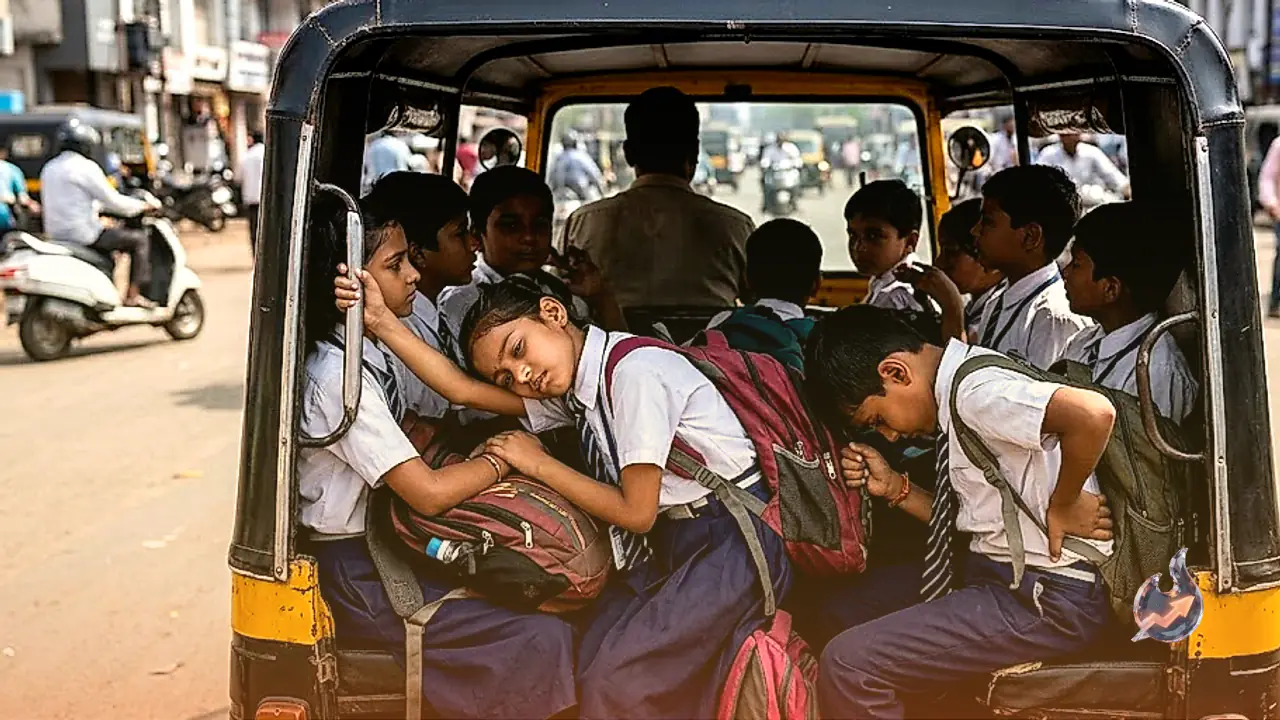

Parents who bundle their children into a school auto or e-rickshaw every morning assume the biggest worry is whether the vehicle reaches school safely and on time. But across Raipur and the rest of Chhattisgarh, that same daily ride is quietly turning into a health hazard, because these vehicles are being packed with far more children than they are built to carry, and doctors say the strain is showing up directly in the children's necks, backs and spines.
Auto drivers chasing a little extra income, combined with parents not always checking how their children are actually seated, is creating a double risk. The threat of a road accident was already there, but now a second, quieter danger has emerged: children's body posture and skeletal structure getting damaged over time.
8 seat autos are carrying 14 children, bigger vehicles up to 22
Autos rated for just 8 seats are routinely carrying 12 to 14 children each day, nearly double their approved capacity. Bigger passenger vehicles rated for 16 seats are in an even worse state, ferrying 20 to 22 young children to and from school in a single trip. With so little room, small children cannot even sit properly. Some are forced to lean forward, others end up half hanging off the edge of a seat, and many children have no choice but to stand for the entire ride.
Why this is hurting children's health
Being squeezed into such tight, overcrowded seating puts constant pressure on children's backs, waists and spines. That is why complaints like neck pain, cervical issues and muscle strain are now showing up in children at a very young age. The paediatric department at Mekahara, along with several leading orthopaedic specialists in the city, have confirmed this worrying trend. Doctors say 3 to 4 such cases are arriving at hospitals every single day.
4 to 5 children a month arrive with fully affected posture
Orthopaedic specialist Dr Surendra Shukla says nearly every parent today hires an auto or a van to ferry their children to and from school, but drivers, chasing a bit of extra earning, load in more children than the vehicle is meant to carry. This keeps the risk of a road accident alive, but it has also created a new and serious danger of children's body posture getting damaged. According to Dr Shukla, 4 to 5 such children arrive at his clinic every month with posture that has been fully affected. Sitting in the wrong position for 20 to 40 minutes of travel every single day puts unnecessary pressure on children's spines, waists and the delicate nerves in their necks.
Why young, developing bones take the biggest hit
Because young children's bones and muscles are still developing, sitting in an uncomfortable position for long stretches can create serious problems later in life. When children are squeezed tightly against one another inside an auto, they have to constantly lean or twist just to keep their balance with every jolt of the vehicle. This repeated leaning and twisting strains the muscles of the back and waist. Doctors say many children are now presenting with neck pain, stiffness in the shoulders, waist pain and swollen muscles on a recurring basis.
Ignoring it now could mean permanent trouble later
If this pattern continues over a long period, the natural structure of a child's spine can itself be affected. Left unaddressed in time, children can develop permanent problems such as waist pain, cervical pain, muscle weakness and disrupted body alignment, which would go on to affect their sports, studies and everyday routine.
What doctors are advising as prevention
Doctors say most children who come in at an early stage of this problem do not need medication at all. The first advice is simply to correct how the child sits. Where necessary, mild painkillers are given, calcium and Vitamin D levels are checked, and muscle strengthening exercises along with physiotherapy are recommended. Parents are being strongly advised never to send their children in an auto or vehicle that has been packed with more children than it is meant to carry. During the ride, a child's back must get full support and their feet should be able to rest on the floor or a footrest. Children should also get at least 20 to 30 minutes of physical activity and stretching every day. If a child repeatedly complains of waist, neck or back pain, parents should not ignore it and should get the child examined by a specialist doctor right away.