






















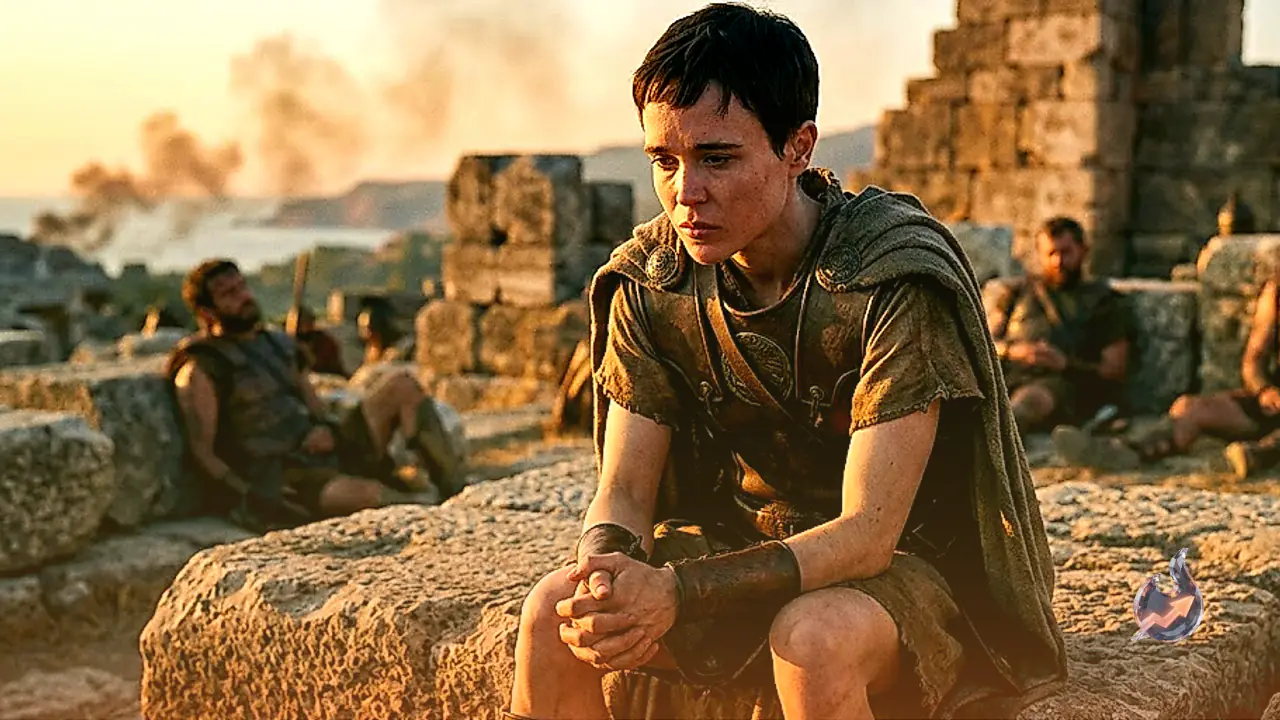

Christopher Nolan's ensembles always turn into a guessing game before release, and his adaptation of Homer's epic proved no exception, with fans hunting for clues about who had landed which mythological part. The roster reads like a highlight reel of Hollywood talent, with Charlize Theron, Zendaya, John Leguizamo and Lupita Nyong'o all turning up in comparatively small parts. Yet amid all that star power, it is a supporting turn from Elliot Page that quietly ends up carrying the film's emotional weight.
A crowded ensemble built around one quiet performance
Nolan pulled a similar trick on Oppenheimer, where several marquee names occupied surprisingly brief roles, and The Odyssey repeats that pattern on an even bigger scale. Before the film opened, online chatter suggested Page had been cast as Achilles, sixteen years after his first collaboration with Nolan on Inception, where he played Ariadne, a character whose name itself comes from Greek mythology. That guess turned out to be wrong. Page instead plays Sinon, one of the soldiers serving under Odysseus, a figure who doesn't actually appear in Homer's original Odyssey at all. He comes from Virgil's The Aeneid instead, and meets a very different fate in this retelling of the Trojan War. Screen time is scarce: Sinon barely registers across the film's 173-minute runtime, and he isn't even present for the sea voyage that gives the story its name. Despite that, the performance casts a long shadow over the whole picture, shaping how audiences read Odysseus's journey and, more pointedly, his failures as a man.
A wooden gift and a soldier's swift death
Page's face appears within the film's opening minutes. Sinon is abandoned on the beach and sent to tell the Trojans that the Greek army has left behind a peace offering, an enormous wooden horse. Naturally, the Trojans don't buy it, and their suspicion, which the story later proves entirely justified, gets Sinon killed almost immediately. He's shot full of arrows before Troy has even fallen. It's a brutal, unglamorous death, tragic in its own right long before his character's real significance becomes clear.
A reunion in the ash of Hades
Sinon doesn't stay gone. Midway through the film, Odysseus travels into Hades, the Greek underworld, and comes face to face with Sinon's spirit, rendered as a shade smeared in black ash. The encounter reframes everything that came before. Sinon confronts Odysseus over his lies and cowardice, and in doing so reveals a devastating twist. Unlike the version of the character found in The Aeneid, this Sinon had no idea the Greek soldiers were hidden inside the horse. He genuinely believed it was an offering to the goddess Athena, and he died defending that belief. He wasn't simply a casualty of war; he was another victim of Odysseus's deception. Page plays the scene as something both furious and wounded, dignified yet deeply sorrowful, a portrait of a life thrown away for nothing. It's arguably the film's most chilling sequence, edging out even the scale of the Cyclops set piece, the pull of the Sirens, or the body horror of the Circe scenes.
The straw that was meant for Antinous
The tragedy runs deeper still, because Sinon was never supposed to be at Troy in the first place. He was conscripted as a boy in place of Antinous, played by Robert Pattinson, who by the film's present day is scheming to win the hand of Odysseus's wife Penelope back home in Ithaca. Antinous drew the short straw for the draft, but it was swapped out for Sinon's, sending Page's character off to war instead. Odysseus was complicit in that swap too, having agreed to let Antinous remain behind as a companion to his young son Telemachus, played by Tom Holland.
Carrying a dead man's name back to Ithaca
All of that comes back to haunt Odysseus by the film's final stretch. When he finally reaches Ithaca disguised as a beggar, he adopts a false identity, Sinon. He calls him, in his own words, "The bravest man I've ever known." Homecoming here isn't a triumphant return; it's a reckoning with everything Odysseus broke to get there, the sacred trust he violated, and the lives, Sinon's among them, that his lies cost in Troy and afterward. Taking on the dead soldier's name works the same way Bruce Wayne absorbing the idea of the Bat does after returning home to Wayne Manor in Batman Begins, turning what haunted him into part of who he now is. When Odysseus eventually confronts and defeats Antinous, he also hands back the swapped straw, an object that has by now taken on as much symbolic weight as Sinon's Athena brooch. It's a small, imperfect attempt to set something right.
A rare return to a blockbuster screen
Elliot Page hadn't headlined anything on this scale in years; his last major blockbuster appearance was arguably X-Men: Days Of Future Past back in 2014. Watching him return to a big-budget production, and reunite with Nolan more than a decade and a half after Inception, is a reminder of just how much presence he brings to a role. Even with limited screen time, he stays lodged in the mind throughout The Odyssey, and well after the credits finish rolling. The Odyssey is currently playing in cinemas.