


















Adapting one of history's most mythological epics for cinema raises an immediate creative question: how do you make a world of gods, monsters, and impossible trials feel physically real? For Christopher Nolan, the answer is the same one he has pursued across his entire career. He grounded Gotham's darkness in textures audiences could feel in the Dark Knight trilogy, and tethered the cosmos of Interstellar to scientifically accurate physics. With The Odyssey, the source material is as fantastical as storytelling gets, which made his commitment to realism all the more demanding.
The 60-Foot Contraption and the Creature Team
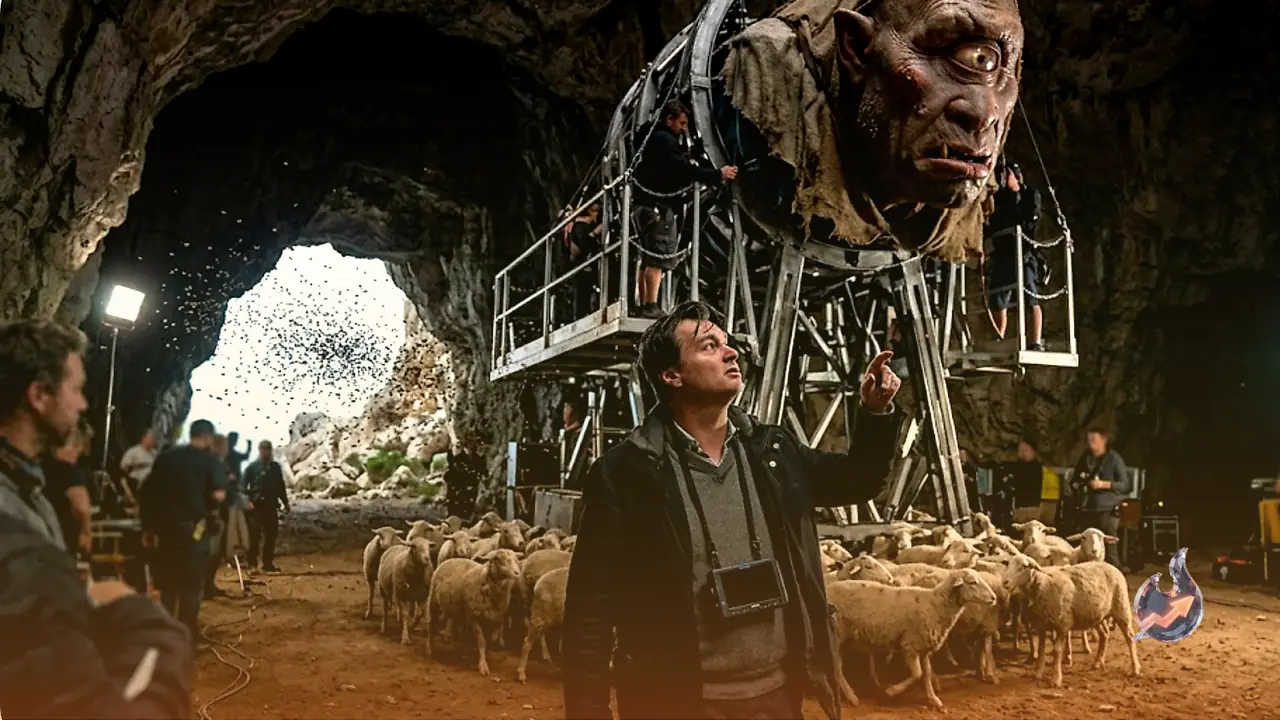
The film's Cyclops sequence is among its most technically elaborate. In it, Matt Damon's Odysseus and his men become trapped in a murky cave with the one-eyed giant Polyphemus. To give the creature genuine scale and presence, the production combined animatronics, puppetry, and a towering 60-foot contraption built on set. Overseeing all of it was Bill Irwin, known for performing TARS in Interstellar. Irwin remained present throughout the shoot, delivering live voices and sounds so that the cast had something real to react to in every take. "Bill was doing voices and noises and was with us that entire time," said Damon.
Nolan was precise about the creative philosophy driving every decision in the scene. "Everything about the Cyclops sequence is aimed at trying to imagine: what would this be like in real life?" he explained. "Not approaching it from a storybook or cartoony point of view, but really trying to be in there with Odysseus and his men. It's a horrifying situation."
A Real Cave, Thousands of Bees, and 40 Sheep
The sequence was filmed on location inside Nestor's Cave in Messenia, Greece, a decision that brought its own set of vivid logistical complications. Thousands of bees had colonised the cave entrance, and the entire cast and crew had to physically pass through them each time they entered. "You can hear it in the movie," Damon recalled, "because there were thousands of bees right at the mouth of the cave. You had to walk through this curtain of bees to get in."
Inside, 40 sheep were brought in as part of the scene, which gradually transformed the atmosphere within the enclosed space. The combination of animals, sealed air, and extended shooting hours produced conditions Nolan described with dry amusement. "It got pungent," he said. "Yeah, it got very, very dank and smelly after a time."
For Nolan, those discomforts were not inconveniences to minimise but exactly the kind of physical reality the film needed. He has constructed artificial caves for previous productions, but he was clear that the real thing delivers something fundamentally different. "Once the rock is moved across the door and you're in the dark, it's very, very oppressive," he said. "It gave it a sense of reality." That same logic of grounding the extraordinary in lived, tactile experience runs through the Dark Knight trilogy and Interstellar, and it shapes The Odyssey's approach to a story as ancient and mythological as any ever told.
Cast and Release
The Odyssey opens in cinemas on July 17. Extensive behind-the-scenes coverage of the film, including conversations with Matt Damon, Anne Hathaway, Tom Holland, and Robert Pattinson, as well as time spent with Nolan during post-production, appears in the August 2026 issue, on sale Thursday, July 2.