



















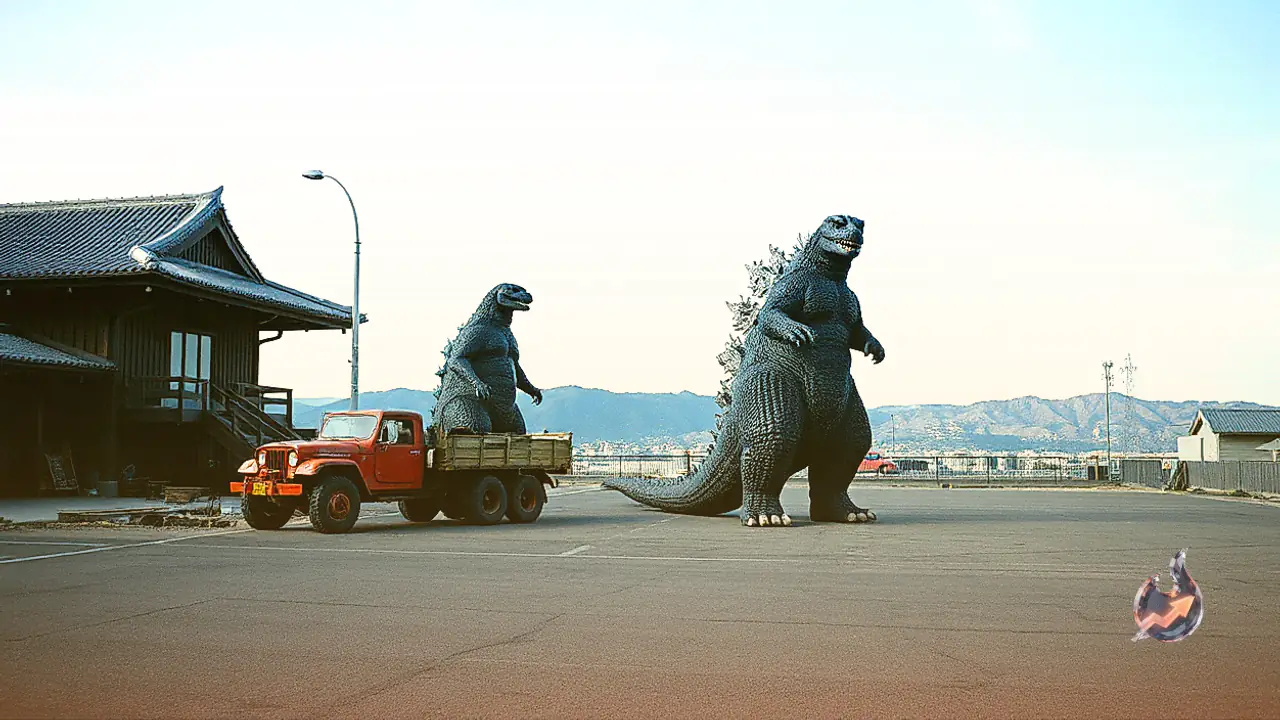

The cat is officially out of the bag in the blockbuster Godzilla Minus Zero, revealing that the giant, three-headed, gold-skinned space dragon King Ghidorah is the main villain. While his appearance was not entirely unexpected, trailers for Takashi Yamazaki’s highly anticipated sequel left subtle yet clear clues for devoted fans. Those distinct yellow lightning beams, the haunting trilling cry, and the crushing gravity beam powers all pointed toward the ultimate Toho rival. Now it is official that the new film is a massive royal rumble as Ghidorah emerges to wreak havoc across post-war Japan before inevitably clashing with Godzilla.
Raising the Stakes With King Ghidorah
For director Takashi Yamazaki, incorporating Ghidorah was the most logical step to elevate the tension in the sequel. Explaining the creative process, he noted that every narrative sign pointed directly toward the iconic dragon. While his overarching cinematic influences for the project stem from James Cameron’s legendary mega-sequels Aliens and Terminator 2, there is also a clear thematic parallel to Christopher Nolan’s Dark Knight trilogy. Drawing a comparison to the Batman franchise, he pointed out that when an opening film succeeds, the natural villain for the follow-up is invariably the Joker. Following that logic, King Ghidorah stands as the ultimate counterpart to Godzilla.
A Personal Connection to Matsumoto
Beyond his towering stature in monster lore, Ghidorah holds deep sentimental value for the director. Yamazaki was born in 1964, which marked the exact theatrical debut of the three-headed beast on the silver screen, establishing an immediate personal bond. In that foundational film, Ghidorah, The Three-Headed Monster, the creature flies directly over a town called Matsumoto located in Nagano Prefecture, which happens to be Yamazaki’s own hometown. During the initial development phase, the director pitched the concept directly to the studio executives, expressing his strong desire to utilize the character. Receiving immediate openness from Toho, the project was swiftly greenlit with the legendary antagonist locked in.
Reinventing a Legendary Kaiju Form
Yamazaki introduces a distinct biological evolution for the creature in this iteration. While maintaining its traditional extraterrestrial origins, Ghidorah arrives on a Japanese mountainside inside an amorphous, crash-landed space organism. After ingesting a bat, a raven, and a deer to construct its initial genetic makeup, it hatches into an aggressive form featuring wings, horns, and sharp talons. When military forces intervene, their lightning attacks inadvertently supercharge the monster into its definitive 'King' state, tripling its head count and magnifying its size and scales. Having the opportunity to add a fresh cinematic interpretation to decades of monster history was an honor the lifelong fan could not pass up.
Redefining Godzilla and Humanity's Role
In previous cinematic showdowns, the introduction of a secondary threat often positioned the giant lizard as a reluctant protector of humanity. However, Yamazaki deliberately ensured that Godzilla remains entirely detached and unallied with humankind during the brutal face-off. Because Godzilla is manipulated and drawn toward the destruction purely through human intervention, his primary instinct is simply survival and combat. This dynamic serves as a pointed critique of human ambition and arrogance rather than reflecting any heroic allegiance from Godzilla, who remains an indifferent, godlike force being exploited by mankind.
Looking Toward Future Accolades
The monumental global success of Godzilla Minus Zero follows the groundbreaking Oscar victory for visual effects achieved by Yamazaki and his team. Whether the sequel can secure another Academy Award nomination remains to be seen, though the director jokes that he might need to carry two action figures down the red carpet next time, holding Godzilla in one hand and Ghidorah in the other.