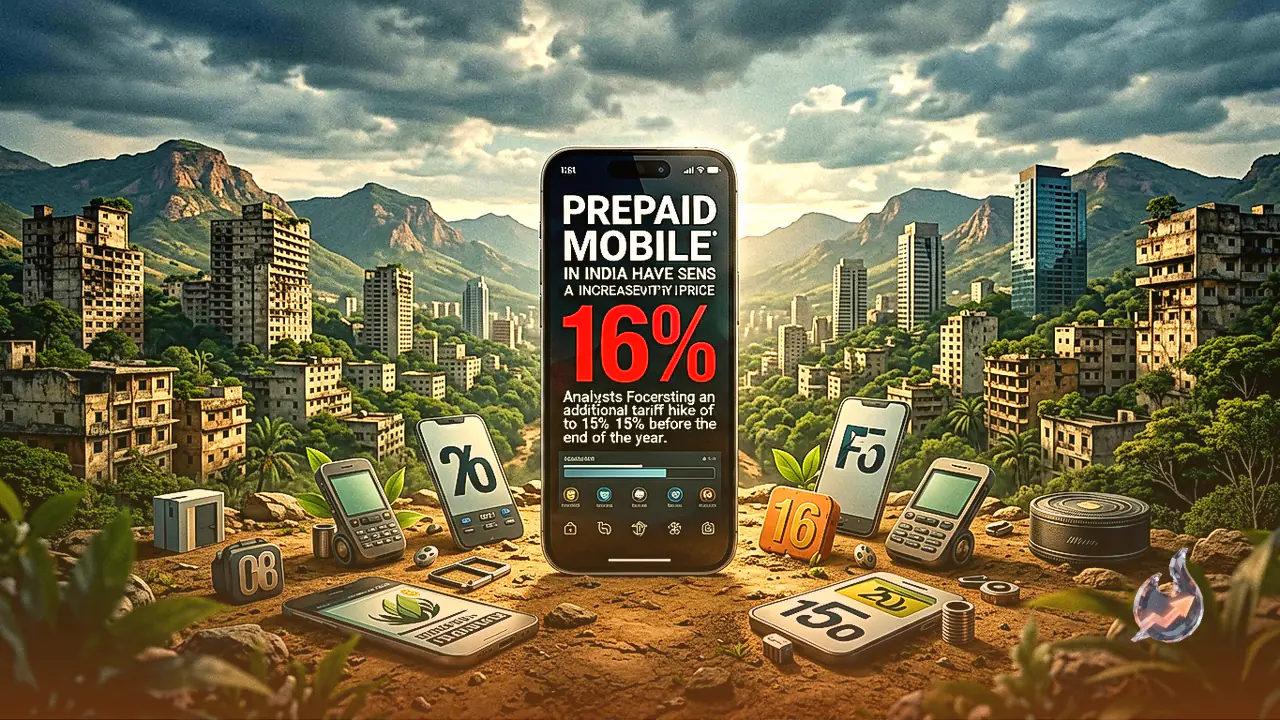





















Mobile phone users across India are facing a subtle yet noticeable rise in their monthly communication expenses as major telecom providers quietly adjust prepaid offerings. Rather than announcing straightforward price increases, operators have begun phasing out low-cost options and introducing paid protection features. With prepaid tariffs already up by as much as 16 percent following recent plan restructuring, industry analysts warn that consumer bills could climb even higher before the end of the year.
Quiet Tariff Increases: How Operators Discontinued Budget Plans
Bharti Airtel took a decisive step on August 12, 2026, by withdrawing five popular prepaid offerings priced at ₹249, ₹299, ₹579, ₹619, and ₹649. This restructuring directly impacts everyday consumers. For instance, subscribers who previously relied on the ₹299 plan to receive 1.5GB of daily data over a 28-day validity period are now redirected to the ₹349 plan, which offers 2GB of daily data for 28 days. While the daily data cap increases slightly, users are forced to pay approximately 16 percent more for their monthly renewal. Across the affected tiers, effective price increases range between 5 percent and 16 percent.
Meanwhile, Reliance Jio adopted a different strategy by keeping its existing prepaid plan lineup intact while unveiling the Jio Prime Membership. For an annual fee of ₹300, subscribers can lock in their current plan prices for 12 months, shielding themselves from prospective tariff hikes during the membership tenure. Analyst firm Avendus Spark points out that distributing this ₹300 annual charge over 12 months (amounting to ₹25 per month) effectively translates to an 8 percent price bump on a standard ₹299 monthly recharge.
In contrast, Vodafone Idea and BSNL have refocused their efforts without pulling existing plans from the market recently, opting instead to roll out new entry-level options to maintain subscriber acquisition.
Future Projections: Up to 15% Further Price Hike Expected by Late 2026
Telecom research firms project that the next formal round of prepaid tariff increases will take place between October and December 2026. Centrum Institutional Research estimates that Jio, Airtel, and Vodafone Idea could implement an additional prepaid tariff increase of up to 15 percent over the next 3 to 4 months. Gaurav Malhotra, Executive Director at Axis Capital, anticipates a 10 percent to 12 percent upward revision over a 3 to 6 month window.
Specific plan adjustments are already anticipated in market reports; for instance, an entry-level ₹199 plan providing 2GB of total data for 28 days could soon be replaced by a ₹219 plan offering 3GB of total data. Notably, market analysts had earlier projected a tariff hike of up to 20 percent as early as July 2026. However, operators deferred the scheduled increase in June due to geopolitical tensions stemming from the Iran-US conflict.
The Jio Prime Strategy: Lock-In Protection or Hidden Tariff Inflation?
Brokerage firm Motilal Oswal anticipates that Jio could adjust its core tariffs within the next six months. The value proposition of the ₹300 annual Jio Prime Membership (amounting to ₹25 per month) depends directly on the timing of Jio's next official tariff revision.
Motilal Oswal outlines two potential trajectories for consumers
First scenario: If Jio raises the price of its ₹299 plan by ₹50 to ₹349 within the next six months, a Prime subscriber would remain at the ₹299 rate. In this scenario, the user recovers the ₹300 membership investment within 6 months while Jio achieves an average revenue per user (ARPU) expansion of approximately ₹46 per month.
Second scenario: If Jio postpones its tariff revision until June 2027, only four months of the one-year Prime membership would remain after the price hike takes effect. Under those circumstances, a customer would need monthly savings of ₹75 over those final four months just to break even on the initial ₹300 expenditure. Consequently, the longer Jio delays an official tariff increase, the lower the financial return of the Prime lock-in feature for consumers.
A Decade of Mobile Tariffs: From Free Data to Multiple Rounds of Hikes
The historical trajectory of India's mobile market highlights how dramatically pricing dynamics have evolved. Reliance launched Jio on September 5, 2016, offering free mobile data, voice calls, and national roaming through December 31, 2017. This aggressive entry forced incumbent carriers to slash prices drastically; Airtel reduced data tariffs by up to 80 percent, while Idea lowered prices by up to 67 percent.
Prior to Jio's launch, 1GB of mobile data in India averaged around ₹225. By 2018-19, intense price competition drove the average cost down to approximately ₹7.7 per gigabyte, positioning India among the most affordable mobile data markets globally. However, as market structure stabilized, operators initiated three major formal tariff hike cycles to restore profitability
1. December 2019 Hike: Airtel and Vodafone Idea raised rates by up to 41 percent on December 3, 2019, followed by Jio with increases of up to 40 percent on December 6, 2019. The popular 1.5GB daily data plan rose from ₹149 to ₹199 on Jio, from ₹199 to ₹248 on Airtel, and from ₹229 to ₹249 on Vodafone Idea, pulling the average cost of 1GB data up to roughly ₹11.
2. December 2021 Hike: Telecom companies executed an industry-wide tariff increase of up to 20 percent. Airtel's 28-day 1.5GB daily plan moved from ₹249 to ₹299. Jio's 1.5GB daily plan increased from ₹199 to ₹239, while its 2GB daily tier went from ₹249 to ₹299.
3. July 2024 Hike: Jio increased tariffs by up to 25 percent on July 1, 2024, raising its core ₹299 plan to ₹349. Airtel and Vodafone Idea made parallel adjustments. Ratings agency CRISIL calculated that the three private carriers pushed rates up by an average of 17 percent to 19 percent, lifting sector ARPU from around ₹182 in 2024 toward a projected ₹225 to ₹230 by 2026.
Following the July 2024 revision, no formal industry-wide price hikes took place for two years. Nevertheless, carriers engaged in quiet adjustments. In April 2026, Airtel increased its 84-day 1.5GB daily plan from ₹859 to ₹899 while removing budget entry plans such as ₹799 and ₹249. The current wave of silent tariff increases, which commenced on August 12, 2026, represents the latest iteration of this ongoing trend.
Why Mobile Charges Keep Rising: ARPU Deficit, 5G Capex, and AGR Obligations
Three core commercial drivers explain why telecom companies continue to elevate mobile rates
Average Revenue Per User (ARPU) Focus: ARPU measures monthly subscriber monetization. For instance, an operator generating ₹2,000 crore monthly from 100 million subscribers records an ARPU of ₹200. Indian operators actively seek higher ARPU figures. In August 2025, Airtel reported an ARPU of ₹250, Jio recorded ₹209, and Vodafone Idea stood at ₹165. The broader sector average ARPU for fiscal 2024-25 was ₹174.46. By comparison, major carriers in the United States record monthly ARPUs around ₹4,300, European operators average near ₹1,000, and Chinese carriers generate approximately ₹600. Market research firm Elara Capital emphasizes that India's telecom landscape is now heavily concentrated among three private operators and BSNL, providing companies greater pricing flexibility to drive industry ARPU beyond ₹21.
Heavy 5G Capital Expenditure: Over recent years, Jio and Airtel have poured vast capital into acquiring 5G spectrum, network hardware, and cell towers. By June 2026, India deployed approximately 4.6 lakh 5G base stations, reaching nearly 99 percent of districts and covering around 80 percent of the population. A report by Outlook Business estimates Jio's 5G network investment at approximately ₹2 lakh crore, while Airtel has invested around ₹1.5 lakh crore. Because both operators have largely bundled high-speed 5G access without charging premium rates, expanding overall tariff structures remains the primary path to recovering these massive capital outlays.
Adjusted Gross Revenue (AGR) Liabilities: Historical regulatory dues under AGR continue to strain carrier balance sheets, particularly Vodafone Idea. The Indian government froze Vodafone Idea's AGR liabilities at approximately ₹64,046 crore, with repayments scheduled between 2032 and 2041. To meet these massive obligations and preserve cash flow, financial projections indicate Vodafone Idea may need to raise tariffs by up to 45 percent between 2027 and 2030. The severity of the AGR dispute traces back to a landmark 2019 Supreme Court ruling, after which Vodafone Idea posted a staggering quarterly loss of ₹50,922 crore and Airtel recorded a loss of ₹23,044 crore, triggering subsequent tariff hikes to restore financial solvency.
Current Industry Status and Company Feedback
Formal queries regarding recent plan restructuring and prospective tariff increases have been submitted to the telecom operators mentioned in this analysis. Updates will be incorporated as official company responses are received.