























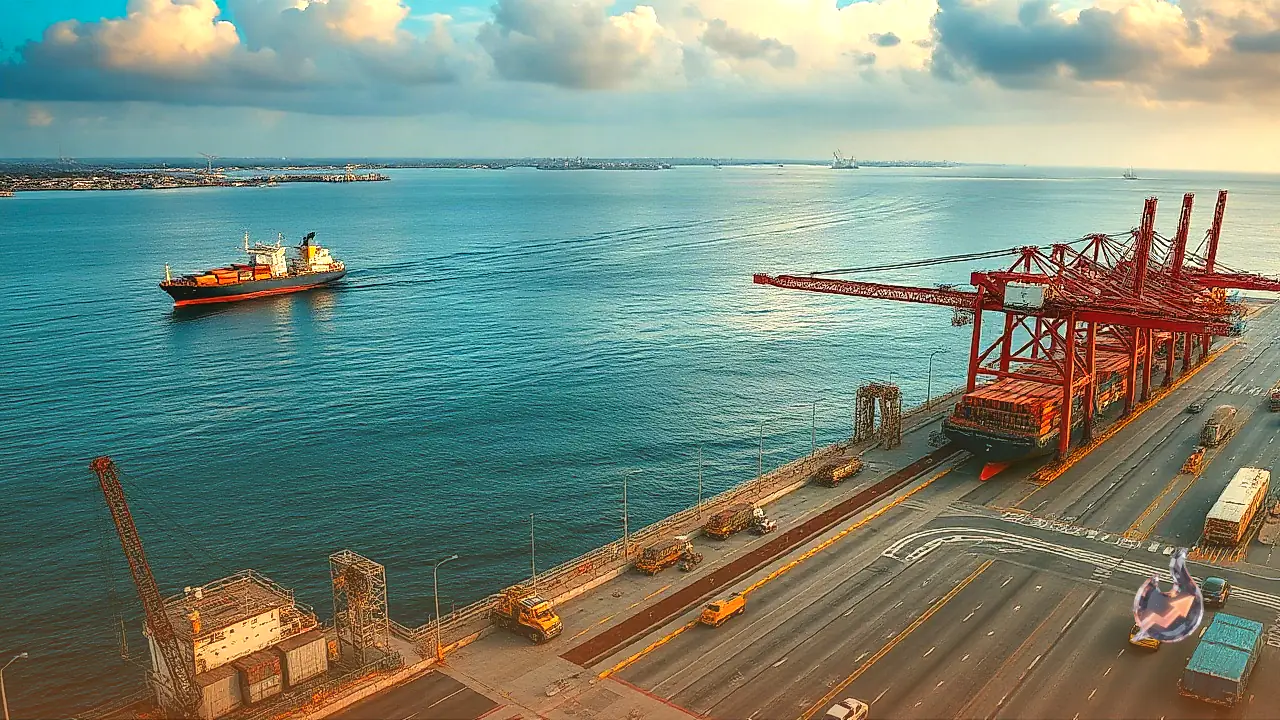

Situated along the coastline of Thiruvananthapuram, the Vizhinjam International Seaport is poised to completely redefine India's maritime commerce and economic landscape. Equipped with advanced automation, deep natural waters, state-of-the-art cranes, and fully indigenous technology, this port is fully prepared to handle massive container vessels. Following its dedication to the nation by Prime Minister Narendra Modi, India has substantially strengthened its standing in the global transshipment trade. Built at a cost of approximately 8,600 crore rupees, the port currently boasts a storage capacity of 35,000 containers as part of its initial phase. In subsequent phases, this capacity will experience a massive expansion, eventually scaling up to 1 lakh containers upon completion, thereby providing a robust boost to India's import and export operations.
Automation and modern machinery accelerate port operations
A standout feature of Vizhinjam is its fully automated container handling system. Modern machinery and remote operations are extensively utilized for unloading containers from ships and organizing them systematically within the yards. The direct advantage of this setup is that operational tasks are executed with much greater speed and precision. The port is outfitted with 8 Ship-to-Shore cranes and 24 Automated CRMG cranes. These sophisticated tools efficiently manage the movement of goods between incoming vessels and the container yards.
18-meter natural depth offers a major advantage for large vessels
Another major strength of Vizhinjam is its natural depth. According to official project details, the site features a natural draft of approximately 18 meters, which can be further deepened to 20 meters in the future. This unique geographical advantage enables the smooth arrival of large container vessels. The port has already demonstrated its capability to handle some of the world's largest container ships, thereby giving India an unprecedented opportunity to increase its market share in international transshipment business and curtailing reliance on foreign hubs.
Expanding capacity toward millions of TEUs
The Vizhinjam project has incurred an expenditure of approximately 8,867 crore rupees. During the first phase, its annual capacity was pegged at 1 million TEUs. According to government disclosures, capacity expansion work encompassing phases II, III, and IV is targeted for completion by December 2028. Following this, the annual capacity could rise to 3 million TEUs, with the potential to handle up to 5.7 million TEUs through enhanced automation and operational efficiency. In essence, the current iteration of Vizhinjam represents merely the beginning of its ultimate operational potential.
IIT Madras technology brings strategic control
An additional hallmark of the port is its integration of indigenous technology. The National Technology Centre for Ports, Waterways and Coasts at IIT Madras developed India's first entirely indigenous Vessel Traffic Management System, which has been successfully deployed at Vizhinjam. This system aids in monitoring and managing vessel traffic seamlessly. The vital advantage of this homegrown technology is that India retains complete strategic control over its source code and underlying data, thereby helping reduce technical dependence on foreign software.
Rail connectivity to complement road transport
The strategic blueprint for Vizhinjam also includes connecting the port via rail networks alongside existing roadways. Official documentation provides for roughly 10.7 kilometers of rail connectivity originating from the Balaramapuram railway station. Once the rail infrastructure is fully established, transporting containers smoothly from the harbor to diverse parts of the country will become considerably faster and more efficient.
An economic catalyst for Thiruvananthapuram and beyond
The impact of Vizhinjam extends far beyond maritime vessels and shipping containers. Concurrent with the port's ongoing expansion, employment and investment opportunities across logistics, transportation, warehousing, the service sector, and allied businesses are bound to multiply. Official project disclosures estimate the creation of approximately 5,500 direct jobs. Consequently, Vizhinjam is viewed not merely as a new port for Kerala, but as a transformative national project cementing India's position within the global transshipment network.