




















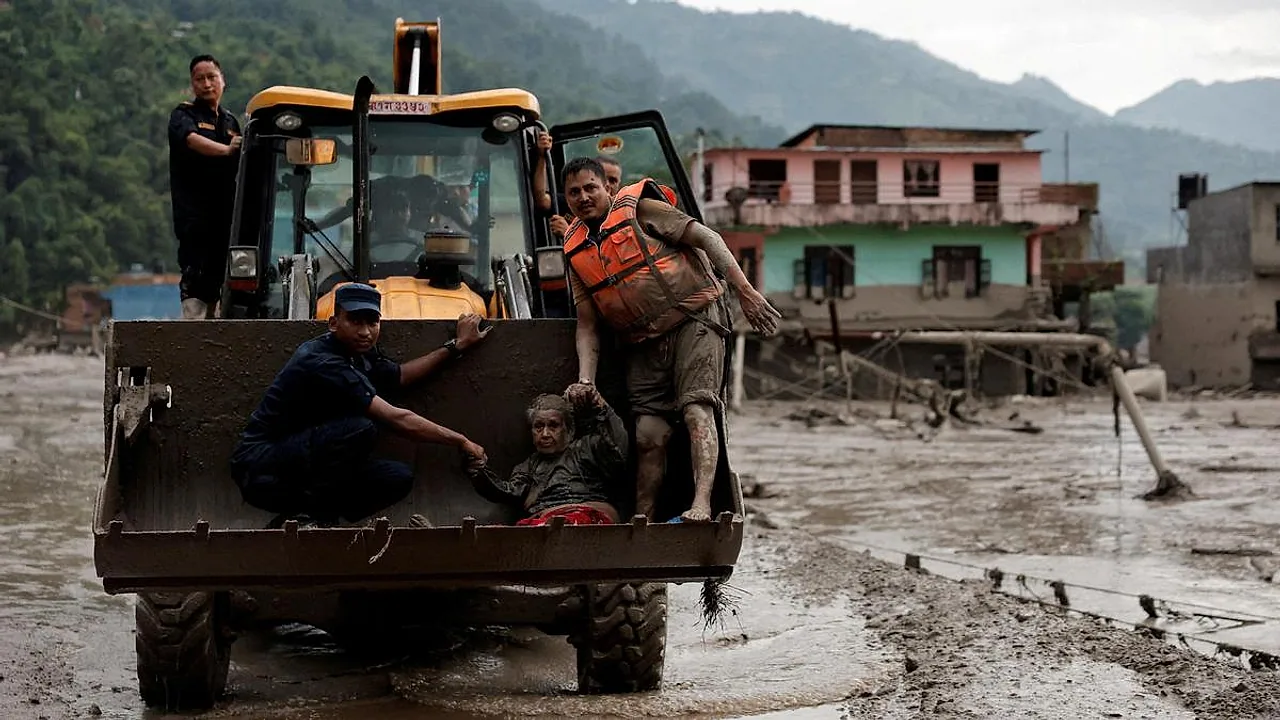

A catastrophic flood disaster triggered by a massive glacial collapse along the Himalayan border between Nepal and China's Tibet Autonomous Region has laid waste to vast mountain valleys, claiming at least 389 lives and leaving over 910 people unaccounted for. Swollen by torrential debris flows, the Bhote Koshi and Trishuli rivers tore through mountain settlements, destroying key highways, bridges, power plants, and tourist destinations across Nepal's Rasuwa, Nuwakot, Dhading, Chitwan, and Gorkha districts. Nearly 300 Indian nationals, including pilgrims undertaking the Kailash Mansarovar Yatra and mountain trekkers, remain missing or out of contact. Emergency rescue personnel, supported by military helicopters and international aid missions, are working against time to locate survivors and evacuate stranded populations from high-risk zones.
Scientific Findings: Glacier Breach Overrides Initial Earthquake Theories
Data released by the U.S. Geological Survey (USGS) clarified that the catastrophic flooding was caused by a sudden glacier rupture and massive debris flow, correcting initial assessments that attributed the disaster to a 5.2 magnitude earthquake recorded on August 26 at 8:37 AM local time near the Nepal-China border. Long-period seismic wave signals confirmed that the ground shaking was generated by an immense collapse of ice, rock, and permafrost rather than tectonic sliding. Experts highlight that rising global temperatures have compromised permafrost stability across the high Himalayas, rendering steep alpine slopes highly susceptible to catastrophic slope failure.
The glacial breach released an estimated 170-kilometer-long surge of ice, mud, and water down the Bhote Koshi river valley, severely damaging the critical trade and transit corridor linking Kathmandu to Lhasa in Tibet. Furthermore, sediment accumulation from landslides has blocked the upper reaches of the Bhote Koshi in Rasuwa district, creating a volatile dammed lake. Disaster management authorities in Nepal and China have issued urgent downstream evacuation warnings, noting that a sudden breach of this artificial barrier could unleash a secondary wave of flash flooding.
Casualty Breakdown and Structural Damage Across Regions
Official updates confirmed 389 fatalities in Nepal, with Chitwan district reporting the highest toll at 64 deaths. Other impacted districts include Dhading (27 deaths), Nawalparasi East (26), Gorkha (20), Nuwakot (12), Tanahun (9), Nawalparasi West (5), and Rasuwa (2). Across the border in Tibet's Gyirong County, Chinese state media confirmed 3 fatalities near a border post, bringing the overall cross-border death toll to 392. Over 1,300 people across both nations were initially reported missing, with current active missing figures standing at 910 in Nepal and 360 in Tibet.
The missing population in Nepal includes 85 armed forces personnel, 162 workers stationed at border customs offices and hydroelectric facilities, and over 579 domestic and international tourists. According to the Nepal Electricity Authority, at least 13 hydroelectric plants along the Bhote Koshi and Trishuli corridors suffered major structural damage. In one relief operation, emergency crews successfully evacuated 63 Indian technicians trapped at the Trishuli-I hydroelectric project site.
Stranded Indian Tourists and State-Wise Crisis Response
Multiple Indian states have reported stranded citizens, prompting state governments to establish emergency control rooms and coordinate with the Ministry of External Affairs (MEA)
- West Bengal: A 32-member travel group from Kolkata (30 tourists, 2 tour managers), including 21 senior citizens and Sharmistha Bhowmick Roy, daughter-in-law of late leader Mukul Roy, has been missing since arriving in Nepal on August 22. State helplines are operational at (033) 24793311 and 9147890181.
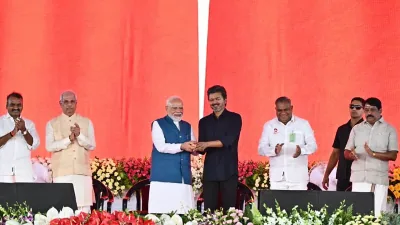
- Tamil Nadu: Out of 57 stranded pilgrims, 21 individuals on the Kailash Mansarovar trek have been safely rescued, while 83 other residents await evacuation. Chief Minister C. Joseph Vijay deployed 4 state ministers and senior official Ashish Kumar to oversee relief operations in Delhi and Kathmandu. State helplines include 1800 309 3793 and +91 80690 09900.
- Kerala: Around 30 tourists remain trapped in flood zones. NoRKA-Roots has established dedicated assistance channels via 1800 425 3939 and +91 88020 12345.
- Karnataka: 13 residents are stranded, including 8 from Bengaluru. Rakesh Naik, a 45-year-old software engineer living in Australia for a decade, went missing during a Mansarovar tour. Meanwhile, a group of 12 travelers from Rattihalli (Haveri) confirmed their safety in Pokhara. State control room lines are 1070 and 080-22253707.
- Maharashtra: 114 tourists were stranded, with 53 confirmed safe in the Saga Mansarovar area. Authorities are tracing the remaining 61 travelers booked through Richa Tours Pvt Ltd.
- Other States: Missing person reports have also been filed for 11 residents from Gujarat, Monika Yadav from Raipur (Chhattisgarh), and travelers from Madhya Pradesh and Meghalaya.
International Relief Efforts and Diplomatic Support
Prime Minister Narendra Modi spoke with Nepal Prime Minister Balendra Shah, offering comprehensive humanitarian assistance. India launched immediate relief flights, delivering two tranches of Humanitarian Assistance and Disaster Relief (HADR) supplies. Foreign Minister S. Jaishankar confirmed the dispatch of a 37.5-tonne consignment containing essential medicines, food packages, and emergency equipment to Kathmandu. The MEA activated a 24x7 control room in New Delhi (+91 11 2308 8718 / 8719, WhatsApp: +91 9968291988), alongside dedicated embassy lines in Kathmandu (+977 985 131 6807, +977 970 910 7500).
Globally, UN Secretary-General António Guterres allocated $2 million from emergency response funds to support relief operations. The United Kingdom pledged £5 million ($6.8 million) in emergency aid, as announced by Prime Minister Ed Burnham and King Charles III. Sri Lanka announced $1 million in financial assistance. In China, Premier Li Qiang inspected flood-hit regions in Gyirong, Tibet, directing military and rescue assets to accelerate search operations.
Border State Preparedness and Transport Adjustments
Downstream regions in Northern India remain on high alert due to surging water levels in rivers originating in Nepal. Bihar Deputy Chief Minister Samrat Choudhary conducted aerial surveys of border districts including Bagaha, Valmiki Nagar, Bettiah, and Motihari. All 36 gates of the Valmikinagar Barrage on the Gandak River were opened as water discharge peaked at 1.50 lakh cusecs on August 26, before receding to 1.04 lakh cusecs on August 27.
In Uttar Pradesh, high alerts were issued in Maharajganj and Kushinagar districts. Armed Border Force (SSB) personnel retrieved 3 unidentified bodies floating down the Gandak River in Maharajganj. The UP state government dispatched a 32-member SDRF team and 22 PAC personnel to assist rescue efforts in Nepal. Additionally, the Delhi Transport Corporation (DTC) temporarily suspended the India-Nepal Maitri Bus Service on August 28 and 29 due to severe road disruptions along the Delhi-Kathmandu highway.