





















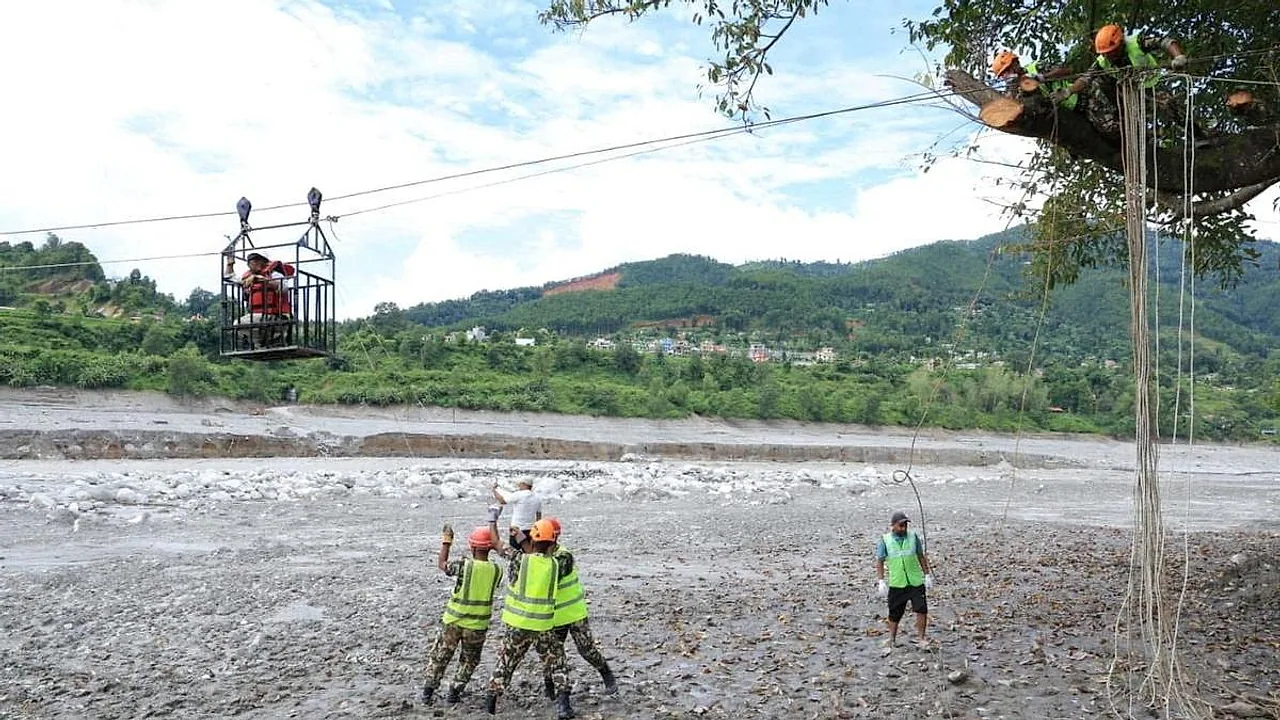

A catastrophic series of flash floods and debris flows, triggered by a glacial outburst near the Nepal-Tibet border, has devastated vast swathes of northern, central, and eastern Nepal. One week after the August 26 disaster, emergency response teams continue to struggle against harsh weather and terrain to locate survivors beneath mountains of mud and rock. The confirmed death toll has crossed 1,050 across eight severely impacted districts, while national authorities report nearly 4,000 individuals still unaccounted for. Among the missing are 583 foreign tourists and 83 security personnel deployed in early response operations. Amidst the destruction, search teams have managed to rescue approximately 12,000 survivors, transferring them to emergency shelters.
Swelling Rivers Keep Low-Lying Himalayan Valleys on High Alert
Nepal’s Department of Hydrology and Meteorology, through its Flood Forecasting Division, has issued fresh high-level alerts as major river systems breach critical safety thresholds. Continuous intermittent rainfall across eastern, central, and western regions has exacerbated the rise of water levels, severely hampering ongoing rescue missions. According to hydrological monitoring data, the Sun Koshi river in Sindhuli district, the Budhi Gandaki in Gorkha, and the Mahakali in Dadeldhura were all flowing well above warning levels.
Furthermore, the Marsyangdi river in Lamjung district surpassed its official danger mark at the Bhukundebesi monitoring station. The National Disaster Risk Reduction and Management Authority (NDRRMA) has urged residents dwelling along riverbanks and in low-lying plains to immediately relocate to pre-identified safe zones, warning that further precipitation could trigger downstream inundation.
Climate Change Warning Sign: Leadership Calls for Global Accountability
Top government officials in Nepal have cited the catastrophe as an undeniable consequence of global climate change, demanding international support for recovery. Nepal Prime Minister Balendra Shah highlighted that regional temperatures in the Himalayan belt have risen by 1.8 degrees Celsius, creating volatile conditions for glacial stability. In a public statement, Prime Minister Shah emphasized that while the cause is linked to global emissions, managing the resulting destruction requires a unified global response.
Similarly, Foreign Minister Shishir Khanal characterized the tragedy as a stark wake-up call regarding the vulnerability of mountainous nations. Speaking on the aftermath of the deluge, Khanal appealed to the international community for financial and technical backing towards climate adaptation and loss-and-damage justice. Forest and Environment Minister Geeta Chaudhary echoed these sentiments, insisting that environmental resilience and climate rights must be elevated to top national priorities and aggressively advocated at global summits.
UN Warning: Escalating Threat of Glacial Outburst Floods Across the Himalayas
The United Nations has alerted international bodies regarding the broader implications of the Nepal deluge for the entire Himalayan region. UN Assistant Secretary-General Kanni Wignaraja noted that rising global temperatures are compounding the risk of Glacial Lake Outburst Floods (GLOFs), which threaten millions of inhabitants residing downstream along major river basins.
Wignaraja warned that current engineering and containment technologies are insufficient to manage the sudden volume of water unleashed when high-altitude ice dams collapse. She stressed that critical hydroelectric infrastructure remains severely exposed, and entire riverine valleys risk becoming uninhabitable if proactive climate mitigation measures are not instituted immediately.
India Dispatches 5th Relief Flight as Specialized Tunnel Teams Advance
In response to the crisis, India has intensified its humanitarian assistance to Nepal. External Affairs Minister S. Jaishankar confirmed the departure of India’s fifth emergency relief aircraft, carrying an 11-member specialized rescue team equipped with advanced tools alongside 5.5 tonnes of essential life-saving pharmaceuticals.
Indian Ambassador to Nepal Naveen Srivastava reported that Indian rescue teams are operating in close coordination with the Nepali Army under extremely hazardous conditions. A 19-member Indian forensic and tunnel rescue unit, active in Kathmandu, achieved significant breakthroughs at major power generation sites. Rescue personnel successfully established access inside the Chilime hydroelectric tunnel despite cramped spaces, deep mud, and limited heavy machinery usability. Additionally, search crews cleared 185 meters within the impacted Langtang hydroelectric project site. Indian External Affairs Ministry spokesperson Randhir Jaiswal confirmed that 163 Indian nationals have been safely evacuated from the flood zones so far.
Glimmer of Hope: 46 Hydropower Workers Trapped in Underground Tunnel
Rescue teams have reported potential survival signs at the damaged Rasuwagadhi hydroelectric power plant, where dozens of workers have been trapped underground for a week. Board member Amsu Kiran Shahi of the Nepal Electricity Authority stated that approximately 46 employees are believed to be safe inside a reinforced room-like chamber within the facility’s main tunnel structure.
Shahi expressed optimism regarding their condition, noting that the chamber contained sufficient food and drinking water provisions to sustain the crew for multiple days. Specialized teams are currently clearing mud and dewatering the tunnel entrance to restore ventilation and extract the trapped personnel.
Billionaire Binod Chaudhary Speaks Out: Massive Infrastructure Losses
Binod Chaudhary, Nepal’s sole billionaire and prominent philanthropist, praised the rapid relief efforts initiated by India and Prime Minister Narendra Modi, noting that the scale of the destruction far exceeded initial estimations. Drawing comparisons to previous seasonal flooding, Chaudhary remarked that the magnitude of the current outburst is unprecedented in recent history.
Chaudhary revealed that entire settlements, market centers, schools, and transportation bridges were swept away in minutes. Furthermore, the disaster has knocked out over 500 megawatts of hydroelectric generation capacity, crippling the nation’s power grid. He emphasized that rebuilding the devastated regions will require immense resources and prolonged international aid coordination.
Victims Swept Into India: Recovery of Bodies Along UP Border
The destructive force of the floodwaters extended into neighboring India, carrying debris and victims across the international border into Uttar Pradesh. Authorities in Kushinagar district recovered the bodies of five Nepali nationals—two women and three men—from the Gandak river near the Barwa Patti and Khadda localities.
The recovered remains were transported to the Sonauli border crossing and formally handed over to Sub-Inspector Hariram Dangi of Nepal’s Belahiya police post. Nepali authorities subsequently transferred the deceased to Butwal for formal identification procedures before returning them to their families.
Bihar Government Issues Urgent Health Advisory Over Flooded River Fish
In Bihar, the Department of Dairy, Fisheries and Animal Resources issued an emergency public health directive urging residents to refrain from consuming unfamiliar fish species caught in floodwaters originating from Nepal. Reports from Eastern Champaran, Western Champaran, Gopalganj, Bagaha, and Saran districts noted locals catching unusually large, non-native fish species from swollen rivers.
State health authorities alerted the public after several individuals fell ill following the consumption of these catches. Local fishermen also reported sighting decomposing human and animal remains floating in the incoming flood currents. Officials explained that fish swimming through floodwaters exposed to decaying organic matter and open sewage carry extreme risks of bacterial, viral, and fungal contamination, posing severe health hazards.
Missing Foreign Tourists and Emergency Rescue Initiatives
Data from Nepal’s Ministry of Foreign Affairs indicates that while 324 foreign tourists have been safely rescued since August 26, approximately 590 citizens from 39 countries remain missing. Nepal Tourism Board spokesperson Sunil Sharma noted a minor positive development, confirming that at least five foreign travelers previously listed as missing had recently re-established contact with authorities via phone and email.
Among the missing foreign nationals are four Indian-origin US citizens from Texas, including North Texas business figures Deepak Ahuja (60) and Madhu Ahuja (57). The group lost communication near Girong Port on the China-Nepal border while returning from a pilgrimage to Mount Kailash. In response, Texas-headquartered non-profit Sewa International USA launched an emergency missing persons tracking portal (sewausa.org/NepalRescue), allocated a $100,000 emergency relief fund, and raised over $55,000 within 24 hours to support search and relief operations.
China Reopens Vital Border Highway: Heavy Machinery Reaches Disaster Zone
Chinese authorities have reopened the primary highway connecting the Girong border crossing in Tibet after a week-long closure caused by landslides and flood damage. The reopening allowed heavy machinery, excavators, and life-detection equipment to enter the primary disaster area for the first time, replacing earlier air-drop and manual rescue operations.
Chinese Foreign Ministry spokesperson Guo Jiakun confirmed that China is dispatching specialized DNA identification experts, emergency Bailey bridges, mortuary refrigeration units, and advanced communication equipment to support relief efforts. Chinese search teams utilizing life detectors and sniffer dogs continue to survey riverbanks, ravines, and damaged inspection complexes, while authorities maintain vigilance against potential secondary landslides.