



















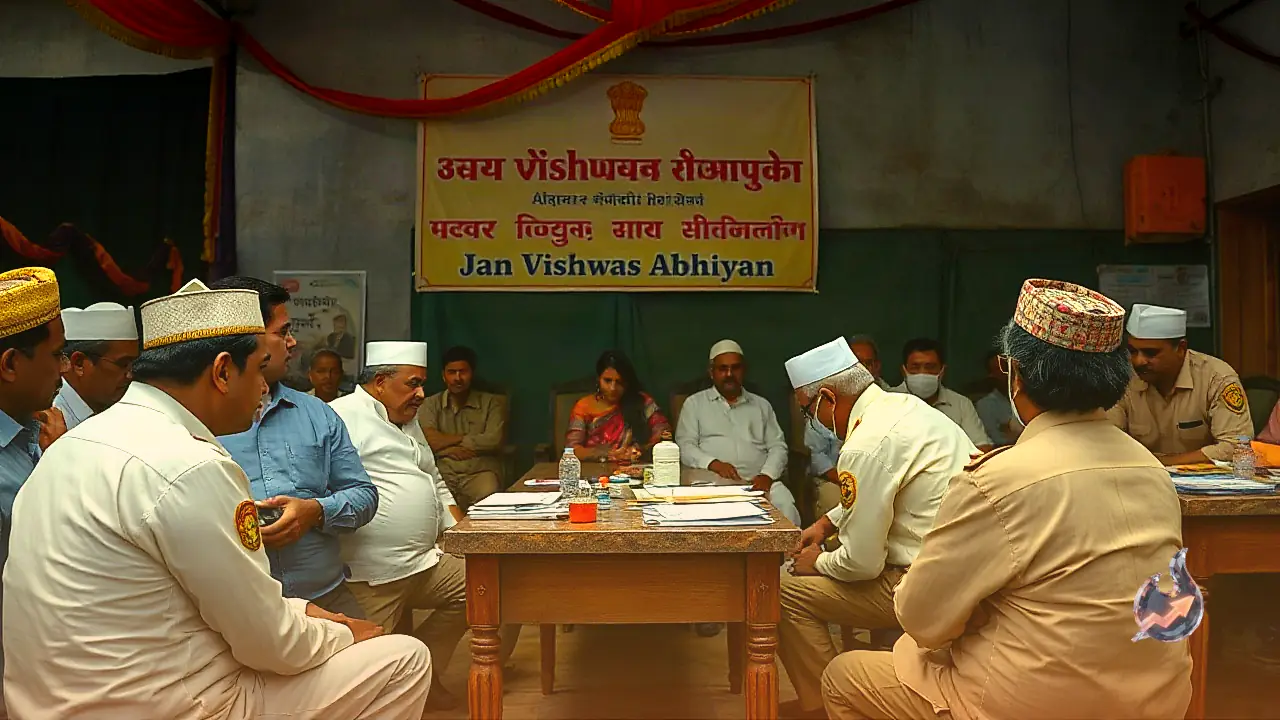

A grand 'Jan Vishwas Shivir' (Public Trust Camp) was organized on Friday at Suthaliya in Rajgarh district of Madhya Pradesh as part of the state government's Chief Minister Jan Vishwas Abhiyan. Setting an exemplary standard of public administration, Minister of State for Fishermen Welfare and Fisheries Narayan Singh Panwar, Member of Parliament Rodmal Nagar, District Collector Girish Kumar Mishra, and Superintendent of Police Amit Kumar Tolani sat directly on the ground alongside local residents to hear their grievances. This empathetic approach allowed senior administrative officials to resolve numerous public issues on the spot. As part of welfare initiatives during the event, the State Minister distributed motorbikes to differently-abled beneficiaries to enhance their mobility and handed over nutritional food baskets to patients undergoing tuberculosis treatment.
Inspection of Departmental Stalls and Interaction with Self-Help Groups
During the event, State Minister Narayan Singh Panwar personally inspected the administrative stalls set up by various government departments within the camp premises. He reviewed the range of public services and welfare schemes being made available to citizens by officials on site. Additionally, he participated in the 'Udyam Samvad' (Entrepreneurship Dialogue), engaging directly with local entrepreneurs to discuss their industrial ventures and economic requirements. The minister also held a detailed interaction with members of women's Self-Help Groups (SHGs) functioning under the National Rural Livelihoods Mission (NRLM). He listened attentively to their operational experiences, vocational achievements, and the challenges faced in running micro-enterprises in rural areas.
Democracy, Spirit of Public Service, and Women's Empowerment
Addressing the gathered public, State Minister Panwar emphasized that while historic governance relied on monarchies, modern democracy rests entirely on the will of the people who elect their leaders. In a democratic framework, public trust can only be secured by dedicated service to the community. Citing Prime Minister Narendra Modi, who consistently describes himself as the 'Pradhan Sevak' (Chief Servant), the minister remarked that every official and public representative must internalize this ethos of service. Highlighting women's advancements, he noted that women in India are excelling across all domain from holding the highest constitutional office as President to piloting fighter jets. He specially commended the rural women of local self-help groups for achieving an impressive economic turnover of Rs 1.5 crore, calling it a shining example of financial independence and women's empowerment.
Resolving Local Disputes Through Dialogue and Mediation
Focusing on social harmony, the minister urged rural residents to resolve minor disputes, such as property or personal misunderstandings between family members and neighbors, within the village itself rather than escalating them to court litigation. He advised that local disagreements should first be brought before village elders and community leaders, where both parties can present their perspectives in an atmosphere of mutual respect. He stated that the primary duty of the government is public welfare, and creating a peaceful community requires collective efforts to minimize unnecessary legal battles and maintain brotherhood among villagers.
Ensuring Continuous Administrative Support Across Rural Belt
Reaffirming the government's commitment, the State Minister emphasized that the Jan Vishwas Shivir is not a mere one-day event, but part of a sustained administrative outreach. Officials and public representatives will remain continuously accessible to address citizen grievances even after the camp concludes. He directed all departmental officers to process every public representation with utmost empathy, clear guidance, and accountability. He shared that information about the Suthaliya camp had successfully reached approximately 50 surrounding villages, bringing officials from multiple departments under a single roof so that rural residents did not have to travel long distances for administrative work. He concluded by extending sincere gratitude to the large turnout of citizens who participated in the camp.