















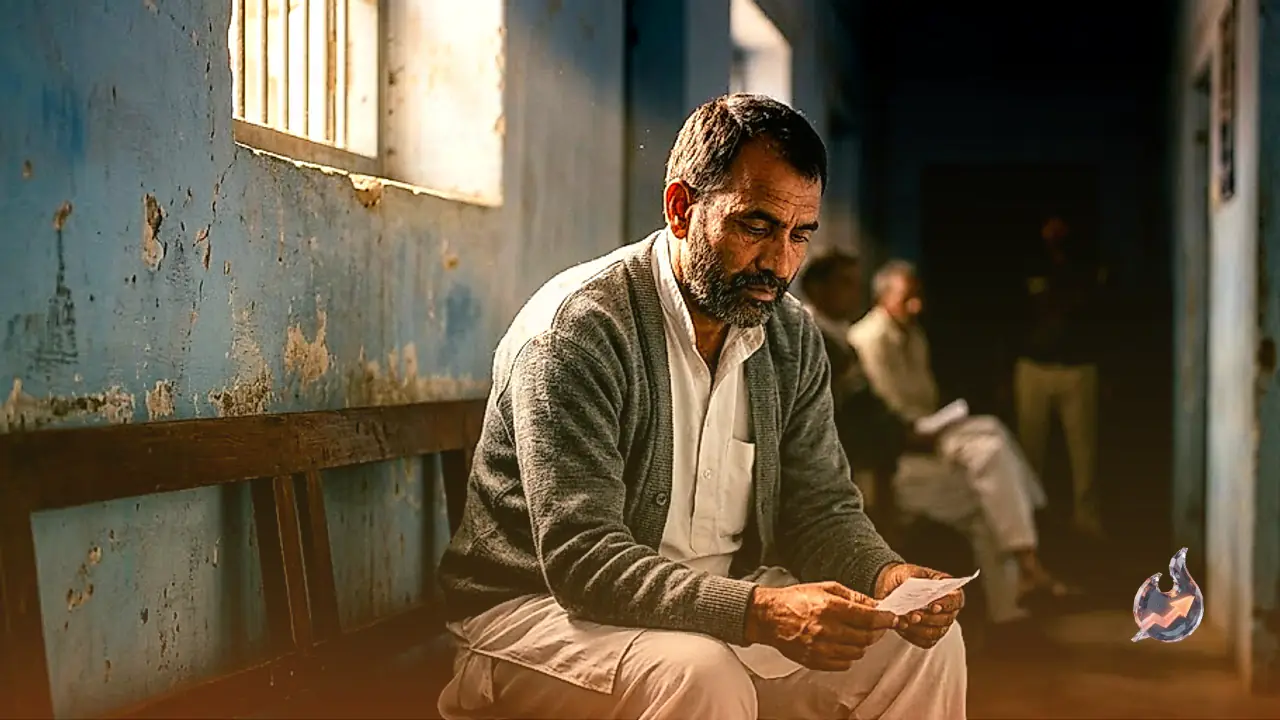

A four-year academic study out of Madhya Pradesh has stripped away any doubt about how India's undertrial system actually works: 77 percent of the prisoners currently sitting in the country's jails have neither been convicted nor cleared of the charges against them. They are undertrials, caught in a cycle where every court appearance ends not in a verdict but in yet another date, sometimes for decades.
A four-year study on why justice keeps getting delayed
The research was carried out by Vaibhav Singh Yadav, a PhD scholar in the Law Department at Dr. Harisingh Gour Central University in Sagar, on the subject Restructuring Trial System in India's Criminal Justice System. Across four years of work, Yadav concluded that the machinery through which India delivers criminal justice is old and overdue for an overhaul, and that only a restructured system can guarantee people justice within a reasonable time. He identified four factors feeding the crisis together: ignorance among undertrials and their families about their own case status, poverty that leaves them unable to pursue appeals or follow up on paperwork, language barriers that stop people from understanding court proceedings, and a chronic shortage of judges. He noted that some criminal trials in India have run for more than 30 years without the court reaching a final decision, leaving both the accused and the complainant in permanent limbo.
Nearly 5 crore cases piled up in lower courts
The scale of the backlog becomes clear from National Judicial Data, which Yadav cited in his research. Almost 5 crore cases are currently pending in lower courts across the country, and of these, 3.8 crore are criminal cases. Madhya Pradesh alone contributes 1 lakh 61 thousand pending cases to that pile, and criminal matters make up more than 1,33,000 of them. Yadav connected this pendency directly to the overcrowding problem inside India's prisons, because trials take years, or even decades, to conclude, undertrials keep accumulating inside jail walls built for far fewer inmates. He pointed out that the government currently spends close to 1.5 to 2 percent of GDP simply to run and maintain this overcrowded prison system, money that flows into keeping people incarcerated while their trials remain unresolved rather than into resolving the cases faster.
Only 15 judges per 10 lakh people
Behind these numbers sits a basic supply problem, judges. According to the report Yadav cites, India has just 15 judges for every 10 lakh people. The United States, by comparison, has 150 judges per 10 lakh people, ten times India's ratio, and Europe has 220 per 10 lakh, nearly fifteen times as many. Yadav's conclusion is direct, if India wants to clear its pending caseload within a realistic timeframe, it needs at least 50 judges per lakh people, more than three times the number it has today. Without that expansion, he argues, the addition of new cases each year will keep outpacing the courts' ability to dispose of old ones, no matter how the process is otherwise streamlined.
A Khurai man's extra 4 years 7 months behind bars
Sagar itself supplied a stark illustration of how poverty, ignorance and language failures translate into lost years of a person's life. A resident of Khurai was sentenced to 14 years in prison. The High Court later reduced that sentence to 7 years, but the reduction never reached the people who needed to know it, not the man's family, and not the prison system responsible for releasing him on time. As a result, instead of walking free after 7 years, he remained in jail for 11 years 7 months, serving 4 years 7 months beyond what the High Court had actually ordered. To correct this, the High Court directed the Madhya Pradesh government to pay the man, named Sohan, Rs 25 lakh in compensation under Article 21, explicitly so that an error of this kind is not repeated with someone else.
Technology, more judges and local language could speed up trials
Yadav's research does not stop at describing the problem, it also lays out what a restructured system could look like. He said the proper use of modern technology could remove much of the friction that currently slows cases down, from tracking case status to notifying families of orders like sentence reductions before they turn into years of extra jail time. Increasing the number of judges is the second piece, since no amount of digitisation can fix a court system that simply does not have enough people to hear cases. Third, he wants language barriers addressed by conducting proceedings and communicating updates in regional languages, so that every accused person and every family can actually understand what is happening in their own case rather than depending on others to interpret it for them. Finally, he called for more flexibility and speed in how summons, warrants and other government orders are issued and delivered, since delays at that basic administrative step often cascade into months or years of additional delay further down the line. Faster, better-communicated trials, Yadav said, would not just clear the backlog, they would also rebuild the trust ordinary people place in the judiciary.