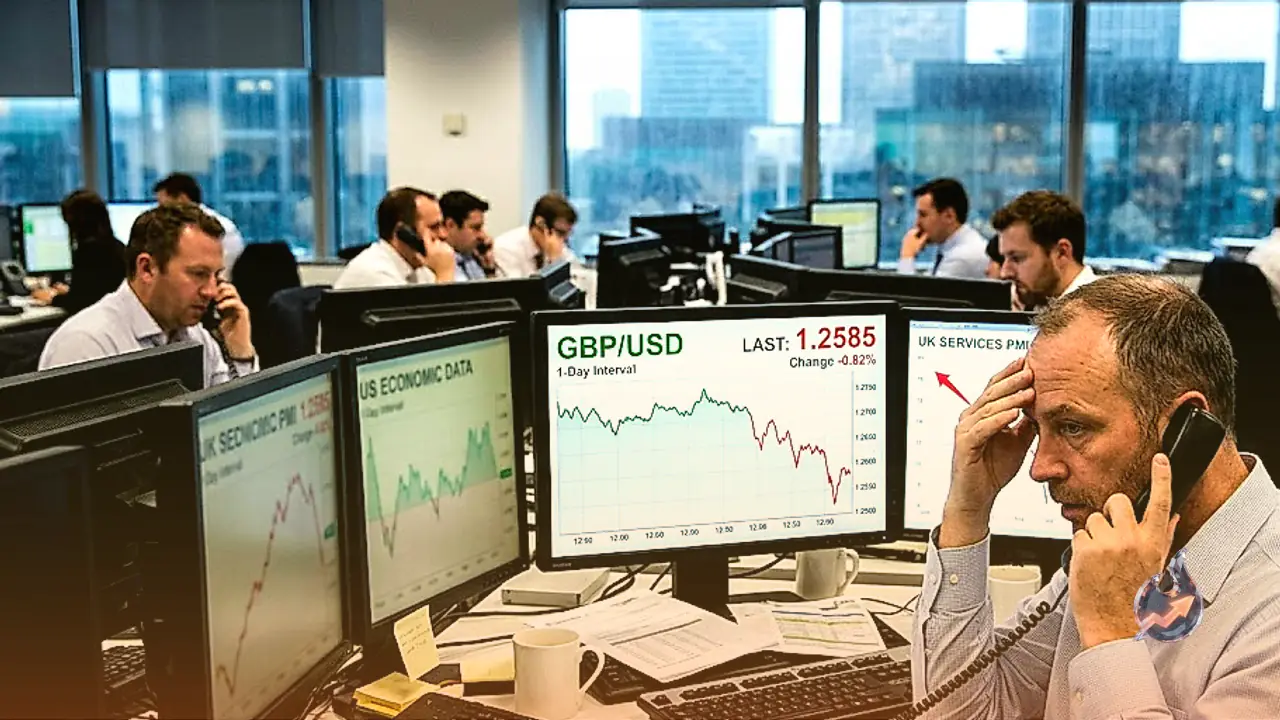























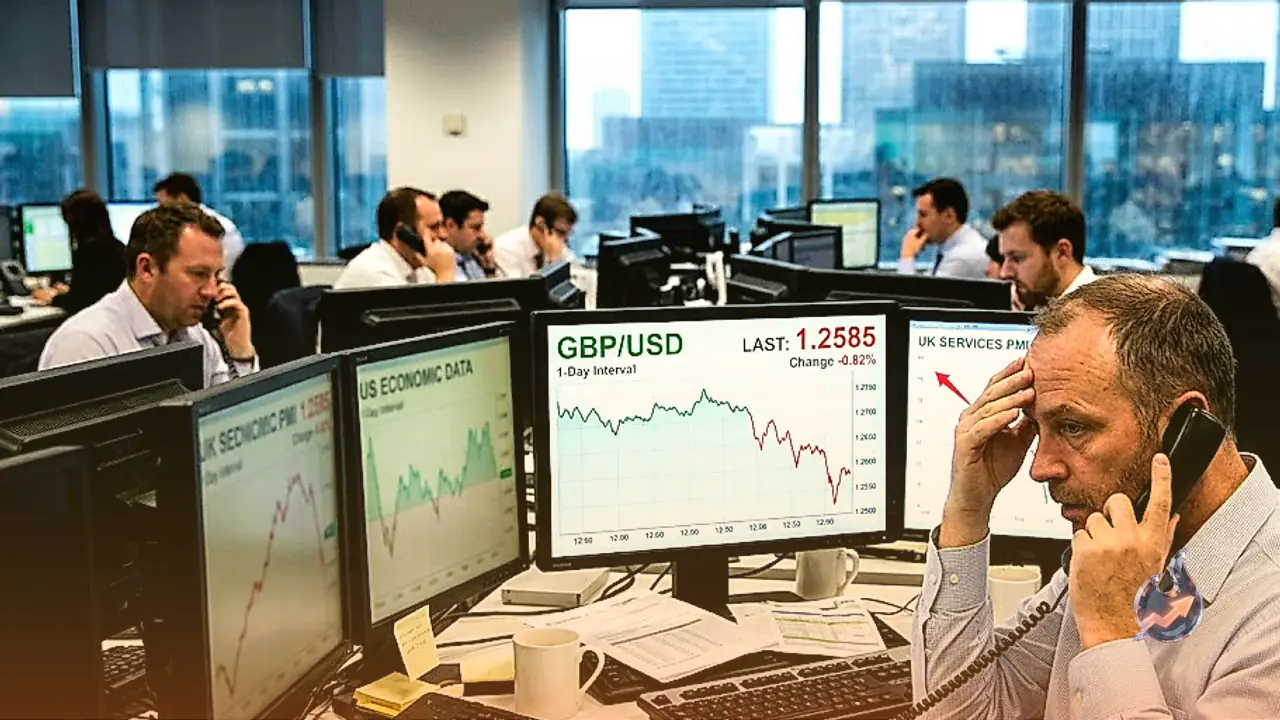

Selling pressure intensified across global foreign exchange desks as the British Pound dropped sharply against a resurgent Greenback, retreating to levels not seen since early July. The downturn was triggered by robust United States economic surveys that exceeded consensus expectations, creating a stark contrast with cooling business activity in the United Kingdom. As economic divergence between the two nations widened, market participants swiftly adjusted their positions, pushing the currency pair through key technical thresholds.
UK Service Sector Softens as Pricing Pressures Reaccelerate
Domestic economic indicators added to the headwinds confronting the British currency. The United Kingdom services Purchasing Managers' Index retreated to a three-month trough of 51.7. While the figure remains above the neutral threshold separating expansion from contraction, the deceleration underscores a cooling trend in the country's dominant economic sector. Compounding these growth concerns, British service-oriented enterprises increased their selling prices at the sharpest rate observed in four months, according to recent survey findings. This stubborn inflationary persistence presents a complex dilemma for policymakers attempting to navigate sluggish activity alongside stubborn cost pressures.
Bank of England Rate Decisions and Internal Monetary Disagreements
The macroeconomic backdrop remains heavily influenced by the Bank of England's recent policy decisions. On September 17, the central bank opted to maintain its benchmark Bank Rate at 3.75 percent through a 6-3 division among Monetary Policy Committee members. While the majority supported keeping rates static, Chief Economist Pill, alongside external committee members Greene and Mann, dissented in favor of an immediate increase to 4 percent. All three central bank officials scheduled to deliver public remarks on Thursday voted with the majority to keep rates on hold during that September gathering, underscoring the prevailing caution among the core leadership.
Technical Landscape: Chart Support, Resistance Ceilings, and Trend Indicators
From a technical trading perspective, GBP/USD faces notable structural deterioration. The pair ceded the pivotal 1.3300 handle during midweek dealings, a support level that had previously absorbed downward pressure since September 17 through Tuesday. Looking higher, the 1.3400 threshold has functioned as an unyielding barrier, capping every recovery attempt since the Federal Reserve implemented its interest rate hike on September 16.
To the downside, the 1.3200 mark serves as the initial floor, situated directly beneath recent session lows and slightly above the bottom recorded in late June. A confirmed drop below both markers would clear the way toward 1.3150. Market positioning skews toward short exposure beneath 1.3300, targeting 1.3200 initially followed by 1.3150 as a secondary objective. Momentum metrics corroborate this downward trajectory, with the daily Stochastic Relative Strength Index hovering near 13 and descending further. Market dynamics would require a decisive daily close above 1.3350 to negate this prevailing bearish bias.
The Historical Footprint and Market Mechanics of the Pound Sterling
Established in 886 AD, the Pound Sterling holds the distinction of being the world's oldest currency still in continuous circulation. Serving as the statutory currency of the United Kingdom, it ranks as the fourth most actively traded monetary unit within global foreign exchange, capturing roughly 12 percent of worldwide transaction volume with an average daily turnover of $630 billion based on 2022 market data. The currency's issuance and regulatory oversight fall entirely under the purview of the Bank of England.
In terms of currency market liquidity, the primary instruments involving Sterling are Cable, the GBP/USD pair representing 11 percent of total global turnover, alongside GBP/JPY, traditionally termed the Dragon by institutional dealers, which accounts for 3 percent, and EUR/GBP, commanding a 2 percent market share. These substantial volumes highlight the deep institutional involvement in UK currency movements.
Monetary Mechanics, Macroeconomic Benchmarks, and Trade Flows
Monetary policy administered by the Bank of England serves as the chief determinant governing Sterling's valuation. The central bank structures policy to fulfill its foundational mandate of price stability, defined as sustaining an annualized inflation rate near 2 percent. Benchmark interest rate adjustments function as the primary mechanism to steer these conditions. When inflationary pressures mount, the central bank implements policy tightening, elevating borrowing expenses across consumer and commercial sectors. This higher-yield environment historically strengthens the Pound by attracting international capital searching for elevated returns. Conversely, when inflation slides excessively, pointing toward an economic stall, policymakers move to reduce lending rates to encourage corporate investment in expansionary enterprises.
Regular statistical releases provide critical insight into overall macroeconomic durability, directly informing currency trends. Measures such as Gross Domestic Product, manufacturing and service-sector survey metrics, and employment rolls consistently guide investor positioning. Resilient data releases draw direct foreign investment while prompting expectations of policy tightening, reinforcing currency valuations, whereas deteriorating figures tend to erode market confidence. Furthermore, the national trade balance, measuring the spread between export receipts and import outlays over specific periods, plays an essential structural role. Solid international appetite for a country's domestic exports generates natural demand for its currency, generating appreciation, while an expanding trade shortfall typically generates sustained currency depreciation.
Broad Currency Performance: Australian Dollar and Japanese Yen
The US Dollar's assertive advance exerted pressure across multiple currency pairs. The Australian Dollar accelerated its descent against the Greenback during midweek trade, slipping back toward the low 0.7000s, an area untouched since early August. The Australian unit's weakness mirrors the ongoing rally in the Greenback, driven by escalating expectations of additional monetary tightening from the Federal Reserve. Domestic market participants have consequently shifted attention toward upcoming national labor force statistics to gauge future direction.
Concurrently, USD/JPY consolidated around the mid-157.00 region during Asian trading hours, lingering near two-week peaks reached late last week. A perceived dovish tone accompanying the Bank of Japan's recent rate adjustment has weighed on the Japanese Yen, while the Federal Reserve's hawkish posturing keeps the US Dollar well supported. Nonetheless, potential intervention rhetoric from Tokyo authorities has prevented unrestricted upward extensions. Meanwhile, broader financial markets demonstrated little reaction to the conclusion of indirect diplomatic discussions between the United States and Iran ahead of a planned summit between Trump and Xi.
Precious Metals Retreat Amid Higher Dollar and Central Bank Tightening
Gold reversed two consecutive sessions of gains, succumbing to pronounced selling pressure through midweek trading. The precious metal breached beneath the $4,300 per troy ounce threshold to touch weekly lows, undermined by the broad recovery in the US Dollar and a firm tone across American money markets.
On the policy trajectory, Federal Reserve forecasts anticipate keeping the benchmark reference rate unchanged straight through 2027. This timeline aligns with projections that elevated maritime freight rates will continue percolating into retail shelves. Container shipping costs from Asian manufacturing hubs to the United States stand at more than four times their levels prior to the outbreak of hostilities with Iran in late February. Analysis published by the International Monetary Fund indicates that the crowning impact of these supply chain bottlenecks on commercial store pricing will manifest roughly a year down the line, in 2027.
Simultaneously, the Bank of Japan advanced its policy normalisation agenda by increasing its short-term interest rate target from 1.00 percent to 1.25 percent in a 7-2 vote. The decision concluded weeks of widespread market anticipation, formalising another deliberate phase in Japan's withdrawal from ultra-accommodative monetary settings.