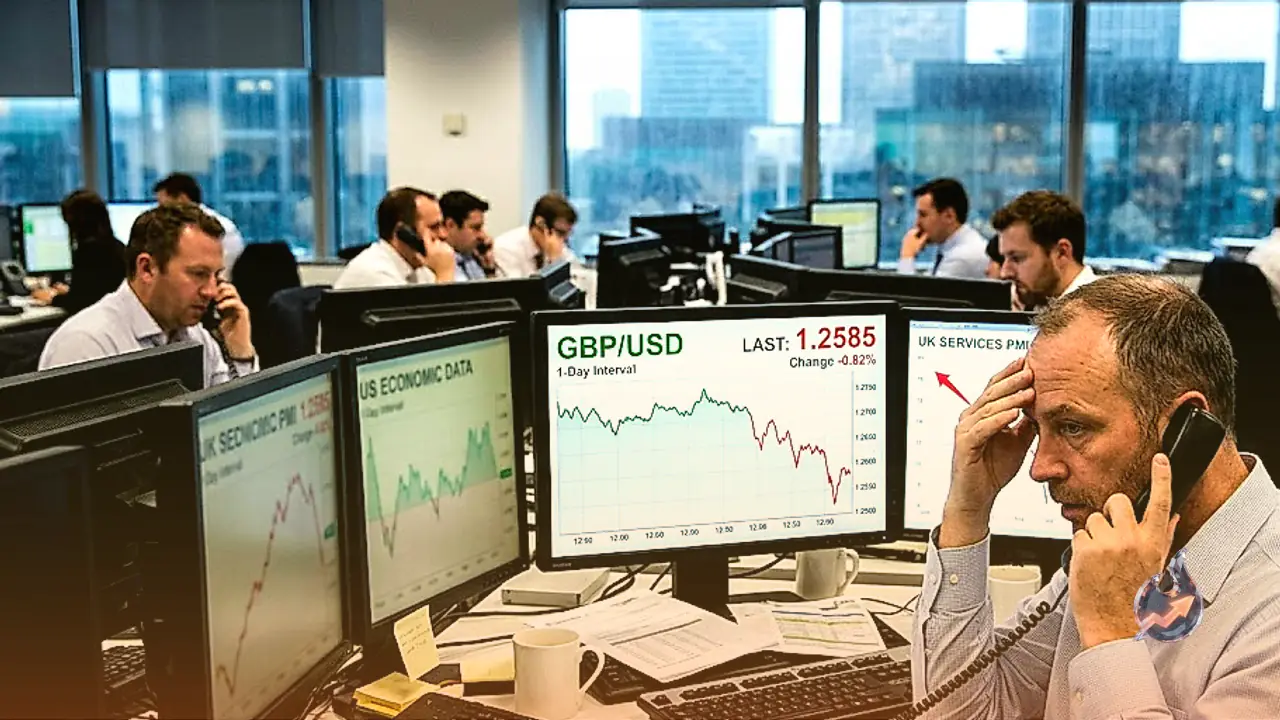

























The euro has resumed its downward slide against the US dollar, retreating to levels last seen in late July as stronger American economic survey data overshadowed a rebound in European business activity. While the Eurozone composite Purchasing Managers' Index climbed to 53.1 to mark its highest reading since April 2023, the data failed to turn the currency's fortunes around in the foreign exchange market. Global currency traders continue to look past regional survey improvements, centering their focus squarely on the wide monetary policy divergence separating the European Central Bank and the Federal Reserve.
Widening Rate Gaps and Crucial Technical Levels
Interest rate disparities between the two economic blocs remain the principal driver weighing down the single currency. The European Central Bank maintains its deposit facility rate at 2.50 percent, contrasting sharply with the Federal Reserve's federal funds target range of 3.75 percent to 4.00 percent. This yield gap continues to drive cross-border capital flows toward the higher-yielding greenback. On the pricing charts, key resistance thresholds have failed to hold up against selling pressure. The 1.1400 resistance level gave way on Wednesday, following a session on Tuesday that breached the 1.1450 boundary which had previously acted as an intraday floor since September 16. Above those marks, the 1.1500 ceiling capped every trading session between September 17 and Monday.
Looking toward downside support, the 1.1350 threshold serves as the primary barrier for the currency pair. Both the intraday trough recorded on Wednesday and the late-July lows sit immediately above this level. Should selling momentum push the exchange rate lower, the next major historical marker rests just above 1.1300, matching the low points set in late June. From a trading perspective, directional bias remains short while prices trade below 1.1450, establishing price objectives at 1.1350 and 1.1300. However, the daily Stochastic Relative Strength Index has plunged to around 8, situating the pair deep inside oversold territory. This technical positioning suggests that a temporary counter-trend bounce could unfold before downward targets are met. Conversely, a daily close above 1.1500 would invalidate the near-term shorting scenario.
The Euro's Economic Footprint and Central Bank Mechanics
The euro serves as the unified official currency for the 20 European Union member nations that comprise the Eurozone. Ranking as the second most heavily traded currency on the planet behind the US dollar, the single currency made up 31 percent of all global foreign exchange market turnover in 2022, representing an average daily volume exceeding $2.2 trillion. The EUR/USD pair constitutes the deepest market segment in global currency trading, accounting for an estimated 30 percent of aggregate turnover. Other active pairings include EUR/JPY at 4 percent, EUR/GBP at 3 percent, and EUR/AUD at 2 percent of total daily activity.
The European Central Bank, headquartered in Frankfurt, Germany, operates as the monetary authority for the euro area. The central bank's primary mandate is the preservation of price stability, which entails managing inflation and encouraging sustainable economic expansion through benchmark interest rate adjustments. Relatively elevated benchmark rates, or firm expectations of policy tightening, generally lend support to the euro by enhancing yields on euro-denominated debt. Policy decisions are handed down by the Governing Council across eight scheduled meetings per year. Voting membership consists of the central bank governors from each of the member countries alongside six permanent executive board members, led by ECB President Christine Lagarde.
Macroeconomic Drivers and Data Dependencies
Consumer price behavior across member states is tracked through the Harmonized Index of Consumer Prices, serving as a primary econometric barometer for monetary authorities. Whenever price increases run ahead of projections and breach the ECB's explicit 2.0 percent medium-term inflation target, the Governing Council faces growing pressure to hike rates to restore price balance. Comparatively higher rates compared to foreign jurisdictions tend to lift the euro by attracting international portfolio investment into local financial assets.
Broad macroeconomic reports provide direct visibility into private-sector momentum and regularly steer currency valuations. Key data sets including gross domestic product, manufacturing and services purchasing managers' indexes, labor market indicators, and consumer sentiment surveys guide market expectations. Solid economic figures support currency valuations by drawing in external investment and allowing the central bank scope to maintain higher rates. Conversely, deteriorating economic activity frequently precipitates currency depreciation. Releases from Germany, France, Italy, and Spain command the closest scrutiny from global investors, as these four economies generate approximately 75 percent of total euro-area economic output.
Foreign trade performance represents an additional core determinant of currency valuations. The trade balance quantifies the net variance between a nation's export earnings and its aggregate expenditure on foreign imports over a designated timeframe. When an economic zone manufactures high-value export goods that encounter robust international demand, purchasing those products requires foreign counterparties to acquire the exporter's home currency. As a consequence, a positive net trade balance generates upward valuation pressure, whereas an ongoing trade deficit creates structural currency headwinds.
Cross-Asset Movements in Currencies, Debt, and Commodities
Broader financial markets reflected the ongoing strength of the US dollar across multiple trading desks. The AUD/USD pair extended its recent declines on Wednesday, retreating into the low 0.7000s to revisit territory last tested in early August. Lingering bearish sentiment in the pair reflects broader dollar demand stemming from elevated expectations surrounding Federal Reserve tightening policies, with upcoming labor data poised to direct near-term volatility. In the Asian session, USD/JPY hovered in the mid-157.00s, holding close to the two-week peak established on Friday. The pair drew strength from a dovish policy hike delivered by the Bank of Japan, which raised its short-term rate target from 1.00 percent to 1.25 percent in a 7-2 vote to advance policy normalization in line with prevailing market forecasts. While the Fed's stance supports the dollar, verbal intervention risks from Japanese authorities have capped wider gains, with traders showing little immediate reaction to concluded indirect discussions between the US and Iran ahead of a planned meeting between Trump and Xi.
In commodity markets, precious metals surrendered earlier momentum as gold faced renewed selling pressure midway through the week, breaking two consecutive sessions of gains. Spot gold dropped through the $4,300 per troy ounce barrier to log weekly lows, undercut by the broad recovery in the greenback and buoyant yields across US money markets. Across the macro horizon, the Federal Reserve has projected its benchmark policy rate to remain unchanged through 2027, coinciding with expectations of prolonged supply chain friction. Freight rates for maritime containers travelling from Asia to the US remain more than four times higher than levels recorded prior to the outbreak of conflict with Iran in late February. Analysis published by the International Monetary Fund indicates that the full pass-through impact of heightened shipping expenses on US retail shelf prices will peak roughly twelve months out, in 2027.