

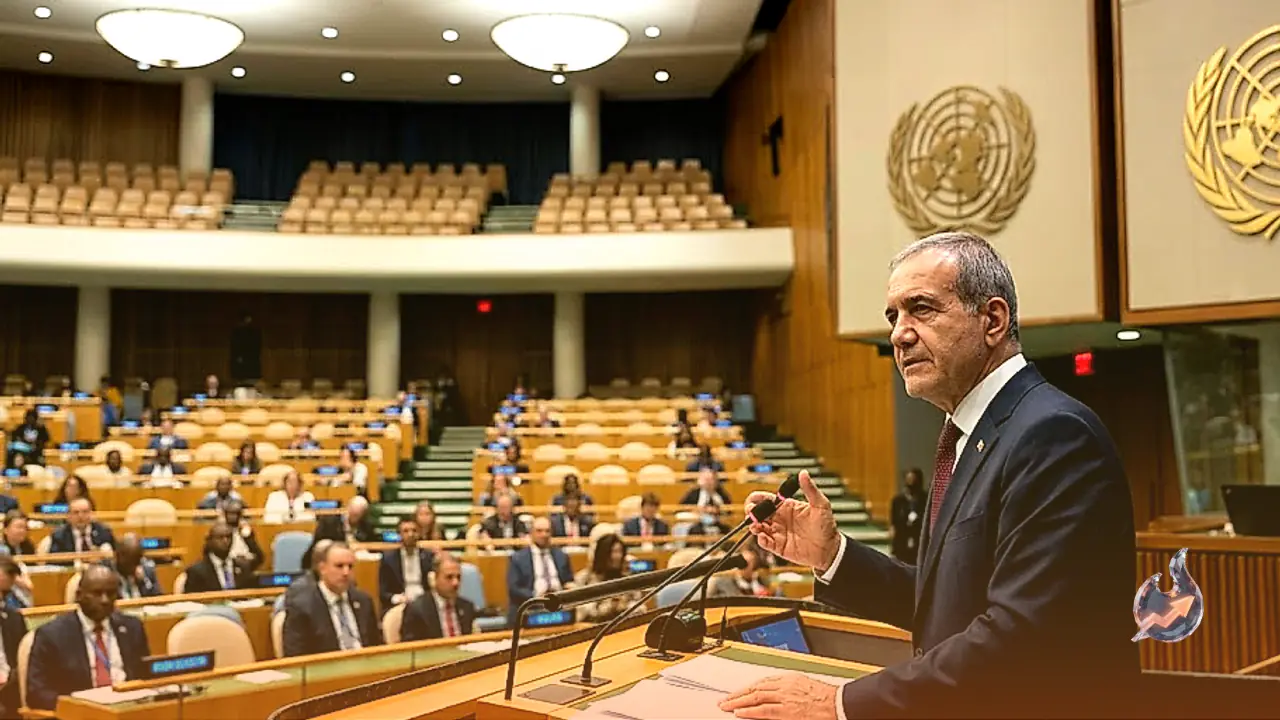





















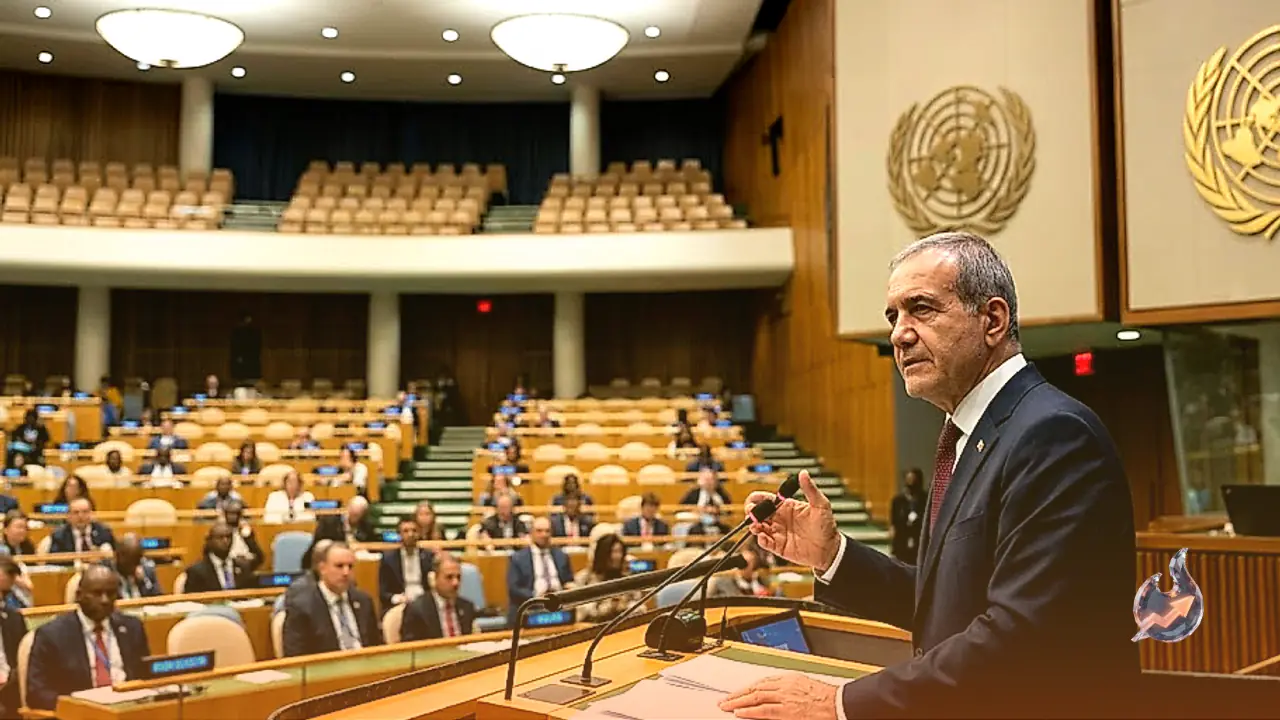

Mounting geopolitical frictions across the Middle East are once again rippling through global energy benchmarks, as diplomatic leaders debate potential off-ramps to escalating conflict. Iranian President Masoud Pezeshkian emphasized that resolving the ongoing hostilities rests squarely on decisions made in Washington, asserting that his administration does not wish to see the violence dragged forward. Pointing to provocative actions taken by Israel, Pezeshkian explained that military confrontation had been forced upon his country, even as he maintained that direct negotiations remain the rightful mechanism to settle regional grievances rather than continued warfare.
Strait of Hormuz and Economic Sanctions Anchor Potential Truce Framework
In diplomatic channels, a senior Iranian official outlined what could serve as a pragmatic blueprint for de-escalation between the adversarial nations. Under this proposed phased structure, Iran would guarantee unhindered passage for commercial and energy vessels through the critical waters of the Strait of Hormuz. In return, Washington would need to dismantle its sweeping economic embargo and grant Tehran access to its overseas frozen capital. Given that the Strait of Hormuz represents the single most vital maritime transit route for international crude shipments, any conditional agreement linking navigational security to sanctions relief carries immense weight for worldwide market stability.
Qatar Dismisses Accusations at the United Nations Assembly
The geopolitical discourse expanded further onto the multilateral stage at the United Nations General Assembly. Qatar issued a firm repudiation of claims delivered by Israeli Prime Minister Benjamin Netanyahu, who had accused the Gulf nation of executing an aggressive influence operation against Israel. Rebutting those assertions, Qatari representatives argued that such rhetoric represents a deliberate attempt to deflect public scrutiny from Israel's own policy choices and responsibilities on the ground. The sharp diplomatic exchange underscores the fragility of regional alliances as regional governments navigate the fallout of the current security crisis.
Crude Oil Gains Strength as Technical Indicators Present Resilient Backdrop
Energy commodities registered immediate gains amidst the heightened geopolitical uncertainty. West Texas Intermediate futures gained 0.80% during the trading day to trade near $92.86 per barrel. Closing market data shows prompt crude contracts settling at $93.92, marking a net advance of 1.91% from the prior session close of $92.16. Over the trailing 52-week period, the commodity has traversed an expansive band between $54.98 and $119.48, while daily trading volume settled at 0.02 times its 20-day historical average.
From a chart perspective, the 14-period Relative Strength Index rests comfortably at 52, denoting a neutral momentum environment. The Moving Average Convergence Divergence line sits at 2.82 against a signal line of 3.84, leaving the histogram slightly negative at -1.02. Yet underlying trend structures reflect durable support, evidenced by a classic golden cross where the 50-day exponential moving average at $89.84 remains comfortably above the 200-day exponential moving average at $79.98. In addition, the 20-day EMA resides at $94.55, complemented by simple moving averages where the 50-day SMA stands at $87.76 and the 200-day SMA marks $81.37.
Volatility measures remain well defined as price action trades within the 20-period Bollinger Bands spanning $82.17 to $107.49, anchored by a centerline of $94.83. The Average Directional Index records a reading of 28, confirming trend continuation, while stochastic lines show the fast metric at 29 and the signal at 27. Given an Average True Range of $4.45 per day, intermediate technical thresholds locate key 20-day support near $80.65 and overhead resistance at $106.75. For active market participants, the central pivot rests at $94.19, bounded by upward resistance levels at $94.48 and $95.04, alongside primary downside safety cushions at $93.63 and $93.34.
Understanding WTI Crude and the Factors Driving Market Valuations
West Texas Intermediate represents one of the three principal global crude benchmarks, alongside European Brent and Middle Eastern Dubai grades. Industry experts describe this American variety as light and sweet due to its lower density and modest sulfur makeup, physical properties that make it exceptionally cost-effective to refine into transportation fuels. Extracted primarily within domestic US fields, WTI flows into storage tanks and pipelines centered at Cushing, Oklahoma, a strategic junction widely recognized as the pipeline crossroads of the world. Because of this extensive infrastructure, WTI prices serve as an indispensable price discovery mechanism quoted daily across international financial outlets.
Fundamental price trajectories for crude stem directly from global supply and demand dynamics. Rapid worldwide industrial growth accelerates petroleum consumption, whereas macroeconomic slowdowns dampen demand expectations. Meanwhile, cross-border armed clashes, political unrest, and economic embargos can abruptly sever pipeline flows and tanker routes, sparking supply deficits. Furthermore, because physical barrels are priced and cleared in US Dollars, exchange rate swings heavily influence international purchasing power. A softer greenback makes imports more affordable for non-dollar consumers, providing tailwinds for crude, whereas dollar appreciation produces the inverse friction.
Inventory Statistics and the Influence of the OPEC Cartel
Traders evaluate weekly storage reports to gauge short-term supply imbalances in the North American pipeline system. The American Petroleum Institute issues its preliminary private inventory survey every Tuesday afternoon, followed on Wednesday by official figures compiled by the Energy Information Administration. Historical tracking indicates that their respective inventory estimates fall within 1% of each other roughly 75% of the time, although institutional participants treat the EIA government publication with greater authority. A substantial reduction in domestic inventories signals robust consumption and elevates spot prices, whereas unanticipated inventory builds frequently induce downward price adjustments.
On the collective supply side, the Organization of the Petroleum Exporting Countries wields substantial influence over global balances. Comprising 12 sovereign oil-producing states, the group convenes biannual summits to establish binding output quotas for member nations. Production cutbacks designed by OPEC curtail available tanker supplies and support crude valuations, whereas quota increases tend to dilute market tightness. The broader coalition known as OPEC+ integrates ten additional non-member producing nations, with Russia serving as the most influential external participant.
Foreign Exchange Pressures, Bond Yields, and Precious Metals Retracement
Beyond commodity complexes, foreign currency and fixed income markets experienced decisive adjustments. The Australian Dollar fell for a fourth straight session against the US Dollar, sliding toward the pivotal 0.7000 threshold while breaching its 200-day simple moving average. Sustained greenback demand gained momentum from elevated Treasury yields and trader repricing of Federal Reserve interest rate projections.
In East Asia, the Bank of Japan advanced its monetary tightening agenda by lifting its benchmark short-term lending rate from 1.00% to 1.25%. The monetary policy committee approved the quarter-point hike by a 7-2 vote margin, meeting widespread consensus expectations. Japanese government bond yields surged following the decision, helping the Yen recover from three-week lows against the dollar to steady near 158.00 as intervention risks lingered. In contrast, gold suffered continuous headwinds, dipping temporarily under $4,250 per troy ounce before staging a muted recovery, constrained by robust dollar valuations and climbing bond yields.