























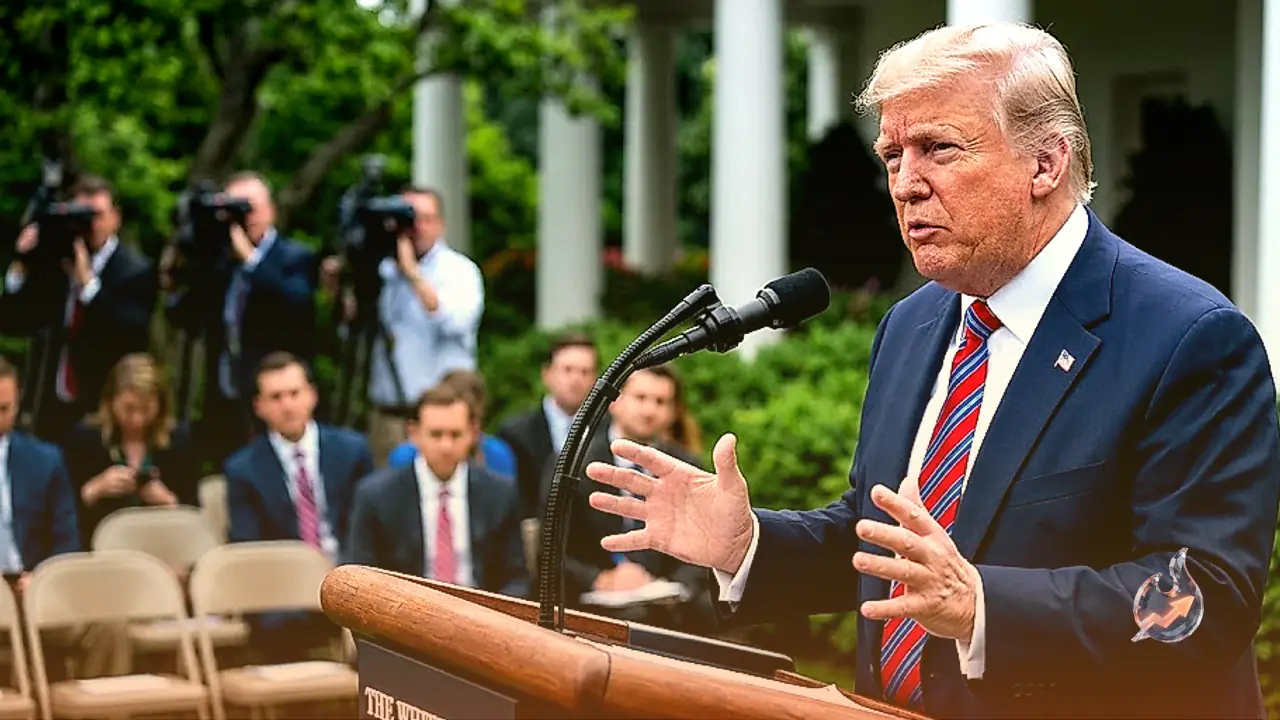

US President Donald Trump has issued a formal directive to launch an investigation into the trade practices of the European Union, a move that has immediately reignited anxieties of a major tariff confrontation between Washington and Brussels. The decision comes as a direct response to a string of regulatory actions taken by European authorities against major American technology giants. Trump warned that if this newly initiated investigation uncovers evidence of systematic discrimination or unfair treatment against businesses based in the United States, European exports heading into American markets could face steep, retaliatory import tariffs.
The Catalyst: A Multi-Million Dollar Penalty on Google
The immediate catalyst for this escalating transatlantic tension was a massive antitrust penalty levied against Google by the European Commission. The European regulatory body imposed a fine of Euro 890 million, which translates to nearly USD 1 billion, asserting that the technology firm had violated the European Union's strict digital competition rules. Trump swiftly condemned the financial penalty, arguing that American tech corporations are being subjected to a pattern of continuous and unjust punishment by European authorities. According to Trump, these multi-million and multi-billion dollar penalties are not genuinely about fair competition, but are instead being utilized by European regulators as a convenient mechanism to generate substantial public revenue.
The regulatory body found that Google's practices restricted rival app developers from reaching users effectively. This massive fine of Euro 890 million (approximately USD 1 billion) is one of several antitrust penalties Google has faced in Europe over the last decade. Trump argued that this is part of an ongoing pattern where European institutions treat American tech companies as revenue sources rather than regulating them impartially.
Trump Warns of 'A Very Big Price' on Social Media
Making the announcement through his social media platform, Truth Social, Trump directed federal agencies to take immediate action in launching the trade probe. He highlighted that prominent US companies, including Google, Apple, Meta, and Amazon, are being systematically targeted by the European Union with exorbitant financial penalties. Expressing his strong dissatisfaction, Trump stated that the United States of America is not a piggybank for Europe, nor would his administration allow it to be treated as one. He further warned that European nations would have to pay a very big price if this aggressive regulatory approach toward American corporations continues unabated.
He targeted the systematic regulatory actions against US pillars like Google, Apple, Meta, and Amazon, suggesting a coordinated effort by European officials to weaken American technological dominance. By declaring that the United States is not Europe's piggybank, Trump emphasized a nationalist trade policy that views regulatory fines as hidden taxes on US commerce. He made it clear that his administration would not sit idly by while American innovation is penalized abroad.
Allegations of Unethical Conduct and Retaliatory Trade Tools
In his public statements, Trump characterized the European Union's regulatory actions as illegal and highly unethical conduct designed to hamstring American commercial dominance. He made it clear that while no new tariffs are being officially implemented at this specific moment, they remain a highly probable outcome depending on the findings of the federal investigation and the subsequent response from Brussels. The probe is currently in its preliminary stages, with the US administration indicating that its future actions will be determined by the evidence collected regarding whether American digital platforms were unfairly singled out. By framing an antitrust enforcement issue as a matter of trade discrimination, the administration is preparing a suite of trade policy tools, including import duties, to protect US commercial interests in Europe.
The EU's Stance on Digital Monopolies and Fair Competition
From the perspective of European Union regulators, the substantial penalty against Google was a necessary step to curb the abuse of market power. The European Commission alleged that Google leveraged its dominant position through its search engine and the Google Play Store to favor its own suite of proprietary applications and digital services over those of independent rivals. EU officials maintained that this anticompetitive behavior directly undermined competitors, stifled innovation, and severely restricted choice for European consumers. The case is part of a broader, years-long campaign by Brussels to enforce stricter regulatory oversight and curb the monopolistic tendencies of massive international technology conglomerates.
EU representatives have consistently defended their decisions, stating that antitrust laws are applied equally to all companies operating within the European single market, regardless of their country of origin. The Commission argued that Google's practices regarding the pre-installation of its own applications and search tools on mobile devices restricted fair market access. They believe that by enforcing these rules, they are promoting a healthier digital ecosystem that benefits European consumers and smaller tech startups who want a fair chance to compete.
Global Market Uncertainty and Supply Chain Vulnerabilities
The potential revival of trade tensions between these two economic superpowers has raised significant concerns among global exporters, multinational corporations, and supply chain operators. If the United States decides to go ahead with retaliatory tariffs, the economic consequences could ripple across multiple sectors, impacting everything from manufacturing to consumer goods. This dispute comes at a time when global financial markets are already navigating a complex landscape of geopolitical strains and macroeconomic shifts. Investors are now closely monitoring both the timeline of the US investigation and any formal diplomatic or regulatory counter-responses emanating from Brussels to gauge the risk of a wider economic conflict.
Economists warn that a tariff battle between the United States and the European Union could disrupt billions of dollars in trade, impacting critical sectors such as automotive, agriculture, and high-tech manufacturing. Multinational corporations that operate extensively in both regions would find themselves caught in the middle of regulatory and tariff crossfire. This friction could also lead to more fragmented supply chains, forcing businesses to relocate operations or face higher operational costs, which would ultimately be passed down to consumers worldwide.
The Looming Threat of a Broader Trade Confrontation
For the moment, the geopolitical standoff remains concentrated on the specific Google antitrust fine and the newly ordered US federal probe. While European officials continue to insist that their regulatory actions are solely motivated by a desire to foster a fair and open digital marketplace, Trump maintains that the underlying motive is trade protectionism and discrimination. As both Washington and Brussels hold their ground, businesses, trade analysts, and global investors are left waiting to see if this escalating war of words will ultimately transform into a full-scale, disruptive trade war.