























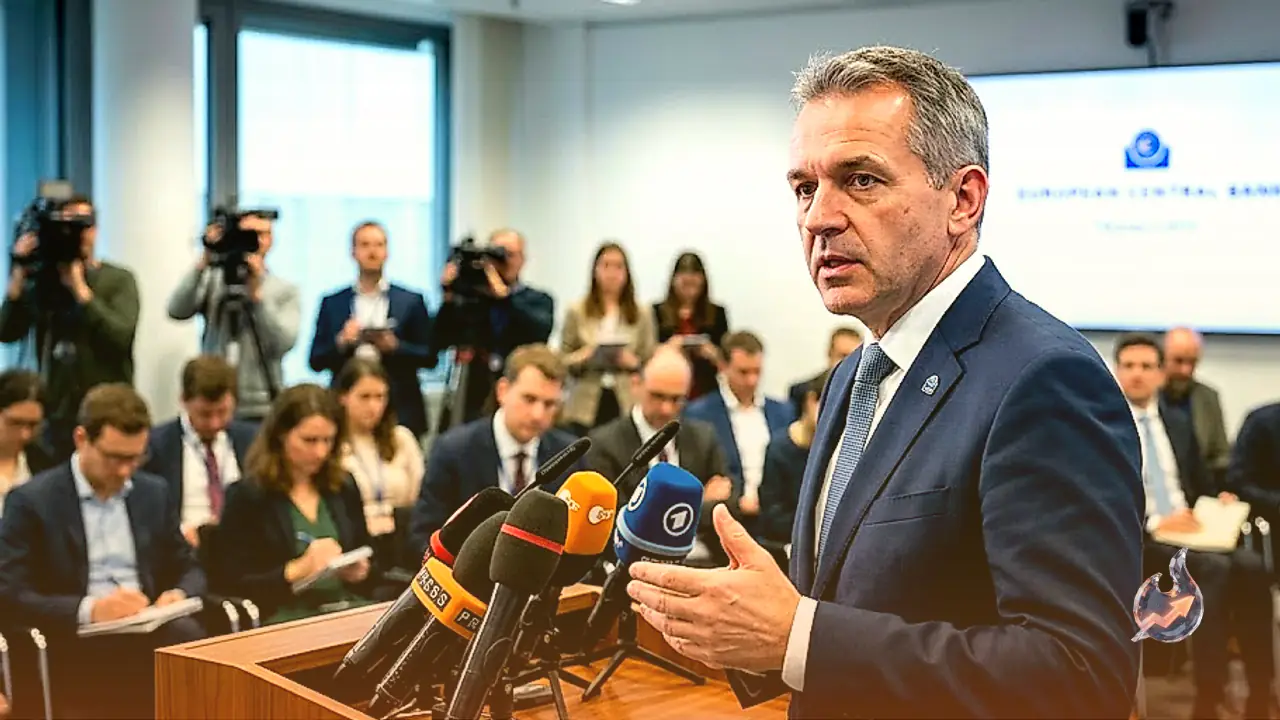

European Central Bank official Peter Kazimir has signaled that at least one more interest rate hike will be needed to ensure economic stability. He emphasized that the secondary effects of inflation can become costly to reverse, meaning the central bank must take proactive measures before those pressures become fully visible in the broader economy.
The Rationale Behind Further Tightening
According to Kazimir, any deterioration in the broader economic outlook would warrant a more aggressive tightening cycle than what financial markets currently anticipate. Furthermore, he noted that a rate hike will remain entirely warranted even if the underlying inflation situation shows some degree of improvement in the near term.
Structure and Mandate of the European Central Bank
Headquartered in Frankfurt, Germany, the European Central Bank serves as the central reserve institution for the Eurozone, responsible for setting interest rates and directing regional monetary policy. The primary mandate of the ECB is to maintain price stability, which translates to keeping inflation hovering around the 2 percent target. The institution utilizes interest rate adjustments as its main instrument to achieve this balance. Ordinarily, maintaining relatively high interest rates results in a stronger Euro, while lower rates have the opposite effect.
Policy decisions at the ECB are formulated by the Governing Council, which convenes eight times a year. This governing body comprises the heads of the national central banks across the Eurozone alongside six permanent members, which includes ECB President Christine Lagarde.
Quantitative Easing and Tightening Measures
During extreme economic scenarios, the central bank can deploy a monetary tool known as Quantitative Easing. QE involves the creation of Euros to purchase government and corporate bonds from commercial banks and financial institutions, a process that typically weakens the currency. QE is treated as a measure of last resort when standard interest rate cuts are insufficient for price stability. The ECB famously deployed this mechanism during the Great Financial Crisis of 2009-11, during a prolonged period of stubbornly low inflation in 2015, and throughout the COVID-19 pandemic.
Conversely, Quantitative Tightening is the reversal of QE, deployed once an economic recovery is underway and inflationary pressures begin mounting. While QE injects liquidity into financial institutions by acquiring their bond holdings, QT involves halting new bond purchases and ceasing the reinvestment of principal on maturing assets held by the central bank. This policy stance is generally viewed as bullish for the Euro.
Across global financial markets, the currency pairs have reacted to shifting geopolitical and economic cues. The British Pound built on a modest bounce from a three-week low, while the Euro maintained sizeable gains supported by a broadly weaker US Dollar amid optimism surrounding diplomatic efforts to resolve the US-Iran conflict. Concurrently, Gold held onto modest intraday gains, whereas crude oil prices experienced a slump as diplomatic hopes revived. Meanwhile, digital assets like Cardano remained under pressure amid subdued momentum, and the Australian Dollar navigated a volatile path driven by shifting international sentiment.