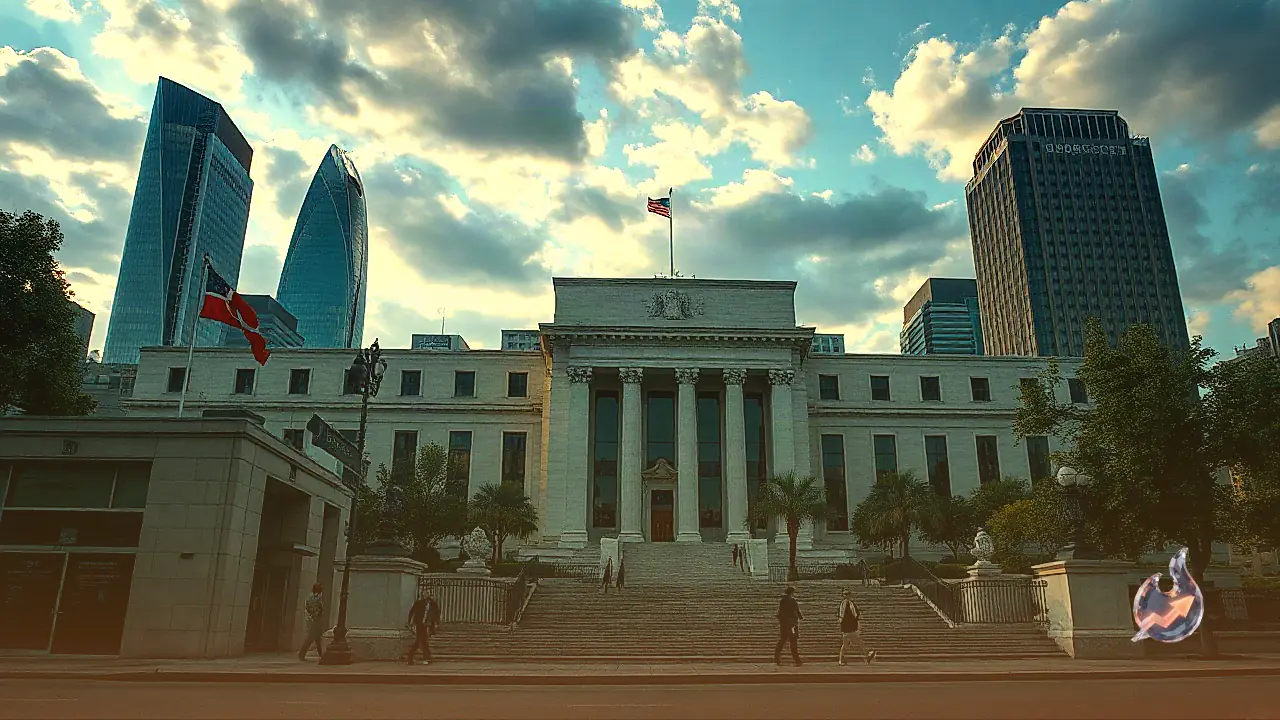

























The Federal Reserve's move to raise its interest-rate range to 3.75-4.00% sent the Dollar Index sharply higher, leaving DXY only one-tenth of a point below 100.00. The jump came six days after the European Central Bank had moved its rate to 2.50%, putting two major central-bank decisions close together in the currency market.
A five-minute bar produced the session's biggest move
On release of the Fed decision, DXY first fell toward 99.70. It did not stay there. The index then advanced to 99.90, the highest level of the day, creating a 0.22 swing inside a single five-minute bar. That brief interval contained the strongest part of the reaction to the decision.
Once the burst had passed, DXY was near 99.85. This was about 0.12 higher than its position just before 18:00 GMT, but still one-tenth of a point under 100.00. The lowest level of the day, close to 99.55, came during the European morning. The later bar therefore accounted for more than half of the index's total movement for the session.
Afterward, the five-minute momentum gauge read close to 56, which is a mid-range reading. The surge and the retreat occurred within the same bar, so their effects cancelled each other out in that measure. The result was a sharp price excursion without a correspondingly extreme momentum signal.
USD has a global role that reaches beyond America
The United States of America uses USD as its official currency. USD also serves as the de facto currency in many other nations, where it circulates alongside local banknotes rather than replacing them completely. That broad presence makes the dollar's value relevant well beyond American borders.
USD is the world's most actively traded currency. It represents over 88% of global foreign-exchange turnover, equaling an average of $6.6 trillion in transactions each day in the 2022 data. After the Second World War, it replaced the British Pound as the leading reserve currency. Gold supported the dollar through most of its history, but the Gold Standard ended with the Bretton Woods Agreement in 1971.
The reserve-currency role also gives the dollar a special place in global finance, because it is held and used beyond the country that issues it. The facts do not attach a price target to that status; they simply show why a change in the dollar's value can matter across many markets at once.
The Fed's mandates make interest rates the main lever
Monetary policy, which the Federal Reserve shapes, is the most important single influence on the dollar's value. The Fed operates under two mandates: controlling inflation to maintain price stability and promoting full employment. Its principal tool for pursuing those goals is changing interest rates.
When prices climb too quickly and inflation exceeds the Fed's 2% target, raising rates tends to support USD. If inflation falls under 2% or joblessness becomes excessive, the central bank may cut rates, which can weaken the Greenback. No inflation or unemployment figure is supplied with this decision, so those numbers should not be inferred.
The two mandates also mean that rate decisions are not made for the exchange rate alone. The Fed's tool affects the dollar, but the stated objectives remain inflation and employment, so the currency move should not be treated as a separate mandate. The immediate reaction fits the general relationship between higher rates and a stronger dollar without proving any additional economic condition.
The ECB move supplied a wider rate backdrop
The Fed's range now stands at 3.75-4.00%. Six days earlier, the ECB had raised its rate to 2.50%. No causal link between the two decisions is stated, but the close timing means that major central banks were moving rates in the same direction within a short window.
For DXY, the Fed announcement was the direct market trigger. The index's path from 99.70 to 99.90 and then near 99.85 followed that release, while the ECB decision formed part of the surrounding policy environment. The index remained below 100.00 in the snapshot described.
QE is an emergency response to a frozen credit system
In extreme situations, the Federal Reserve can print additional dollars and introduce quantitative easing, or QE. The purpose is to increase the flow of credit substantially when the financial system has stalled. QE is a non-standard measure for moments when lending has dried up because banks do not want to lend to one another, fearing that the other side may default.
That makes it a last-resort option when lowering interest rates alone is unlikely to produce the required result. During the Great Financial Crisis of 2008, the Fed used QE as its main weapon against the credit crunch. The operation paired newly created dollars with purchases of US government bonds, sourced mainly from financial institutions.
Because banks are reluctant to lend when they fear counterparty default, the extra credit supplied through QE is intended to restore functioning rather than simply change the headline rate. The usual dollar effect of QE is downward, which is the opposite of the supportive effect associated with the rate increase in this episode.
QE's bond purchases are described as predominantly directed at financial institutions. For currency readers, the important direction is the usual one: expanding QE tends to weigh on USD, even though the emergency program's immediate purpose is to restore credit.
QE should therefore be understood as an emergency credit tool, not as the same mechanism as an ordinary rate decision. The Fed can use it when the financial system is stuck, while the latest event involved the standard rate-setting channel that immediately affected DXY.
QT is the reverse of QE
Quantitative tightening, or QT, works by reversing that process. The Fed stops buying bonds from financial institutions and does not reinvest the principal returned when bonds it already owns mature. Instead of channeling that money into new purchases, the central bank lets the holdings age without replacing them through the same buying program.
QT is generally positive for USD, while QE is generally associated with a weaker dollar. The contrast is important because the two policies move the credit and bond-purchase channels in opposite directions. One expands the Fed's emergency support, while the other removes that support as securities mature.
The move was sharp, but the evidence has limits
The price sequence shows a rapid approach to 100.00 rather than a confirmed break above it. DXY rose from near 99.70 to 99.90 within one five-minute bar, then traded near 99.85, still one-tenth of a point short. The day's low near 99.55 and the mid-range momentum reading near 56 show that the late surge and its pullback belonged to the same episode.
Readers should also keep the timing clear: 99.90 is the day's high in the described snapshot, not a claim about a closing value. Likewise, 0.22 is the swing inside one bar, not the full session range. The policy explanation is bounded in the same way: higher rates usually help USD, QE usually weakens it, and QT is usually supportive, but no forecast is given for the next Fed or ECB decision.
The facts do not say that 100.00 was crossed or that 99.90 would remain the high. They establish the rate levels, the intraday path, the five-minute swing, and the usual effects of the Fed's main policy tools. Nothing in the account supports a more specific prediction.