







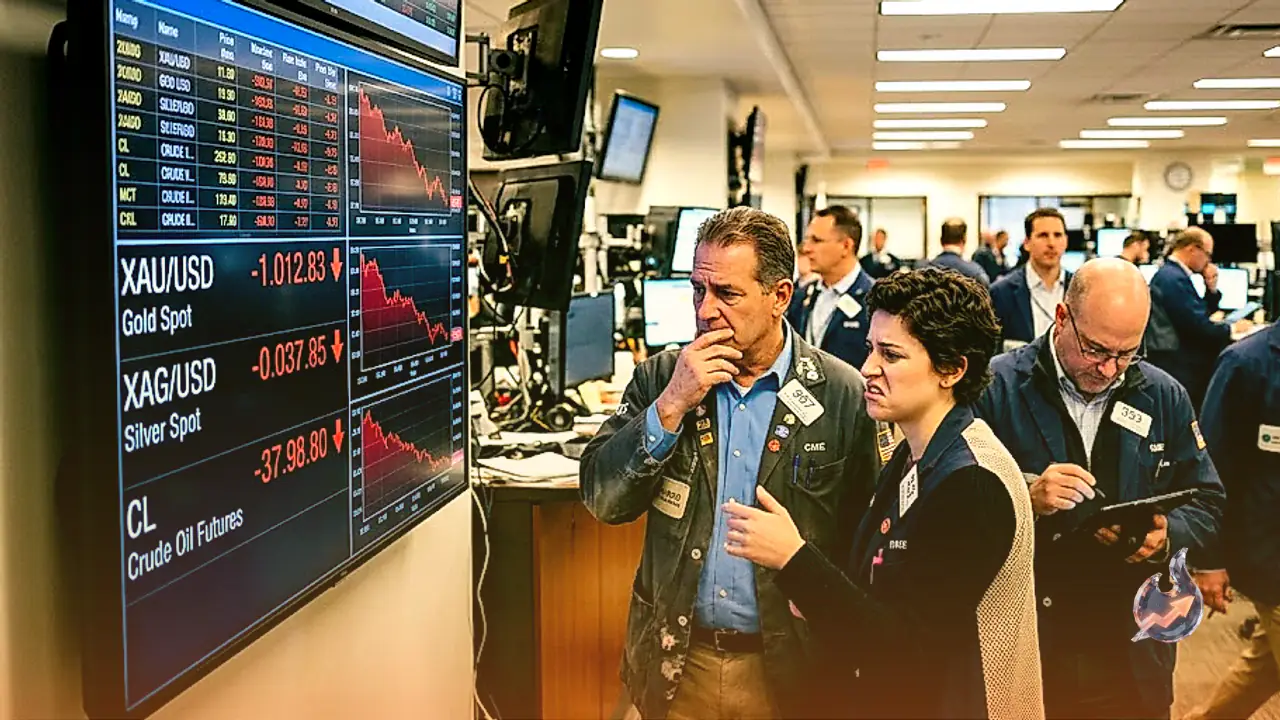

















Bullion opened the trading week on the defensive as a revitalized greenback trimmed recent recovery attempts across precious metals. Spot bullion retreated from the $4,383 mark and settled into trading near $4,350 per troy ounce. Simultaneously, the US Dollar Index (DXY), which tracks the currency against a basket of six major peers, climbed 0.2% to trade near 100.42, establishing an overhead ceiling for commodities priced in dollars.
Hawkish Federal Reserve Commentary Bolsters the Greenback
Investor conviction around tighter monetary settings deepened following assertive public statements from several regional Federal Reserve policymakers. Market confidence in the central bank revived in the wake of the latest rate decision, reinforced by perceived strategic alignment between Fed Chair Kevin Warsh and US President Donald Trump. Traders have consequently recalibrated expectations toward prolonged policy restraint rather than immediate loosening.
St. Louis Fed President Alberto Musalem offered a firm assessment of inflationary persistence, remarking that without further policy restraint, inflation is more likely to remain substantially above the 2% target in 18 months. Musalem explicitly maintained that additional rate hikes remain necessary. Chicago Fed President Austan Goolsbee reinforced that message, pointing out that continuous supply-side disruptions cannot simply be overlooked and warning that restoring price stability to the 2% objective might not be painless. In addition, Minneapolis Fed President Neel Kashkari underscored on Sunday that excessive price pressures are pervading the entire domestic economic landscape rather than remaining isolated within the energy sector.
Technical Indicators Point Toward Consolidation with Downward Bias
Technical chart patterns suggest bullion is entering a consolidation phase with a clear tilt toward the downside. The Relative Strength Index (RSI) is trending lower within bearish territory, while the overarching market structure continues to exhibit a sequence of lower peaks and lower troughs. Live market indicators show gold trading near $4,382, marking a 0.97% decline from its preceding close of $4,425, within an extensive 52-week trading corridor spanning $3,718 to $5,586.
Immediate downward support sits at the session low of $4,322. A decisive break below that threshold exposes the 100-day Simple Moving Average (SMA) located at $4,319, with the 50-day SMA situated nearby at $4,295. If sellers clear both dynamic boundaries, the broad psychological target around $4,000 becomes the primary demand zone. Conversely, if buyers reclaim the $4,400 handle on a daily closing basis, prices could establish a wider oscillation band between $4,400 and $4,500. Extended upward momentum would eventually test the 200-day SMA at $4,541.
Currency Crosses and Central Bank Policy Divergence
The dollar’s resilience produced notable ripple effects across global foreign exchange pairs. The Australian Dollar struggled to preserve upward momentum against the greenback, sliding back into the low 0.7100s after testing the 0.7140 resistance barrier ahead of Asian market activity. Broader strength in the US currency dominated trading flows.
Meanwhile, USD/JPY pulled back underneath 157.00 in early Asian dealing, reflecting selective Yen demand amid lingering intervention threats following Friday's rate check by Japanese authorities. The Bank of Japan (BoJ) formally elevated its short-term interest rate target from 1.00% to 1.25% in a 7-2 vote, advancing its planned normalization course in line with longstanding projections. However, deepening geopolitical concerns involving Russia and Ukraine alongside persistent friction across the Middle East kept safe-haven interest alive, checking the dollar’s pullback and containing downside losses on the pair.
Reserve Accumulation and Safe-Haven Appeal
Throughout financial history, gold has retained its premier role as an enduring store of purchasing power and universal medium of trade. Outside of commercial jewelry consumption, the metal functions primarily as a premier capital hedge during geopolitical upheavals and systemic economic stress. Sovereign central banks represent the largest institutional custodians of physical gold, deploying bullion purchases to strengthen national balance sheets and insulate domestic currencies against excessive depreciation.
According to official historical records from the World Gold Council, central banks accumulated an unprecedented 1,136 tonnes of bullion valued at approximately $70 billion throughout 2022, setting an all-time annual benchmark for sovereign acquisition. Prominent emerging market monetary authorities, including those of China, India, and Turkey, have sustained rapid reserve diversification strategies to bolster financial credibility. Because gold carries no counterparty or credit liability, it remains inherently insulated from sovereign default risks.
Broader Market Dynamics and Macro Catalysts
As trading progresses through the final stages of the third quarter, financial markets face an unusual backdrop characterized by sliding crude oil benchmarks alongside positive opening futures for European and American equities. Stress points remain heavily concentrated within sovereign debt markets, where bond yield fluctuations continue to dictate broader risk appetite.
Gold typically shares an inverse relationship with both sovereign debt yields and equities, suffering during equity rallies while attracting capital during aggressive equity liquidations. In the sessions ahead, market participants will track incoming ADP private employment statistics, purchasing managers index (PMI) readings, and subsequent speeches by Federal Reserve officials to gauge whether dollar momentum will continue to cap bullion prices.