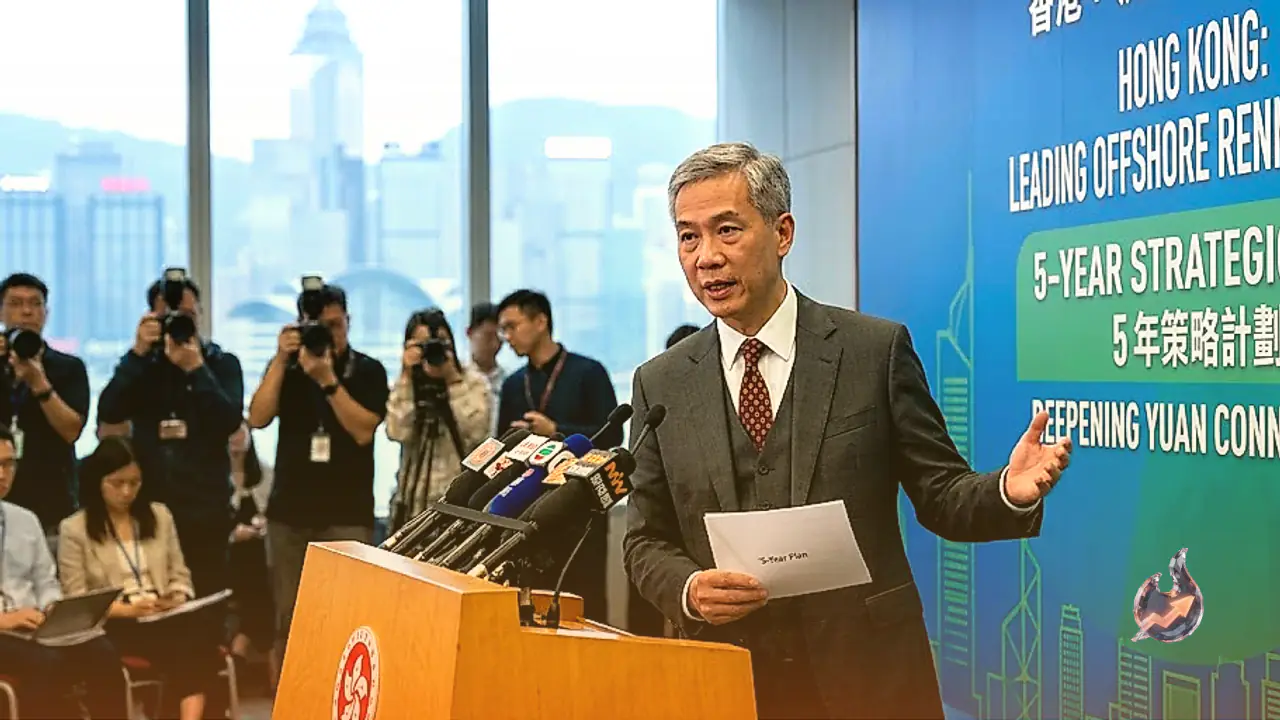






















Hong Kong has published its first-ever five-year roadmap for its financial sector, and one of its central goals is to lock in the city's status as the world's biggest offshore trading hub for the Chinese yuan, according to an analysis from Commerzbank's Charlie Lay. The blueprint doubles down on a strategy Beijing has followed for more than a decade: let the yuan travel further into global finance while keeping a firm grip on the mainland's capital account.
What the five-year plan actually changes
Under the plan, Hong Kong intends to widen the menu of yuan-denominated financial products available to investors, from CNY bonds and deposits to new hedging instruments that let holders manage their currency risk more precisely. Alongside this, the city plans to upgrade its Stock Connect, Bond Connect and Wealth Connect schemes, the trading links that let international money flow into mainland-listed shares, bonds and wealth-management products through Hong Kong accounts, and expand financing tied to commodities and technology sectors. Lay describes all of this as designed to deepen two-way capital flows between Hong Kong and the mainland, meaning money should be able to move in and out more easily in both directions, not just one.
A gateway, not an open door
Lay frames the measures as another step toward what analysts call yuan internationalisation, the process of getting the currency used more widely for trade, investment and reserves outside China, but crucially one that does not require Beijing to fully liberalise its capital account. That distinction matters. A fully open capital account would let money flow freely in and out of mainland China, something Beijing has resisted for fear of destabilising capital flight or currency volatility. Hong Kong's special status as a separate financial jurisdiction lets Beijing test and expand yuan usage abroad while keeping the mainland's own capital controls intact.
"Hong Kong plans to deepen its role as the leading offshore CNY and cross-border financial center under its first-ever five-year plan," Lay said.
A broader set of offshore yuan assets and hedging tools, combined with the expanded Connect programmes, should make it simpler for international investors to build up, hold and manage their yuan exposure without needing direct access to mainland markets. Seen from Beijing's side, Lay argues, Hong Kong functions as a controlled gateway, a channel through which the yuan can spread internationally while cross-border capital flows remain firmly supervised.
Limited impact today, a modest tailwind over time
For traders watching the USD/CNY exchange rate right now, Lay's assessment is that the near-term impact of the plan is limited, since this is a structural, multi-year initiative rather than a policy shock that moves the spot rate overnight. The longer-term implications, however, are seen as modestly positive for the yuan, since greater international usage of the currency, more products to trade it in, and more channels to hold it through, tend to support demand for CNY assets over time even if it does not show up in the exchange rate immediately.
Part of a longer pattern
This is not the first time Hong Kong has been used this way. Over the past decade, mainland China has progressively opened narrow, controlled channels for foreign capital, first through the original Stock Connect programme linking Hong Kong with mainland exchanges, then through Bond Connect for fixed income, and later Wealth Connect for retail wealth products in the Greater Bay Area. Each expansion added another pipe through which foreign money could flow into China and Chinese money could flow out, without dismantling the underlying capital controls. Folding a fresh set of CNY products and financing tools for commodities and technology into a formal five-year plan signals that Hong Kong's role in this strategy is being formalised and scaled up rather than left to ad hoc expansion.
Who this matters to
The practical audience for this shift is fairly specific: global fund managers who want mainland Chinese equity or bond exposure without setting up onshore accounts, multinational companies that invoice trade with China in yuan and want to hedge that exposure, and commodity or technology financing desks that would gain access to a wider set of yuan-based instruments. For everyday currency markets, though, Lay's own reading is that the announcement does not change the near-term calculus around USD/CNY.