























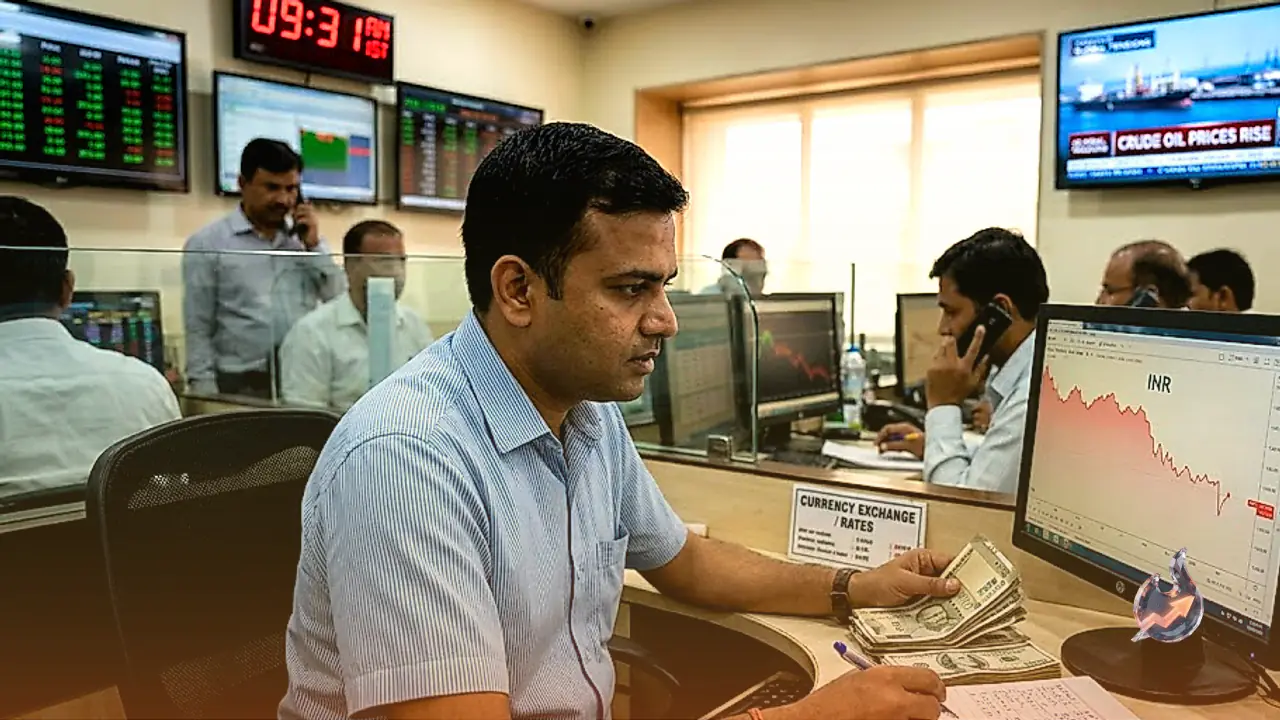

The Indian Rupee weakened against the US Dollar at the commencement of a data-heavy trading week for the United States. Downward pressure on the Indian currency mounted primarily due to escalating geopolitical tensions between Washington and Tehran, which have reignited fears of a prolonged disruption in global oil supplies.
In early trading sessions, the near-term MCX Crude Oil futures contract expiring on September 21 advanced 2.13% to trade near Rs. 8,160. Because India imports a vast majority of its energy requirements to power its domestic economy, rising petroleum costs immediately weigh on the local currency. Conversely, softer energy markets historically tend to benefit emerging import-dependent economies.
Market participants acknowledge that the revival of hostilities could severely disrupt petroleum shipments worldwide. Financial actors had largely not factored in aggressive military maneuvers, particularly after signals earlier in the month suggested that authorities would rely strictly on economic leverage to bring Tehran back to the negotiating table. Concurrently, Federal Reserve Chair Kevin Warsh remarked that while summer inflation readings surpassed projections, underlying economic trajectories had not shifted fundamentally, emphasizing that price stability remains the central bank's primary mandate.
Although Warsh refrained from detailing future monetary policy adjustments, traders subsequently escalated expectations regarding potential interest rate hikes. From a technical standpoint, the Relative Strength Index hovers around 45, remaining beneath the neutral 50 threshold to signify a current absence of sustained upward momentum rather than indicating oversold market dynamics.
Immediate overhead resistance for the USD/INR exchange rate rests near the 20-day exponential moving average around 95.53, clearing which is essential to alleviate ongoing bearish sentiment and clear a path toward recovery. Beyond that dynamic moving average, the 95.43 and psychological 96.00 thresholds serve as critical barriers, while downside support remains anchored near the August 5 swing low of 94.92.
The Rupee remains exceptionally sensitive to external macroeconomic variables. Crude oil import expenditures, the valuation of the US Dollar given its dominance in global invoicing, and foreign capital inflows represent primary determinants of its valuation. Active intervention by the Reserve Bank of India in currency markets alongside domestic interest rate adjustments further dictates exchange rate stability.
The Reserve Bank of India routinely intervenes in foreign exchange markets to smooth excessive volatility and facilitate predictable commercial exchanges. Additionally, the central bank utilizes benchmark interest rates to anchor consumer inflation around its targeted 4% threshold. Higher domestic yields typically reinforce the Rupee by attracting carry trade inflows, wherein participants borrow in low-yielding jurisdictions to invest in higher-yielding domestic assets.
Broader macroeconomic barometers influencing currency valuation encompass gross domestic product growth, current account balances, and cross-border investment inflows. Robust economic expansion attracts overseas capital, generating organic demand for the Rupee, while a narrowing trade deficit gradually improves currency fundamentals. Real interest rates adjusted for inflation also provide crucial support for local asset valuations.
Persistently elevated inflation relative to trading partners generally erodes purchasing power and weighs on the currency by increasing import bills, forcing participants to exchange more Rupees for foreign exchange. However, elevated price pressures frequently compel the central bank to tighten monetary policy, which can inadvertently support the currency by enhancing returns for international fixed-income investors.