






















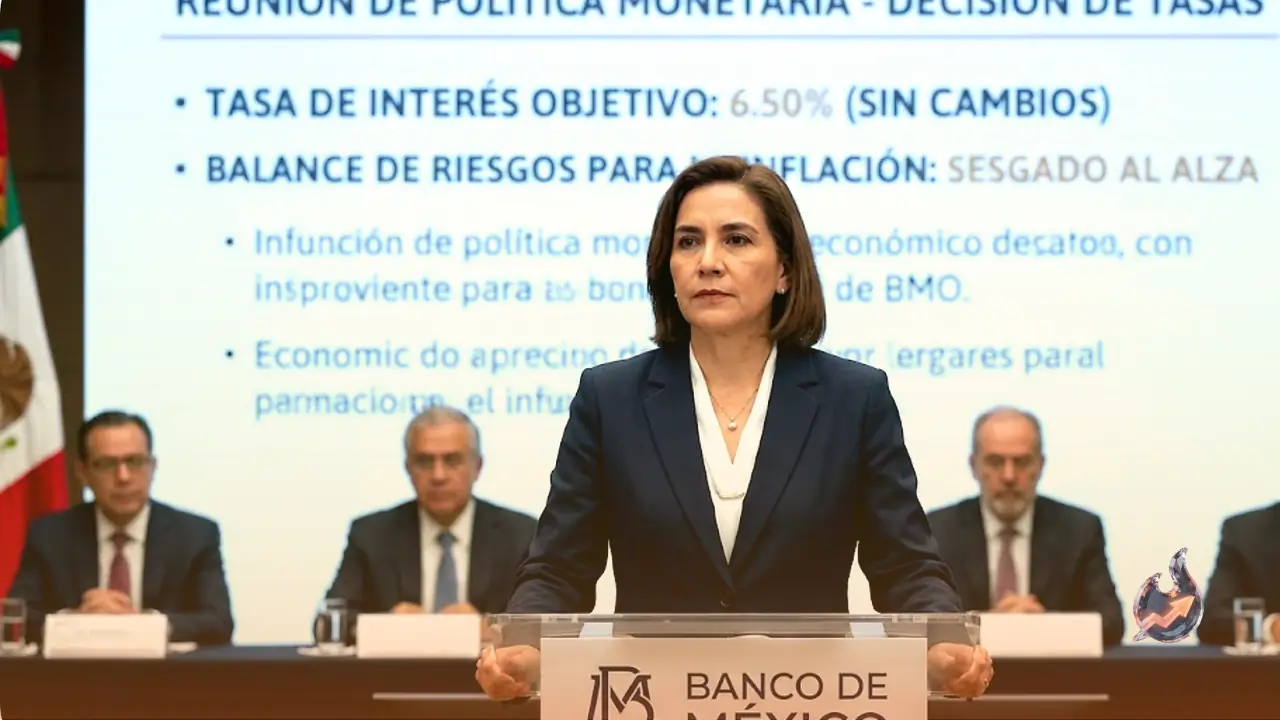

Mexico's central bank chose to leave its main interest rate exactly where it was, at 6.50%, a move that lined up perfectly with what markets had penciled in and one that was reached by a unanimous vote. Even so, policymakers made clear that the risks surrounding inflation still lean to the upside.
What the decision delivered
The Bank of Mexico, widely known as Banxico, held its main reference rate untouched at 6.50%. Every member of the committee backed the call, with no dissent. The fact that the rate did not move did not mean officials see the inflation threat as over. On the contrary, the bank signaled that the risk of prices climbing further remains the bigger concern.
Banxico's job and its inflation goal
As the country's central bank, Banxico is tasked with protecting the value of the Mexican Peso (MXN) and setting monetary policy. Its overriding aim is to keep inflation low and steady. The bank treats 3% as its target, the midpoint of a tolerance band that runs from 2% to 4%, and it works to keep price growth parked at or near that level.
How interest rates do the work
The bank's chief tool for guiding policy is the interest rate it sets. When inflation runs above target, Banxico tries to rein it in by lifting rates, which makes borrowing more expensive for households and businesses and slows the economy down. Higher rates are generally good news for the Mexican Peso (MXN), since they push yields up and make the country a more appealing destination for investors. Lower rates, by contrast, tend to weaken the currency. A key factor here is the rate gap with the US Dollar, in other words how Banxico is expected to move compared with the US Federal Reserve.
Why the Fed looms so large
Banxico meets eight times a year, and its policy is shaped heavily by what the US Federal Reserve does. That is why its decision-making committee usually gathers a week after the Fed, allowing it to react to and sometimes get ahead of the Fed's moves. After the Covid-19 pandemic, for instance, Banxico raised rates before the Fed did, hoping to limit the chance of a sharp drop in the Mexican Peso (MXN) and to head off capital outflows that could have destabilized the country.