























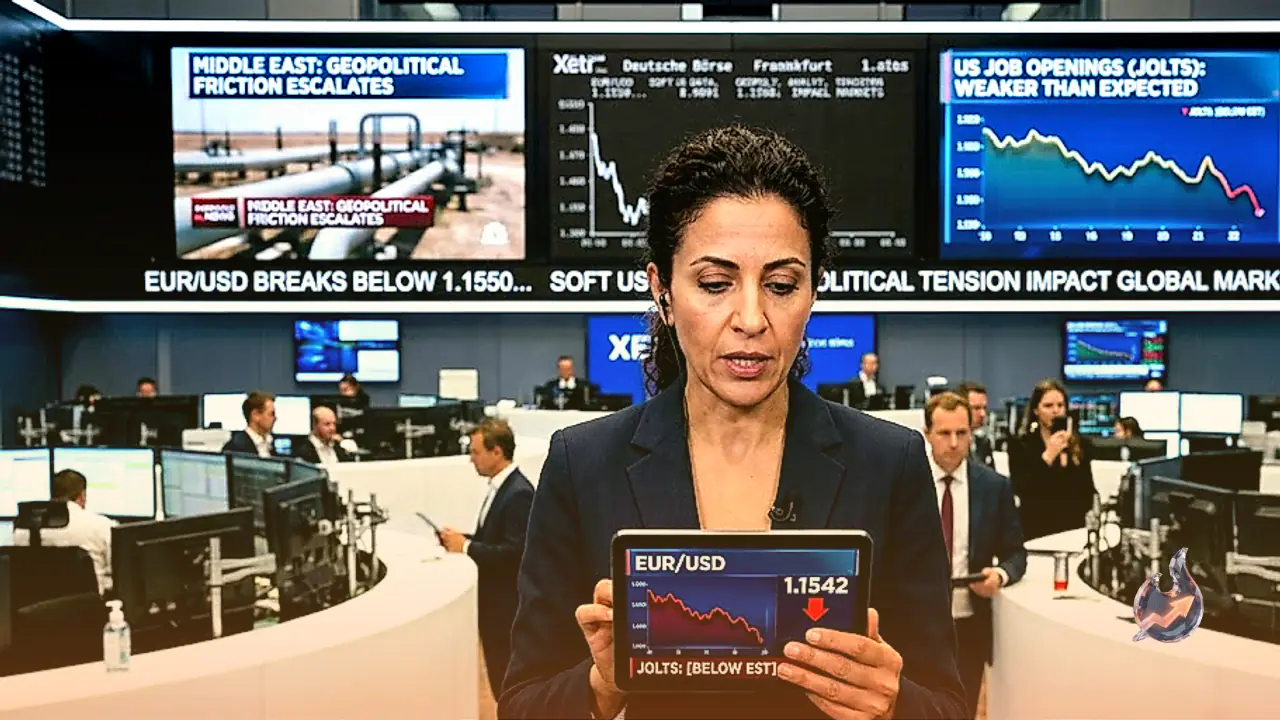

The EUR/USD major currency pair has come under renewed downside pressure during Wednesday’s Asian trading session, retreating to trade around the 1.1530 region. Intensifying geopolitical uncertainty in the Middle East has driven global investors toward safe-haven assets, boosting demand for the US Dollar and creating a persistent headwind for the Euro. Tensions escalated after Iranian authorities explicitly rejected the US claim regarding the uninhibited status of the Strait of Hormuz. An Iranian official clarified that ongoing diplomatic consultations with Oman are proceeding independently without US participation. The primary objective of these talks is to establish an intermediate maritime corridor designed to halt both the northern route currently controlled by Iran and the southern passage supported by the United States. This ongoing confrontation over critical shipping lanes has injected risk aversion into international financial markets, providing strong underlying support for the Greenback.
US Labor Market Deceleration and Upcoming Payroll Insights
Adding to the complex macroeconomic backdrop, fresh economic indicators from the United States highlight a cooling labor market. Data published by the US Bureau of Labor Statistics revealed that US JOLTS Job Openings dropped to 7.359 million in June. This reading marks a decline from the 7.537 million open positions recorded in May and missed market expectations, which had anticipated openings to center around 7.4 million. The deceleration in job openings suggests that tight monetary conditions are gradually weighing on employment demand across the American economy.
Market participants are now closely shifting their focus to the forthcoming US Nonfarm Payrolls and employment report scheduled for release on Friday. This comprehensive data release will offer critical insights into the underlying health of the US labor market and play a pivotal role in shaping the Federal Reserve's future interest rate trajectory. Should the Friday employment numbers print below consensus projections, it could sap bullish momentum from the US Dollar and offer EUR/USD a window for a potential near-term recovery.
EUR/USD Daily Chart Technical Analysis and Key Levels
A detailed inspection of the daily chart shows EUR/USD holding around the 1.15 pivot level, mirroring its previous close of 1.15. While spot price continues to trade above the 20-period simple moving average of the Bollinger Bands, upward progress remains constrained by a formidable resistance cluster overhead. The upper band of the 20-period Bollinger structure near 1.1550, combined with the 100-day simple moving average around 1.1570, creates a technical ceiling that keeps the broader market bias neutral to mildly capped on the upside.
Oscillators present a nuanced technical picture. The 14-day Relative Strength Index (RSI) stands at approximately 60, maintaining a posture in positive territory and indicating that buyers retain modest control over momentum. The 14-day Average Directional Index (ADX) sits at 25, pointing to an established trend in motion. Meanwhile, the Stochastic oscillator displays a fast line reading of 91 and a signal line at 87, signaling overbought conditions near current resistance levels. In terms of trend averages, the 20-day Exponential Moving Average (EMA) and 50-day EMA both sit at 1.15, while the 200-day EMA aligns at 1.16. A long-term death cross remains active as the 50-day SMA at 1.15 trades below the 200-day SMA at 1.16.
From a structural perspective, initial overhead resistance is anchored at the Bollinger upper band around 1.1550, followed by the 100-day SMA barrier at 1.1570. A decisive daily breakout above this cluster would be required to unlock further upside potential toward the 52-week high region of 1.20. Conversely, immediate downside protection is provided by the Bollinger 20-period middle band near 1.1440, with secondary support established at the lower band near 1.1330. A sustained breakdown below these support thresholds would compromise current consolidation and expose the currency pair to a deeper bearish corrective phase. The 14-day Average True Range (ATR) measures 0.01, establishing the daily volatility buffer for risk management strategies.
Eurozone Structural Overview and ECB Monetary Governance
The Euro serves as the official currency for the 20 European Union member nations comprising the Eurozone. It ranks as the second most heavily traded currency globally, following only the US Dollar. According to global foreign exchange statistics, the Euro was involved in approximately 31 percent of all foreign exchange transactions, generating an average daily turnover exceeding $2.2 trillion. Among currency pairs, EUR/USD commands the largest market share, representing an estimated 30 percent of total global transactions. It is followed by EUR/JPY at 4 percent, EUR/GBP at 3 percent, and EUR/AUD at 2 percent.
Monetary policy for the Eurozone is directed by the European Central Bank (ECB), located in Frankfurt, Germany. The ECB is tasked with setting benchmark interest rates and managing systemic liquidity across member states. The ECB’s primary mandate is maintaining price stability, defined as keeping consumer price inflation stable while fostering sustainable economic growth. Higher relative interest rates typically enhance the attractiveness of the Euro by incentivizing capital inflows into Eurozone financial assets. Policy decisions are formulated by the ECB Governing Council during eight scheduled meetings per year. The Council comprises the governors of the national central banks of all Eurozone nations alongside six executive board members, including ECB President Christine Lagarde.
Inflation Tracking, Macro Economic Data, and Trade Balance Dynamics
Inflation across the Eurozone is benchmarked using the Harmonized Index of Consumer Prices (HICP). When HICP readings accelerate above the ECB’s 2 percent target, the central bank faces pressure to tighten monetary policy by raising interest rates. High interest rate expectations relative to global peers strengthen the single currency by enhancing yield differentials for international institutional investors.
Beyond inflation metrics, high-frequency economic reports serve as barometers for currency strength. Key releases including Gross Domestic Product (GDP), Manufacturing and Services Purchasing Managers' Indexes (PMIs), employment figures, and consumer sentiment metrics significantly impact price discovery. The four largest Eurozone economies (Germany, France, Italy, and Spain) collectively account for 75 percent of total Eurozone GDP, making their individual national data releases crucial for forecasting the Euro's trajectory. Robust economic activity encourages investment inflows and supports monetary tightening, whereas stagnant growth data exerts downward pressure on the currency. Additionally, the Trade Balance indicator, measuring net earnings from exports against import expenditures, plays a vital role. Positive net trade flows generate structural demand for the Euro, reinforcing its exchange value.
Broader FX Market Context and Central Bank Watch
Developments across other foreign exchange markets show the British Pound (GBP) trading under modest selling pressure, falling 0.1 percent to trade near 1.3420 against the US Dollar during European market hours. Concurrently, market participants are keeping a close eye on the Reserve Bank of India (RBI), which is scheduled to announce its bi-monthly monetary policy decision. The RBI rate decision comes at a time of elevated global uncertainty driven by ongoing Middle East conflicts and fluctuating energy prices, highlighting the interconnected challenges facing global central banks.