























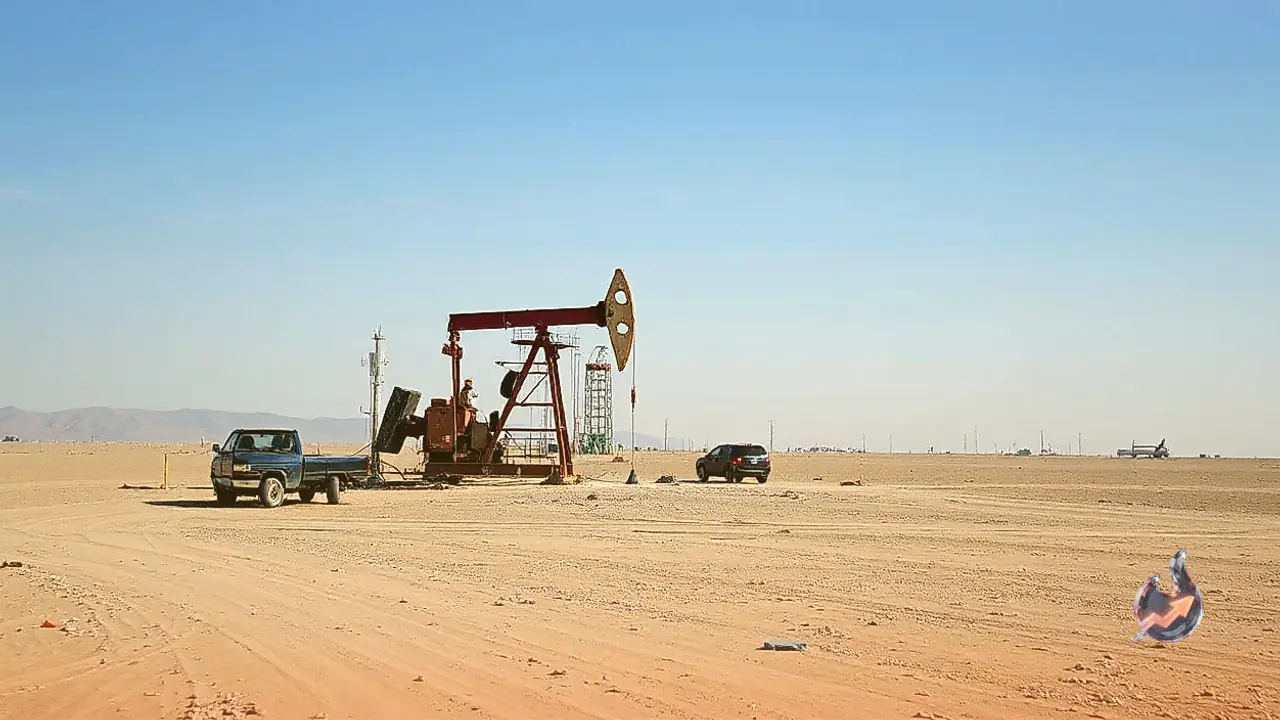

Crude oil benchmarks retreated during early week trading as immediate anxieties over renewed military confrontations between the United States and Iran began to recede. On the New York Mercantile Exchange (NYMEX), West Texas Intermediate (WTI) futures dropped 2.25 percent to trade near $99.80 per barrel during European hours. The pullback extended a correction that commenced after the asset failed to sustain upward momentum past Friday's five-month peak of $104.03. Current market figures show crude trading at $100.77, marking a 3.22 percent decline from its prior close of $104.12, against a 52-week trading span of $54.98 to $119.48.
Diplomatic Initiatives and Potential Reopening of Hormuz Corridor
The retreat in petroleum prices reflects an easing of geopolitical risk premiums across energy markets. Washington conveyed clear signals that diplomatic engagement with Tehran takes precedence over an immediate resumption of armed operations. Over the weekend, US Secretary of State Marco Rubio indicated that the administration has not arrived at any determination to restart air or missile strikes against Tehran. Rubio underscored that President Donald Trump favors pursuing a diplomatic resolution to the standoff, although he cautioned that the US military preserves comprehensive operational capabilities to execute any directive the president might authorize.
Concurrently, dialogue mediated through Qatari officials generated constructive market sentiment. Statements from Iranian officials indicated that active negotiations are underway regarding a formal arrangement to reopen the Strait of Hormuz within two days, contingent upon American cooperation. Because this maritime passage serves as a vital arterial route for global seaborne crude shipments, the prospect of its reopening alleviated acute supply bottleneck concerns. Financial participants also discounted allegations publicized by political commentator Tucker Carlson, who claimed Israeli Prime Minister Benjamin Netanyahu was actively urging President Trump to authorize a tactical nuclear strike against Iran within days.
Technical Indicators and Moving Average Thresholds
From a technical analysis perspective, WTI crude is currently oscillating around the pivotal psychological boundary of $100 per barrel. Price action is pressing just below the 9-day exponential moving average (EMA) situated at $100.09, establishing immediate overhead resistance and tempering the aggressive momentum that propelled oil out of the mid-$80 zone. Trading below this short-term barrier indicates that short-term buyers have lost leverage, even though the 14-day Relative Strength Index (RSI) stands in positive territory at 55 to 58, signifying latent momentum that has yet to generate an outright upside breakout.
Broader technical metrics outline a nuanced structure: the Moving Average Convergence Divergence (MACD) prints at 2.51 above its signal line of 2.32, creating a positive histogram reading of 0.19. The 20-day EMA sits at $99.08, the 50-day EMA rests at $94.99, and the 200-day EMA stands at $84.52. On simple moving average metrics, the 50-day SMA trades at $94.90 while the 200-day SMA is positioned at $86.55, sustaining a long-term golden cross confirmation. Bollinger Bands on a 20-period parameter span from $88.21 to $107.80, centered around a $98.00 midpoint. The Average Directional Index (ADX) registered at 33 reflects a strong prevailing trend, while the Stochastic oscillator displays a fast line at 43 and a signal line at 56. Key intraday levels highlight a pivot mark at $101.22, with overhead resistance levels at R1 $102.30 and R2 $103.82, and defensive support tiers at S1 $99.70 and S2 $98.62. Friday's peak of $104.03 serves as primary resistance, whereas the October 20 trough at $95.05 offers substantial downside cushion.
Fundamental Mechanics: WTI Crude, Pricing Drivers, and Inventory Dynamics
West Texas Intermediate represents one of the premier international crude benchmarks alongside Brent and Dubai blends. Sourced within the United States, WTI is characterized as 'light' due to its low relative density and 'sweet' because of its minimal sulfur content. These chemical properties make it particularly prized by refiners, as it yields high proportions of gasoline and diesel with lower processing overhead. Delivery and settlement occur primarily through the Cushing, Oklahoma storage infrastructure, widely recognized as the pipeline crossroads of the world.
Petroleum valuations respond directly to the balance of international supply and consumption. Sustained economic expansion drives industrial and transport fuel usage, supporting prices, whereas sluggish macroeconomic conditions curb procurement. Geopolitical turmoil, armed hostilities, and international trade sanctions inject volatility by restricting vessel flows or extraction capacity. Additionally, foreign exchange movements play a decisive role; because crude contracts are denominated in US Dollars, a weakening greenback reduces import costs for foreign currency holders, stimulating buying demand, while a strengthening dollar exerts downward pressure.
Weekly inventory reports from the American Petroleum Institute (API) and the US Energy Information Administration (EIA) serve as fundamental barometers for energy desks. Drawdowns in stockpiles indicate consumption outstripping supply, which typically supports upward price momentum, whereas unexpected builds point to surplus volume. The API publishes its survey results on Tuesday afternoons, followed by the EIA statistical report on Wednesday mornings. Historical correlations show the two reports align within a 1 percent variance approximately 75 percent of the time, with institutional desks placing greater weight on the EIA release due to its official governmental standing.
OPEC Production Quotas and Cross-Asset Market Repercussions
The Organization of the Petroleum Exporting Countries comprises 12 petroleum-exporting nations that coordinate output volumes during biannual conferences. Adjustments to individual member quotas exert direct influence over global crude balances; quota reductions contract physical availability to prop up prices, whereas quota expansions have the reciprocal effect. The broader OPEC+ framework incorporates ten non-member allies, chief among them the Russian Federation, giving the collective significant sway over global export volumes.
Shifts in Middle Eastern geopolitical sentiment reverberated across foreign exchange, commodities, and digital asset markets. The pullback in crude and easing tensions weighed modestly on the safe-haven US Dollar. This permitted the Australian Dollar (AUD/USD) to rebound from its Asian session dip, though spot prices held below last week's monthly high as investors awaited the Reserve Bank of Australia's rate policy announcement. Meanwhile, USD/JPY advanced toward the 158.00 threshold, rebounding from sub-157.00 levels logged after the Bank of Japan meeting, ignoring verbal warnings from Japanese Finance Minister Satsuki Katayama. Spot gold recovered from sub-$3,900 marks, breaking a two-session slide, while digital assets logged stabilization, with Bitcoin trading above $78,462 and Ethereum recovering over $2,295 after four consecutive weeks of October declines.