























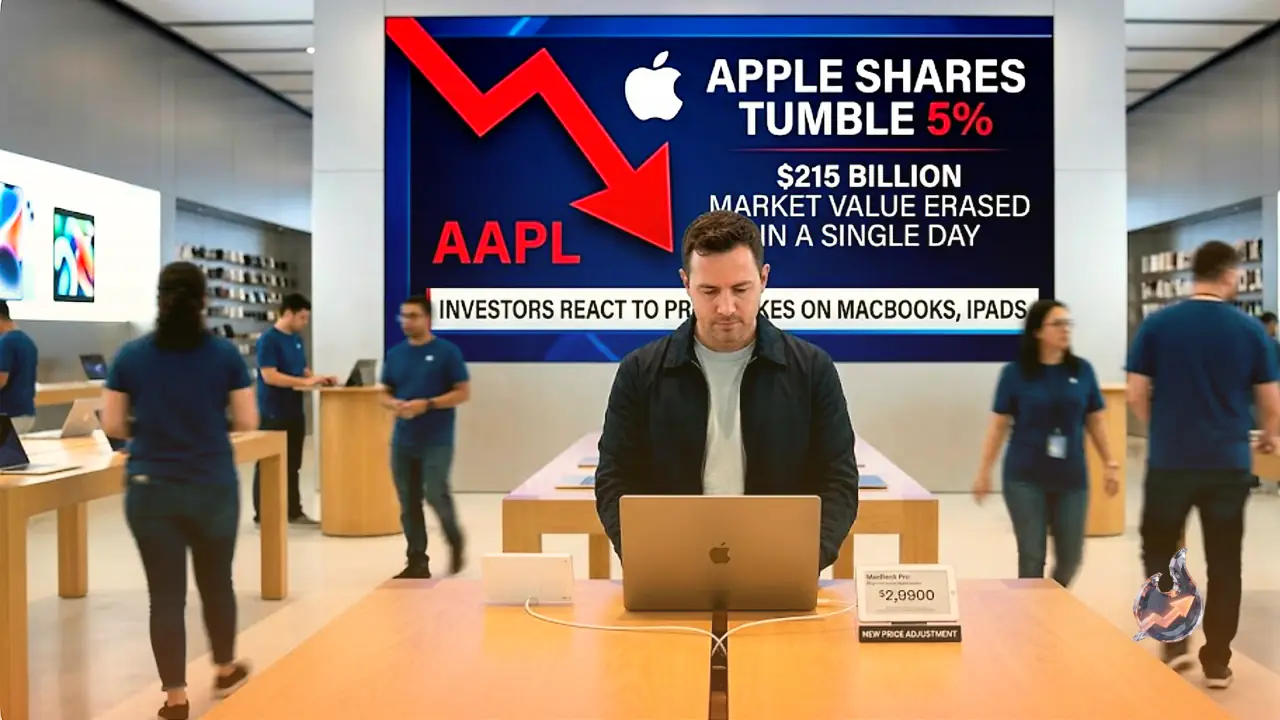

Apple's stock took a heavy hit on Thursday, sliding as much as 5% and wiping more than $215 billion off the company's market value in a single trading session. The sell-off arrived just after the iPhone maker confirmed it is raising prices across a wide range of products, blaming the rising cost of building them.
The drop did not come out of nowhere. Last week, CEO Tim Cook said that "price increases are unavoidable," pointing to the enormous buildout of AI infrastructure that is draining the global supply of memory and storage chips.
Which products are getting more expensive
Apple confirmed higher prices on MacBooks, iPads and several other devices. The new pricing breaks down like this:
- MacBook Neo entry model: $599 rising to $699
- MacBook Air 512GB: $1099 rising to $1299
- MacBook Pro 1T: $1699 rising to $1999
- iPad Air 128GB: $599 rising to $749
- iPad Pro Wifi 256GB: $999 rising to $1199
Why Apple says it had no choice
"The consumer electronics industry is facing an unprecedented challenge," the company said in a statement. "The rapid expansion of AI data centers has created an extraordinary surge in demand for memory and storage. We have never seen a component price increase this much, this quickly." Apple added that it has "reached a point where we need to begin raising prices on a number of products," leaving the door open to further increases later on. "We know this is not welcome news, and we are working tirelessly to find solutions," the company said.
The chip squeeze behind the hikes
Memory and storage prices have quadrupled over the past three quarters, pushing up the cost for companies like Apple to manufacture their products. On the other side of the trade, chip makers such as Micron (MU) and AMD have benefited from the shortage and the surge in demand. Apple still lags in its push to build its own self-sufficient chips, and it continues to rely on the same chip technology that has run short this year.
AI doubts add to the pressure
Lingering worries about Apple's wider artificial intelligence strategy are feeding the bearish mood around the stock. Following the annual Worldwide Developers Conference earlier this month, investors remain wary about the absence of a firm, committed consumer launch date for the much-anticipated Siri upgrade. The growing sense that key agentic features may lean heavily on third-party models under the hood has further punctured the idea that Apple will be an independent, high-margin AI powerhouse anytime soon. The shift also lands at a delicate moment for the company's leadership, with the market bracing for a rare, generational CEO transition set for September.