























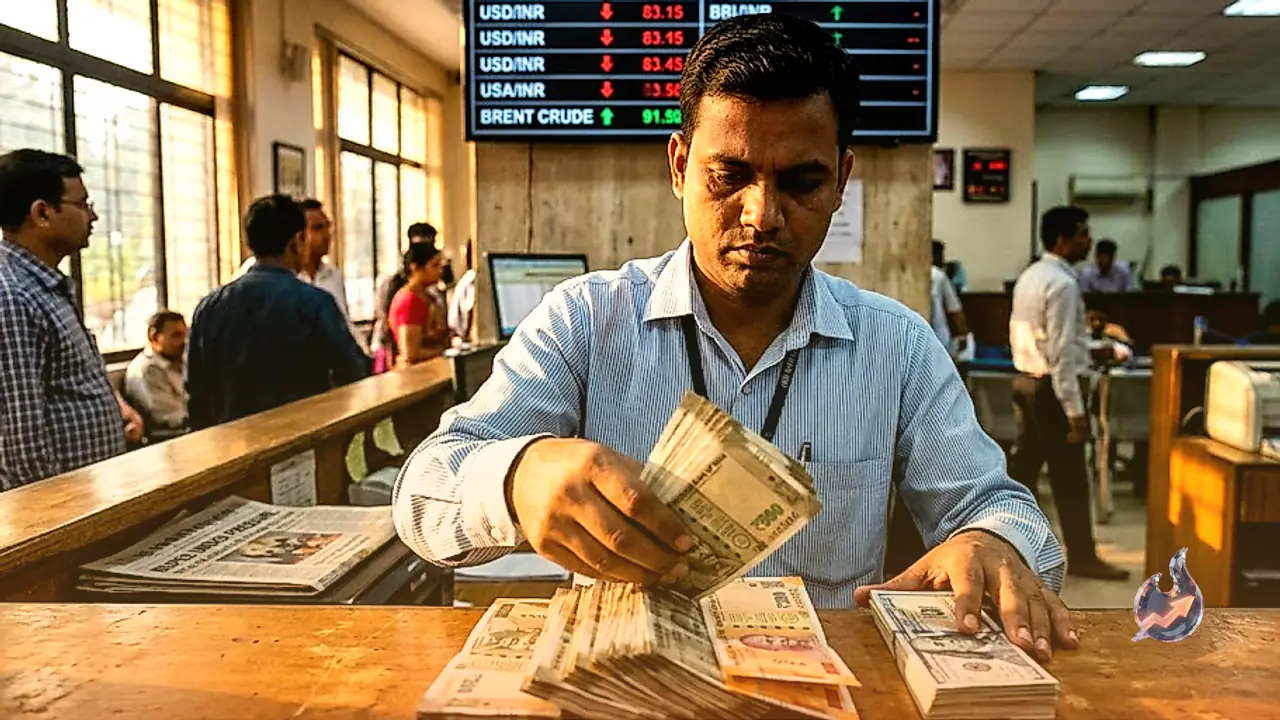

The Indian currency market is currently witnessing an era of intense, unyielding turbulence as the Rupee desperately struggles to maintain its structural integrity against a relentlessly powerful US Dollar. In a calculated and desperate bid to prevent the domestic currency from collapsing into a catastrophic freefall toward fresh, unprecedented record lows, the Reserve Bank of India (RBI) has proactively and aggressively stepped into the foreign exchange arena. A close examination of live market data reveals the grim reality: the USD/INR currency pair is currently trading at an elevated 96.53, which marks a notable 0.20 percent absolute increase from its previous closing level of 96.34. Earlier in the trading session, the pair had edged slightly downward, hovering near the 96.47 level, but it stubbornly remains precariously close to the ominous two-month high of 96.75 that was emphatically established during Monday's trading hours. This persistent, grinding upward pressure on the dollar has ultimately forced the central bank's heavy hand. Acting as the ultimate lender and buyer of last resort, the RBI is systematically stepping in to flood the market with dollar liquidity while simultaneously absorbing excess rupee supply. This aggressive intervention is being executed with precision across both the traditional spot markets and the complex non-deliverable forwards (NDFs) markets. The fundamental objective behind these massive defensive maneuvers is to introduce a layer of artificial stability, crush excessive speculative volatility, and place a hard floor under the South Asian unit. However, seasoned market participants and institutional traders are acutely aware that these central bank interventions, while necessary, are merely a temporary, expensive bandage. As the currency continues its dangerous, prolonged drift back towards historically weak levels, the broader, more powerful macroeconomic forces driving this brutal depreciation, namely a massive, global commodity supply shock and tightening liquidity, remain completely and dangerously unresolved.
The Red Sea Conflict and the Crude Oil Nightmare
The most immediate, severe, and systemic threat to the Rupee's long-term stability originates from the boiling geopolitical cauldron in the Middle East, a crisis that has successfully sent global energy markets into a state of absolute, unmitigated frenzy. The root cause of the current panic directly traces back to the highly perilous and strategically vital waters of the Red Sea. In a dramatic, violent escalation of the ongoing proxy conflicts intrinsically linked to the broader, decades-long United States-Iran standoff, Yemen’s heavily armed, Iran-aligned Houthi militia has brazenly launched aggressive, highly sophisticated missile and drone strikes against two major Saudi Arabian oil tankers. One of these massively targeted vessels has been explicitly identified by international maritime monitors as the Encelia. These coordinated military attacks are not isolated incidents but rather part of a formally declared, rigorously enforced maritime blockade on the Saudi kingdom. This blockade is causing massive, cascading disruptions to one of the global economy's most critical and irreplaceable shipping lanes. The financial fallout has been immediate, explosive, and devastating for importing nations. In the commodities futures market, the MCX Crude Oil contract, which is set to expire on August 19, witnessed a fierce, relentless rally, surging by a massive 1.75 percent in early trade to reach a staggering price of around Rs. 8,570. This represents the absolute highest price level recorded in well over six weeks. For a rapidly developing economy like India, which is fundamentally structured to import the vast, overwhelming majority of its crude oil simply to meet its insatiable, ever-growing domestic energy demands, this sudden spike represents an absolute worst-case scenario. Exorbitantly high oil prices instantly and violently bloat the national import bill. This structural deficit demands an astronomical, continuous outflow of US dollars to settle international invoices, applying a crushing, inescapable downward pressure on the domestic currency. Economic history dictates a simple, brutal law: whenever crude oil prices experience a sustained, violent spike, the currencies of heavy import-dependent economies will invariably and predictably underperform on the global macroeconomic stage.
Foreign Capital Flight: Why Global Institutional Investors Are Fleeing
Compounding the Rupee's already severe fundamental woes is a massive, highly coordinated exodus of foreign capital from the Indian domestic financial markets. The rapidly soaring cost of global energy, combined with the looming, terrifying specter of runaway inflation, has severely and fundamentally spooked international investors. This fear has triggered a widespread, systemic risk-off sentiment across global trading desks. Foreign Institutional Investors (FIIs), the massive institutional behemoths who play an absolutely crucial role in maintaining India's vital dollar reserves and providing essential market liquidity, have aggressively and unequivocally shifted their vast portfolios to the sell side of the ledger. On Wednesday alone, these institutional giants ruthlessly dumped Indian equities, relentlessly offloading their substantial stakes worth a massive, market-moving Rs. 819.20 crore in a single trading session. This severe single-day selloff, however, is not a mere isolated event or a temporary blip, but rather a core component of a sustained, deeply concerning, and highly destructive long-term trend. Throughout the entirety of the current month, these powerful foreign investors have maintained an overwhelming, unbroken net-seller status, systematically withdrawing a staggering, liquidity-draining total of Rs. 4,836.95 crore from the Indian stock market ecosystem. The underlying economic dynamic driving this massive capital flight is remarkably straightforward yet utterly devastating. When global systemic risks become elevated, especially those risks inherently tied to unpredictable energy supply shocks, geopolitical warfare, and supply chain destruction, foreign funds traditionally and predictably flee the perceived higher risks of emerging markets. They ruthlessly liquidate their local, rupee-denominated equity holdings, convert their vast capital back into the ultimate safe-haven asset of US Dollars, and rapidly exit the domestic financial system. This relentless, panicky demand for dollars, directly coupled with a massive, unprecedented oversupply of aggressively dumped Rupees on the open market, creates a brutal, self-sustaining vicious cycle of severe currency depreciation that even the most well-funded central bank struggles to organically contain.
Technical Outlook: Moving Averages and Algorithmic Momentum Indicators
Transitioning from geopolitical fundamentals to rigorous technical analysis, the projected trajectory of the USD/INR currency pair points firmly and unequivocally toward continued, unabated dollar dominance. A deep dive into the live algorithmic charting data paints a robustly bullish, undeniable picture for the American greenback. The currency pair is currently riding a powerful, well-established, long-term macroeconomic uptrend. This institutional upward bias is emphatically and mathematically confirmed by a classic golden cross formation actively present on the daily trading charts. This highly sought-after bullish signal occurs precisely when the faster 50-day Exponential Moving Average (EMA), which currently sits powerfully at 95.37, violently crosses above the slower, long-term 200-day EMA, currently positioned at 92.46. Quantitative momentum indicators further validate and reinforce this aggressive upward thrust. The 14-day Relative Strength Index (RSI), an essential, widely followed gauge of underlying market momentum and trader psychology, is presently hovering at a very healthy, constructive level of 61. It remains firmly and securely entrenched within positive, bullish territory, but it has notably and crucially not yet breached the critical, dangerous overbought threshold of 70. This specific RSI positioning strongly suggests that the current dollar rally possesses substantial, untapped fuel to run significantly higher before facing any natural algorithmic exhaustion. Additionally, the Moving Average Convergence Divergence (MACD) indicator currently sits at an elevated 0.37 against a trailing signal line of 0.29, aggressively printing a bullish, expanding histogram of 0.09. For professional traders and institutional algorithms monitoring critical intraday price levels, immediate structural downside support is firmly and immovably established precisely at the 20-period EMA of 95.90. This level acts as a vital floor, actively reinforcing the broader constructive architecture of the chart as long as this critical barrier holds against selling pressure. A significantly deeper, historical secondary support zone is structurally located all the way down around the 94.22 region. Conversely, any attempted upward, bullish breakout will inevitably face severe, intense selling friction at the near-term mathematical resistance ceiling of 96.81, before eventually aiming for the ultimate, psychological all-time high boundary permanently parked near the ominous 97.10 mark.
The Macroeconomic Engine: Inflation, Interest Rates, and Trade Balances
Beneath the surface-level price action, the Indian Rupee constantly operates as one of the world's most hyper-sensitive, volatile currencies, reacting violently to a highly complex, interconnected web of global macroeconomic forces. Its daily valuation is not arbitrary, but rather a delicate, high-stakes balancing act strictly dictated by the unpredictable whims of international crude prices, the omnipresent, suffocating strength of the US Dollar, and the volatile, unpredictable ebb and flow of foreign direct and indirect investments. The Reserve Bank of India employs multiple, highly sophisticated levers far beyond mere direct market intervention to actively manage this delicate, fragile equilibrium. The single most powerful, blunt-force tool remaining in its monetary arsenal is the aggressive manipulation of domestic interest rates, a strategy primarily aimed at fiercely defending its rigid, legally mandated 4 percent inflation target. Structural inflation is a deadly, insidious poison for any fiat currency; it silently but rapidly erodes domestic purchasing power and simultaneously makes a nation's vital exports prohibitively expensive and uncompetitive on the global macroeconomic stage. If India's domestic inflation rate begins to consistently outpace that of its international trading peers, it inherently and unavoidably devalues the Rupee through fundamental, structural oversupply in the forex markets. To fiercely combat this devastating outcome, the central bank aggressively hikes base interest rates. While elevated borrowing costs inevitably cool down domestic economic growth, they simultaneously and magically transform the Rupee into a highly attractive, lucrative asset for massive international speculative funds engaging in the highly profitable carry trade. In this complex institutional strategy, global investors deliberately borrow massive amounts of cheap capital from developed countries suffering from ultra-low interest rates, and aggressively park those funds in high-yielding Indian financial assets to effortlessly pocket the lucrative, risk-free difference. Therefore, maintaining higher real interest rates, defined strictly as the nominal interest rate minus the prevailing inflation rate, acts as a massive, irresistible magnet for foreign capital, directly and forcefully strengthening the domestic currency. Similarly, fostering robust, world-leading domestic economic growth and artificially narrowing the gaping national trade deficit serve as the absolute foundational macroeconomic pillars that can permanently reverse a devastating depreciation cycle by naturally and organically increasing massive, long-term global demand for the Indian Rupee.
Global Market Pulse: European Currencies, Safe-Haven Gold, and the Digital Crypto Rebound
While the Indian Rupee fights a grueling, bloody defensive war on its home turf, massive, unprecedented tectonic shifts are simultaneously occurring across the broader, highly interconnected global financial landscape. In the realm of major forex pairs, the battered British Pound (GBP/USD) managed to orchestrate a surprisingly modest, resilient rebound, slowly climbing to near the 1.3385 level during the typically quiet Asian trading session on Thursday. However, its ultimate upside trajectory is currently being severely crippled and capped by unexpectedly cooler-than-anticipated inflation data originating from the United Kingdom, perfectly combined with the overarching, suffocating dread of further Middle Eastern military escalation. Institutional traders are now collectively holding their breath, anxiously waiting for the upcoming, highly critical UK Retail Sales report, scheduled for global release later on Friday, to ultimately dictate the next major, portfolio-defining directional move. Simultaneously, the European Euro (EUR/USD) successfully extended its victorious, grinding upward march for a remarkable second consecutive trading day, trading confidently and securely around the 1.1410 psychological level. The single currency is currently building a formidable, impenetrable fortress of technical support as algorithmic traders aggressively and preemptively position their vast portfolios ahead of the European Central Bank's looming, highly anticipated, and potentially market-altering interest rate decision.
In the highly volatile commodities sector, traditional safe-haven assets are currently experiencing a massive, unprecedented renaissance of global demand. Physical Gold is stubbornly and aggressively consolidating its massive gains above the monstrous, psychological $4,100 threshold, flatly and defiantly refusing to surrender its immense, accumulated gains from a massive, record-breaking two-week high achieved previously. The rapidly escalating, highly dangerous proxy warfare between the United States and Iran is actively acting as pure, unadulterated rocket fuel for precious metals, hyper-charging global inflation fears and permanently solidifying institutional bets that the US Federal Reserve will eventually be violently forced into aggressive, economy-crushing rate hikes.
Meanwhile, operating entirely in its own parallel universe, the digital asset ecosystem is aggressively flashing early, undeniable signs of a spectacular, face-melting revival. According to a highly circulated report by Matt Hougan, the deeply respected Chief Investment Officer at Bitwise, the next colossal, wealth-generating cryptocurrency bull market will not be driven by retail speculation, but rather ignited by the inevitable, structural fusion of cutting-edge blockchain technology with the massive, multi-trillion-dollar traditional financial infrastructure. Hougan confidently and publicly argues that the digital asset market has already hit absolute, impenetrable rock bottom, pointing directly to Bitcoin's (BTC) remarkable, defiant resilience in the face of macro headwinds. While traditional, highly valued tech stocks recently floundered and crashed, evidenced vividly by the NASDAQ 100 index plunging a painful 6 percent, Bitcoin has completely decoupled, surging a massive, market-beating 9 percent since July 1. In the highly speculative altcoin arena, legacy tokens Ripple (XRP) and Stellar (XLM) are currently navigating incredibly treacherous, algorithmically complex technical waters. XRP is currently engaged in a brutal, hand-to-hand battle right at its critical 50-day EMA resistance line, while XLM remains frustratingly trapped in a suffocating, low-volume consolidation pattern sitting just inches above the critical $0.187 structural support floor. Global derivatives data reflects a heavily mixed, deeply conflicted market sentiment with a slight, undeniable bearish tilt, violently forcing retail and institutional traders alike to maintain extreme, hyper-vigilant caution as they anxiously await the next explosive, wealth-destroying or wealth-creating directional breakout.