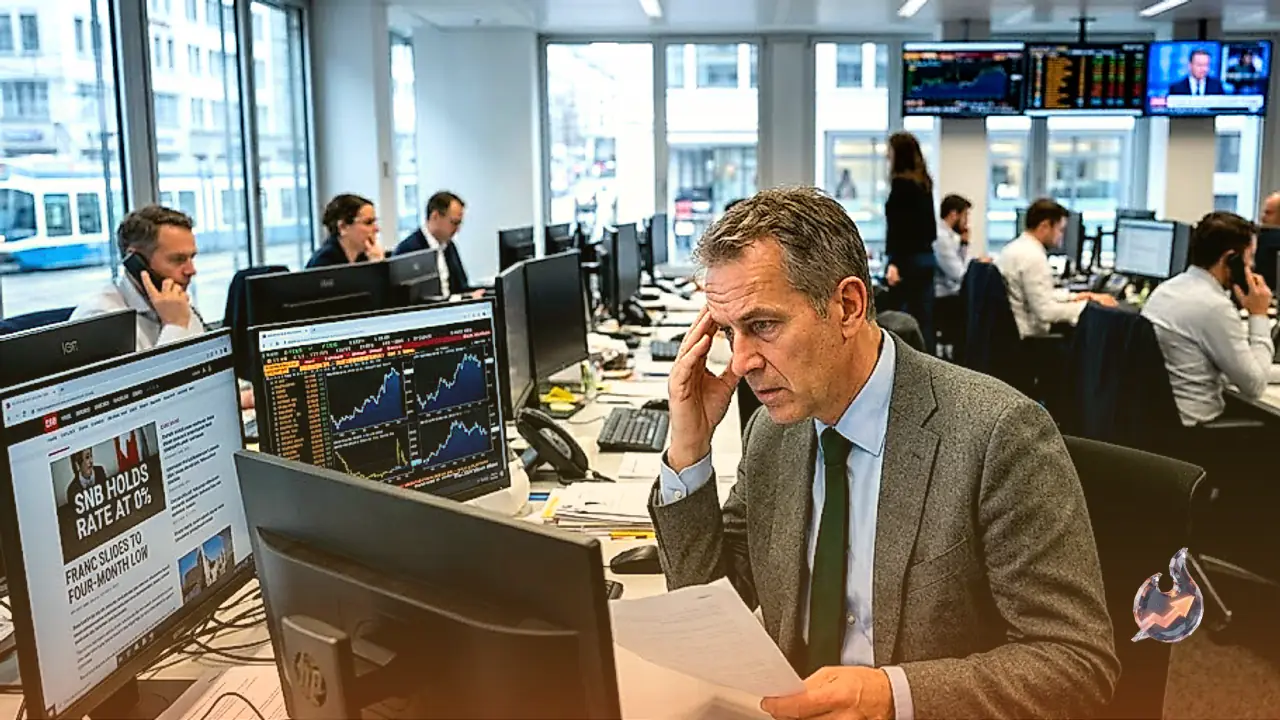

























Economic activity in Switzerland expanded at an exceptionally robust pace during the second quarter, buoyed by standout momentum across core manufacturing segments. According to Swiss National Bank official Tschudin, an unusually strong performance within the chemicals and pharmaceutical industry served as the primary catalyst behind the economic surge. Furthermore, currency dynamics provided a meaningful tailwind, as the depreciation of the Swiss Franc generated a supportive effect for exporters and broader commercial operations. This positive trajectory of broad-based expansion successfully carried over into the third quarter, sustaining firm domestic footing.
Swiss National Bank Rate Decision and Inflation Trajectory
In terms of monetary policy, the Swiss National Bank chose to hold its benchmark policy rate steady at 0%, fully matching market consensus. The central bank outlined key parameters within its monetary policy assessment, clarifying that commercial banks' sight deposits parked at the institution will receive remuneration at the policy rate up to a predefined ceiling. On the price stability front, the central bank slightly adjusted its long-range projections. Inflation expectations for 2026 have been revised modestly higher to 0.7%, moving up from the prior estimate of 0.6%.
Global Headwinds and Exchange Rate Pressures
Looking ahead toward future quarters, Tschudin outlined expectations for moderate GDP growth, indicating that supportive economic stimuli are most likely to originate from international markets rather than domestic sources alone. Nevertheless, policy authorities pointed out notable headwinds clouding the medium-term horizon. The primary vulnerability confronting Switzerland's macroeconomic stability arises from broader global headwinds, particularly tensions across the Middle East. Furthermore, shifts in the international trade policy environment combined with unpredictable exchange rate fluctuations continue to inject uncertainty into corporate planning. On financial flows, the central bank noted that it is not observing any large increase in Swiss Franc carry trade volumes.
FX Markets Navigate Australian Employment Data
Foreign exchange trading throughout Thursday's Asian session reflected widespread caution across major currency pairs. The AUD/USD pair retreated toward the 0.7000 threshold following the publication of Australia's official jobs report for August. The labor survey revealed that the national Unemployment Rate ticked higher to 4.6% against the consensus forecast of 4.5%. Conversely, the Employment Change component outperformed expectations by delivering a net gain of 39.5K positions. Market participants broadly restrained their exposures as nervousness lingered ahead of scheduled diplomatic talks between high-ranking global leaders.
Bank of Japan Rate Hike and Currency Dynamics
The Japanese Yen showed resilient behavior against the greenback, causing the USD/JPY pair to pull back from three-week highs and consolidate near the 158.00 mark during Asian trading hours. Rising Japanese government bond yields offered support to the domestic currency, underscored by lingering concerns over potential official market intervention. Simultaneously, the US Dollar defended overnight gains hovering near a two-month peak, underpinned by expectations of hawkish Federal Reserve action and persistently elevated US Treasury yields. In a widely anticipated move, the Bank of Japan advanced its policy normalisation agenda by hiking its short-term interest-rate target from 1.00% to 1.25% in a decisive 7-2 vote.
Gold Consolidates Ahead of Critical Trump-Xi Talks
Precious metals experienced restrained activity, with gold prices stabilizing close to a one-week trough set earlier in the Asian session. Traders largely remained on the sidelines awaiting the outcome of direct discussions between US President Donald Trump and Chinese leader Xi Jinping. While broader market expectations for a landmark breakthrough remain relatively subdued, investors are closely monitoring potential progress concerning export controls on rare earths, technology sector limitations, and an official prolongation of the current bilateral tariff truce between the United States and China.