
























Global currency and commodity markets experienced significant shifts on Tuesday as improving risk appetite challenged safe-haven assets and put fresh pressure on the US Dollar. The USD/CHF currency pair extended its downward trajectory, sinking below the 0.8200 threshold to trade nearly 1% beneath its peaks from the previous week. This decline reflects broader movements across international financial markets, where geopolitical de-escalation hopes triggered an aggressive sell-off in energy benchmarks and encouraged market participants to rotate capital away from defensive positions. Concurrently, Switzerland's central bank signaled that it remains fully prepared to step directly into foreign exchange trading desks to curb excessive appreciation in its national currency.
The catalyst driving this wave of risk tolerance stems from diplomatic developments surrounding the United Nations summit. Market participants grew optimistic that an evening meeting between US President Donald Trump and Iran's President Masoud Pezeshkian would pave the way for a brand-new cycle of peace negotiations. The prospect of easing hostilities in the Middle East prompted traders to unwind long holdings in the greenback and allocate capital toward assets viewed as riskier. Nevertheless, the ongoing hawkish repricing of the Federal Reserve's near-term monetary path has prevented a steeper collapse in the greenback, keeping baseline demand relatively well defended.
Plunging Oil Prices and the Geopolitical Backdrop
The energy complex felt the most acute immediate shock from the diplomatic headlines. Brent crude tumbled sharply during the session, touching its weakest pricing point in more than a fortnight at $94.20 per barrel earlier in the day. That print marks a steep drop of more than 10% from the highs recorded just last week, underscoring how swiftly geopolitical risk premia can evaporate from physical commodity contracts. With crude retreating, systemic inflationary concerns softened somewhat, reinforcing the broader market rotation into risk-sensitive asset classes.
Operating against this shifting backdrop, the Swiss National Bank issued an unambiguous warning on Tuesday, stating that the conflict in the Middle East means it remains fully prepared to intervene in the foreign market should the need arise. Although officials withheld granular operational specifics regarding execution or trigger thresholds, market participants understood the objective immediately: central bank policymakers want to prevent a rapid, destabilizing surge in the Swiss Franc. An overly aggressive run-up in the domestic currency would directly counter the institution's ongoing efforts to lift consumer prices back toward preferred policy targets.
The Swiss National Bank Mandate and Monetary Mechanism
As Switzerland's sovereign monetary authority, the Swiss National Bank operates with complete institutional independence, tasked with safeguarding price stability over the medium and long horizon. Achieving that core statutory mandate requires managing appropriate domestic monetary conditions, a balance shaped simultaneously by policy interest rate benchmarks and foreign currency exchange rates. Within the bank's formal framework, price stability is defined explicitly as an annual increase in the Swiss Consumer Price Index of less than 2%.
The Swiss National Bank Governing Board evaluates and adjusts its key policy rate to meet this price objective. Whenever domestic inflation climbs above the targeted range, or is projected to exceed it across the forecasting horizon, policymakers move to rein in price pressures by hiking borrowing costs. Higher policy rates typically boost the valuation of the Swiss Franc because they generate higher yields, transforming Swiss assets into more appealing targets for global capital allocators. Conversely, lower interest rates generally act to dampen foreign demand and soften the currency.
Foreign Exchange Interventions and Historical Precedent
To defend the domestic economy against exchange rate volatility, the Swiss National Bank has consistently resorted to direct operations within the foreign exchange market to prevent the Swiss Franc from strengthening too dramatically against global peers. A relentless upward surge in the franc inflicts severe damage on the international competitiveness of Switzerland's export-driven corporate sector, rendering Swiss goods and services far more costly in overseas markets. Between 2011 and 2015, the central bank famously enforced a minimum exchange rate peg against the Euro to halt the currency's relentless appreciation.
To conduct these interventions, the central bank deploys its extensive reserves of foreign currencies, entering the marketplace to purchase massive quantities of external currencies like the US Dollar or the Euro. Notably, policymakers adopt a different stance during bouts of high inflation driven by global energy shocks: under those specific circumstances, the Swiss National Bank deliberately refrains from holding back currency gains because a potent franc makes imported energy considerably cheaper, insulating Swiss households and commercial enterprises from external inflationary shocks. The central bank convenes quarterly monetary policy assessment meetings in March, June, September, and December, publishing comprehensive medium-term inflation forecasts alongside its formal policy rate rulings.
Currency Fluctuations Across Global Desks
The broader currency landscape reflected mild underlying softness in the greenback throughout Tuesday. The US Dollar Index, which gauges the performance of the American currency against six major international trading partners, retreated from its near two-month summit of 100.67. Even with that pullback, the index managed to hold its ground above the key psychological 100.00 level. Across other major pairs, the Australian Dollar found renewed traction during Asian trading hours, lifting AUD/USD above 0.7100. The pair drew momentum from hawkish guidance delivered by Reserve Bank of Australia Assistant Governor Sarah Hunter and Governor Michele Bullock, although lingering Middle Eastern frictions and the Federal Reserve's hawkish stance continue to anchor underlying dollar demand. Investors also kept a close watch on the upcoming bilateral summit between Trump and Xi scheduled for later in the week.
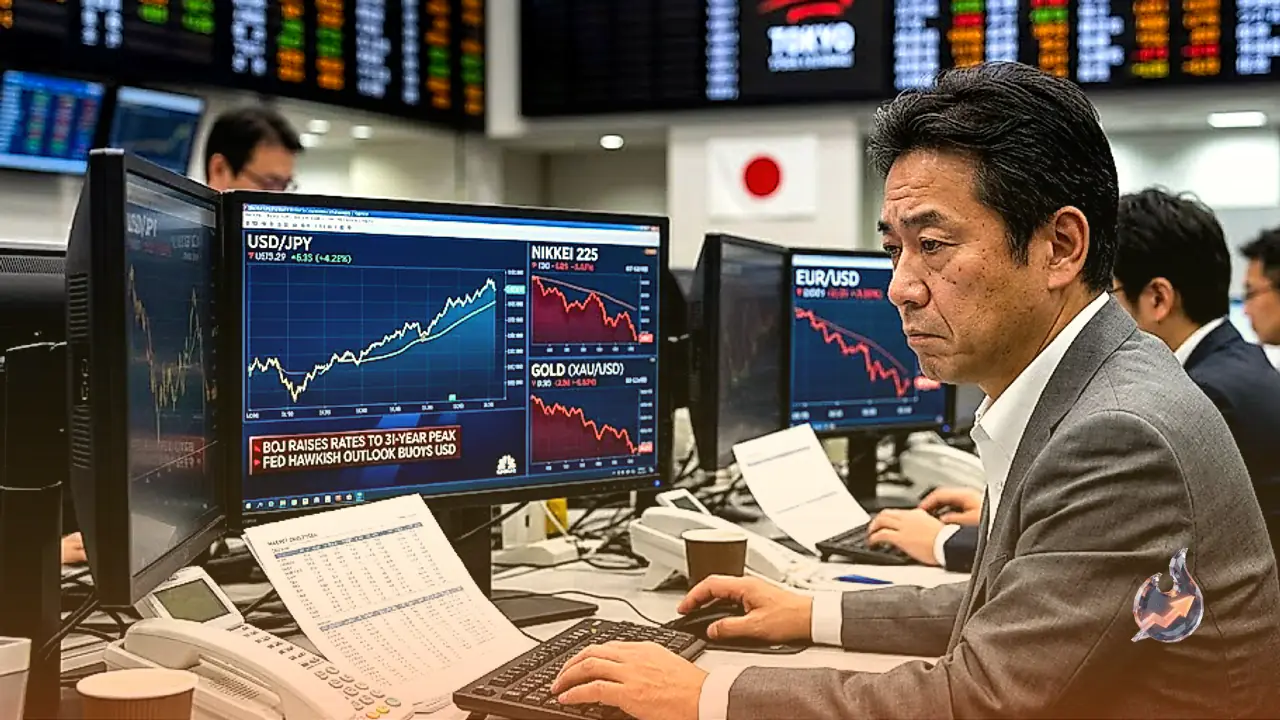
Meanwhile, the USD/JPY cross posted modest advancements, hovering near 157.50 in Tuesday's Asian trading session. The pair's downside remained checked by persistent market anxiety that Japanese authorities could intervene to protect the Japanese Yen. However, the Bank of Japan's dovish interest rate hike to a 31-year peak has kept yen bulls constrained. The Bank of Japan raised its short-term policy target to 1.25% from 1.00% via a 7-2 vote, executing a milestone step toward long-awaited monetary normalisation that aligned closely with extensive market forecasts.
Consolidation in Precious Metals and Digital Assets
In the commodities arena, gold prices slipped for a second consecutive session after an early intraday rally fizzled out. The yellow metal retreated toward the $4,315 region during European trading hours, touching a three-day low. Analysts cited the Federal Reserve's persistent hawkish monetary trajectory as the central driver encouraging investors to reallocate funds away from the non-yielding precious metal into yield-bearing paper instruments.
In the digital currency ecosystem, Bitcoin took a momentary pause following an explosive 6.7% rally the previous day, dipping below the $85,500 mark on Tuesday as short-term traders locked in gains. Despite this mild retracement, underlying institutional accumulation remains exceptionally strong. Spot Bitcoin Exchange Traded Funds took in nearly $1 billion in fresh capital on Monday alone, while Strategy expanded its corporate holdings by acquiring another 950 BTC, reinforcing the structural bid beneath the cryptocurrency market.