





















Do not let the familiar branding create misconceptions: the newly unveiled Mission 1 Pro ILS is far removed from the concept of a conventional action camera. Bearing the acronym for interchangeable lens system, this device forfeits waterproof ruggedness and adopts fragile external optics, effectively functioning as a cinema camera compacted into a pocket-sized shell. While standard outdoor enthusiasts will naturally gravitate toward the regular Mission 1 Pro, specialized filmmakers, independent creators, and camera enthusiasts who have long called for a miniature modular rig finally have a dedicated tool capable of capturing miniature 8K footage.
Shared Chassis Design and Core Recording Specifications
From an operational standpoint, the Mission 1 Pro ILS shares nearly its entire physical layout with the baseline Mission 1 Pro. The hardware foundation remains identical, with the factory fixed glass swapped out in favor of an open lens mount. The unladen camera body tips the scales at an identical 207 grams prior to attaching any secondary glass. Physical buttons, touchscreen panels, and software navigation mirror earlier models, ensuring zero learning curve for operators already familiar with the brand ecosystem.
Internal processing benchmarks match the primary Mission 1 line, maxing out at detailed 8K video capture at 60 frames per second. High-speed recording enthusiasts retain access to deep slow-motion modes, including 4K at 240 frames per second alongside ultra-high-rate 1080p recording at 960 frames per second. The single most consequential mechanical divergence lies in environmental shielding, as the lens mount assembly strips away all native waterproofing.
Specialized Roles in Cinema Sets and Small Productions
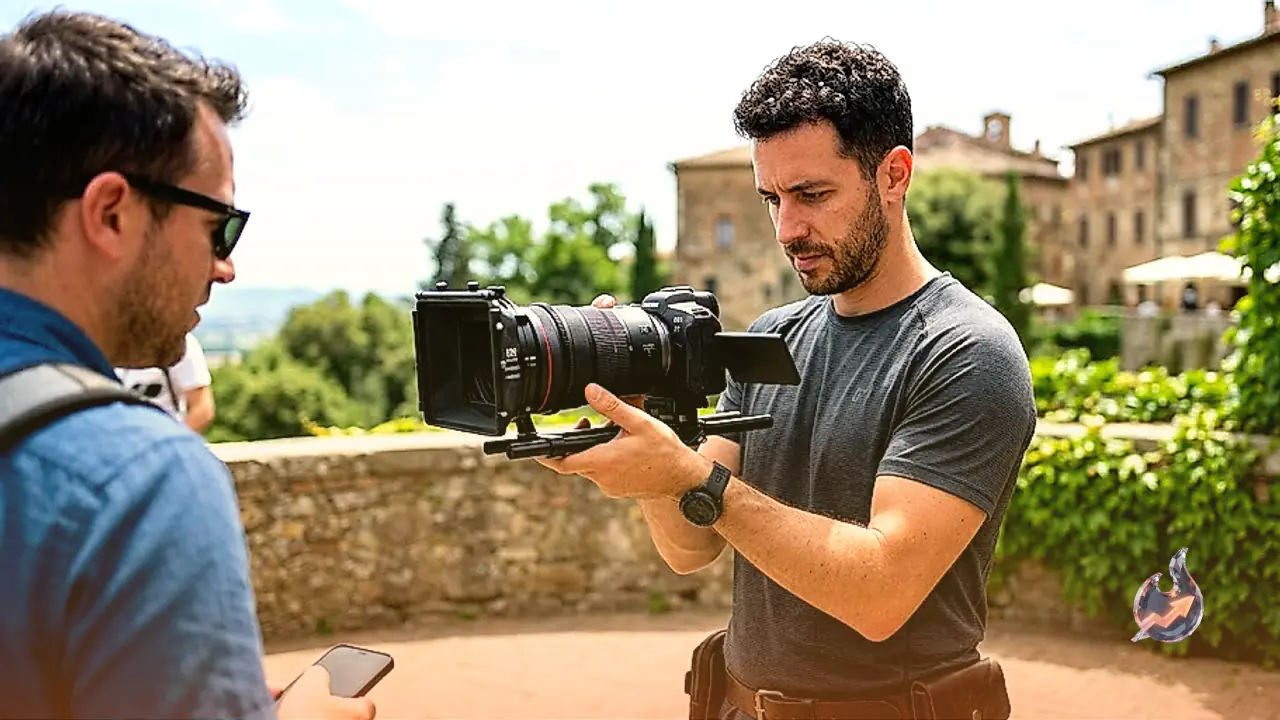
Swapping lenses on professional camera rigs has always allowed cinematographers to dictate focal perspective, depth, and emotional atmosphere. Bringing those optical variables into a sub-compact chassis solves very tangible challenges on movie sets. Following the widespread adoption of compact DSLRs and mobile hardware on major productions, compact bodies frequently serve on low-budget indie shoots or act as sacrificial secondary cameras deployed where multi-thousand-dollar cinema rigs cannot fit or survive. Industry stalwarts including Sony, Nikon, and Canon have similarly engineered compact cinema bodies to satisfy this demand.
Two deployment scenarios highlight where the Mission 1 Pro ILS delivers distinct utility. First, it serves as an ideal crash camera for large-scale films, surviving disposable installations inside vehicle collisions or dangerous stunts where gear destruction is expected. Second, it functions as an unobtrusive secondary B-camera on wildlife assignments, where an ultra-small footprint is easily ignored by animal subjects. Additionally, solo shooters and small production teams such as wedding videographers gain a cost-efficient secondary angle without the prohibitive expense of full cinema setups.
Micro Four Thirds Compatibility and the Sensor Crop Factor
Choosing the Micro Four Thirds mount, widely known as MFT, opens a versatile catalog of budget-friendly glass, while adapter rings allow cinematographers to mount distinctive vintage lenses. Because veteran directors of photography frequently prioritize optical character over the underlying camera body, this miniature unit simply serves as an unobtrusive digital recorder behind the chosen glass. Panasonic and Olympus, now branded as OM System, originally pioneered MFT to give mirrorless systems an accessible, compact physical profile.
Operators must, however, calculate optical framing against sensor dimensions. Even though the camera accepts Micro Four Thirds glass, the light falls upon the existing 1-inch sensor retained from the Mission 1 Pro. This mismatch induces a noticeable crop factor compared to native MFT cameras. When compared to full-frame standards, the crop measures roughly 2.7X with HyperSmooth digital stabilization deactivated, tightening to approximately 3X whenever HyperSmooth is engaged.
Mounting a Laowa 7.5-mm lens illustrates the practical optical translation. Running the camera with HyperSmooth active renders a field of view equivalent to a 23-mm focal length on full-frame sensors. Disabling HyperSmooth widens that perspective to roughly 20-mm equivalent coverage. Consequently, shooters demanding dramatic wide-angle perspectives on this setup must source extreme focal lengths or specialized fisheye optics.
Manual Operation and Missing Electronic Connectors
The primary engineering compromise in the Mission 1 Pro ILS is the complete omission of electronic communication pins across the lens mount. Lenses that depend entirely on motorized autofocus mechanisms or electronic aperture communication cannot function normally. For instance, Panasonic's classic 20-mm pancake lens cannot be utilized effectively because it lacks a manual aperture adjustment ring on the barrel.
Focusing also relies entirely on manual adjustment by hand. Nailing precise sharpness across a miniature built-in display presents genuine technical friction during fast-paced movement. While serious cinematographers circumvent miniature displays by tethering wireless smartphones or field monitors, the lack of electronic iris controls remains an acute barrier that disqualifies many popular lenses. Future revisions will urgently need electronic pins to govern iris blades and electronic manual focus assemblies.
Still Photography Results and Mount Weight Restrictions
The camera conclusively resolves the ongoing debate over whether tiny fixed optics throttle action camera image performance. Backed by high-grade glass, the recorded clips outclass standard action camera output across every metric. When held securely inside its protective case, balance remains steady even with substantial wide glass like the Laowa 7.5-mm attached.
Structural tolerances must be respected, as official guidelines cap the maximum supported lens weight at 250 grams on the bare mount. Mounting heavier telephoto optics necessitates a dedicated external cage to relieve physical strain off the body. On the photography side, capturing 50-megapixel RAW stills delivers fidelity equal to premier 1-inch sensor hardware, letting superior optical glass elevate images far beyond standard action camera expectations.
Market Positioning and Purchase Considerations
Carrying a standalone price tag of $700 without optics, the Mission 1 Pro ILS does not target general action camera shoppers, who remain well served by models like the Hero 13 Black. Instead, the pricing aligns realistically with independent videographers and creative directors who already maintain a stable of manual MFT lenses.
Ultimately, the device redefines miniature camera capabilities by trading action-grade durability for optical variety. Despite glaring limitations surrounding electronic lens communication and native weatherproofing, it presents a compelling creative platform for filmmakers eager to capture top-tier 8K visuals from an impossibly compact form factor.