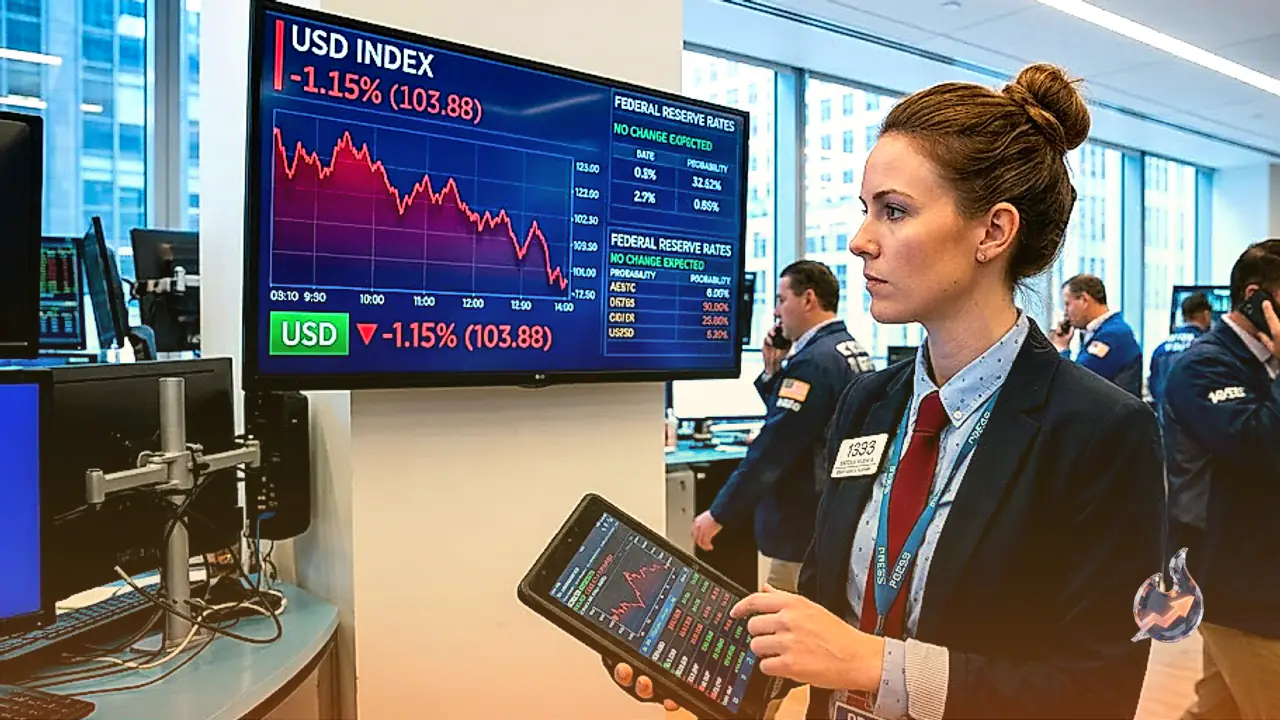
























The US Dollar has recovered the majority of its previous pullback, with market participants pricing in solid expectations for the upcoming Federal Reserve policy meeting. Fed funds futures indicate a 67 percent probability of a 25 basis point hike on September 16, alongside an implied 60 basis points of total tightening over the next twelve months. Pricing is expected to remain elevated heading into the September gathering, with the August consumer price index release on September 11 acting as the ultimate decisive test for these projections.
Global Currency and Commodity Market Movements
During the European trading session, GBP/USD traded with mild losses and remained below the 1.3550 threshold. Ongoing Middle East tensions and hawkish monetary policy expectations from the Federal Reserve provided underlying support for the greenback, weighing on the currency pair ahead of upcoming US data releases. Similarly, EUR/USD struggled to build momentum following an overnight bounce, trading below the 1.1600 mark. Eurozone economic data revealed that annual HICP inflation rose to 3.3 percent in August from 2.9 percent in July, matching market forecasts, while core HICP inflation edged down from 2.5 percent to 2.4 percent. Later in the day, the US economic calendar is set to feature JOLTS job openings and ISM manufacturing PMI figures.
Meanwhile, gold prices experienced further downward pressure, dropping below the $4,400 mark to hit a nearly two-week low during the early European session. Traders rapidly increased their bets regarding a September rate hike following remarks delivered by Federal Reserve Chair Kevin Warsh. In the digital asset sector, Ripple, Cardano, and Dogecoin continued to exhibit weakness following double-digit losses from the previous week, as they tested crucial exponential moving averages for immediate support. Technical indicators warn of continued downward pressure for XRP, ADA, and DOGE as bullish momentum fades.
Live market tracking shows XRP-USD trading at $1.38, matching its previous close with a modest 0.38 percent change within a 52-week range of $0.9884 to $2.41, on volume running at 0.53x the 20-day average. Technical indicators for the asset reveal an RSI(14) reading of 63, a MACD value of 0.09 against a signal line of 0.09 with a slight bearish histogram reading of -0.00, and moving averages showing the EMA20 at $1.31, EMA50 at $1.21, and EMA200 at $1.39, alongside an SMA50 of $1.16 and SMA200 of $1.28, confirming a long-term downtrend characterized by a death cross. Bollinger Bands place the asset between $0.8788 and $1.67 with a middle band at $1.28, while ADX stands at 44 indicating a trending market, stochastic readings show the fast line at 56 and signal line at 55, and ATR(14) sits at 0.07 providing a volatility buffer for key intraday levels including a pivot at $1.38, resistance points at R1 $1.40 and R2 $1.41, and support levels at S1 $1.37 and S2 $1.35.
Manufacturing Data and Fiscal Policy Considerations
Incoming US economic data is anticipated to keep the possibility of a September rate hike firmly supported. The August ISM manufacturing index, scheduled for release at 3:00 pm London time and 10:00 am New York time, is expected to post a headline reading of 55.2 compared to 55.6 in July, reflecting resilient manufacturing conditions. Significantly, the Prices Paid index is projected to drop to a six-month low of 70.8 from 71.1, pointing toward a reduction in upside inflation risks. In fiscal commentary, concerns regarding rising Treasury yields reflecting mounting fiscal policy worries were pushed back against, pointing out the relative outperformance of US 10-year Treasuries compared to other major sovereign bond markets, though analysts note that relative strength does not eliminate long-term fiscal vulnerabilities driven by rising interest expenses.
The US Bureau of Labor Statistics maintains a heavy reporting schedule, kicking off with the July Job Openings and Labor Turnover Survey, or JOLTS report, which is projected to show job openings holding at 7.3 million. Concurrently, the energy sector is presenting distinct underlying pressures, particularly in the oil and diesel markets. Although crude may appear relatively calm compared to prior months, the US diesel crack spread, representing the premium of ultra-low sulphur diesel futures over WTI, climbed above $100 per barrel for the first time on record, hitting an intraday peak of just over $102.00.