






















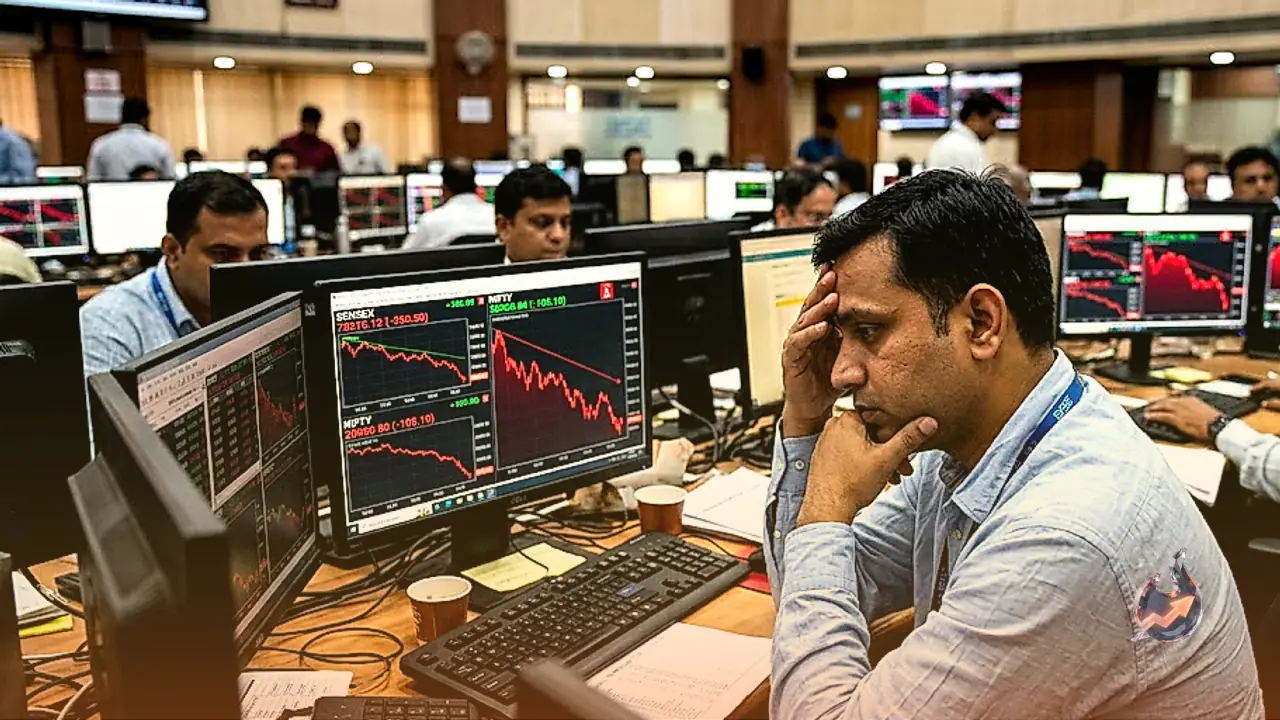

Indian stock markets kicked off the month of September on a sluggish note, leaving investors disappointed during the opening trading session. Although the market showed some resilience in early trade, persistent selling pressure later in the day dragged key indices into negative territory. While a few selective stocks attempted to cushion the blow, the broader market sentiment remained subdued as sellers dominated the floor.
Sensex and Nifty Movement
At the closing bell, the BSE Sensex dipped 12.99 points or 0.02 percent to settle at 76,944.28. Concurrently, the NSE Nifty dropped 24.60 points or 0.10 percent to finish at 24,055.80. The extent of the market downturn was clearly visible in the advance-decline ratio, with 2,476 stocks ending in the red, 1,655 advancing, and 185 remaining unchanged.
Pressure on Banking and Auto Stocks
Selling was widespread across heavyweights during the session. Shriram Finance emerged as the top loser, crashing by over 5 percent. Banking heavyweights also witnessed profit-booking, with shares of Axis Bank, ICICI Bank, and SBI sliding roughly 2 to 3 percent. Meanwhile, Maruti Suzuki shares slumped nearly 5 percent to hit a one-month low following lower-than-expected dispatch numbers for August. Nestle India and InterGlobe Aviation also registered losses of over 3 percent each.
ITC Provides Cushion to the Market
Amid the broader market weakness, ITC stood out by rallying nearly 4.6 percent to become the top gainer on the Nifty 50. HCL Technologies, Adani Ports, and Bharti Airtel also witnessed robust buying, posting gains of 3 to 4 percent. Tata Motors Passenger Vehicles managed a modest gain of about 1 percent, supported by favorable vehicle sales data for August.
Midcaps and Bank Nifty Lag Behind
Broader indices suffered steeper losses compared to frontline benchmarks. The midcap index dropped approximately 1.4 percent, while smallcap stocks also faced considerable weakness. Bank Nifty fell nearly 1 percent, weighed down heavily by selling in key lenders such as SBI and Axis Bank.
Rising Crude Oil Prices Fuel Anxiety
A significant external trigger for the market downturn was the sharp escalation in global crude oil prices. Mounting geopolitical tensions between the US and Iran raised severe concerns regarding potential disruptions to oil transit through the Strait of Hormuz. Consequently, Brent crude climbed to around 92 dollars per barrel, intensifying worries over domestic inflation and economic stability. Further details can be found here.