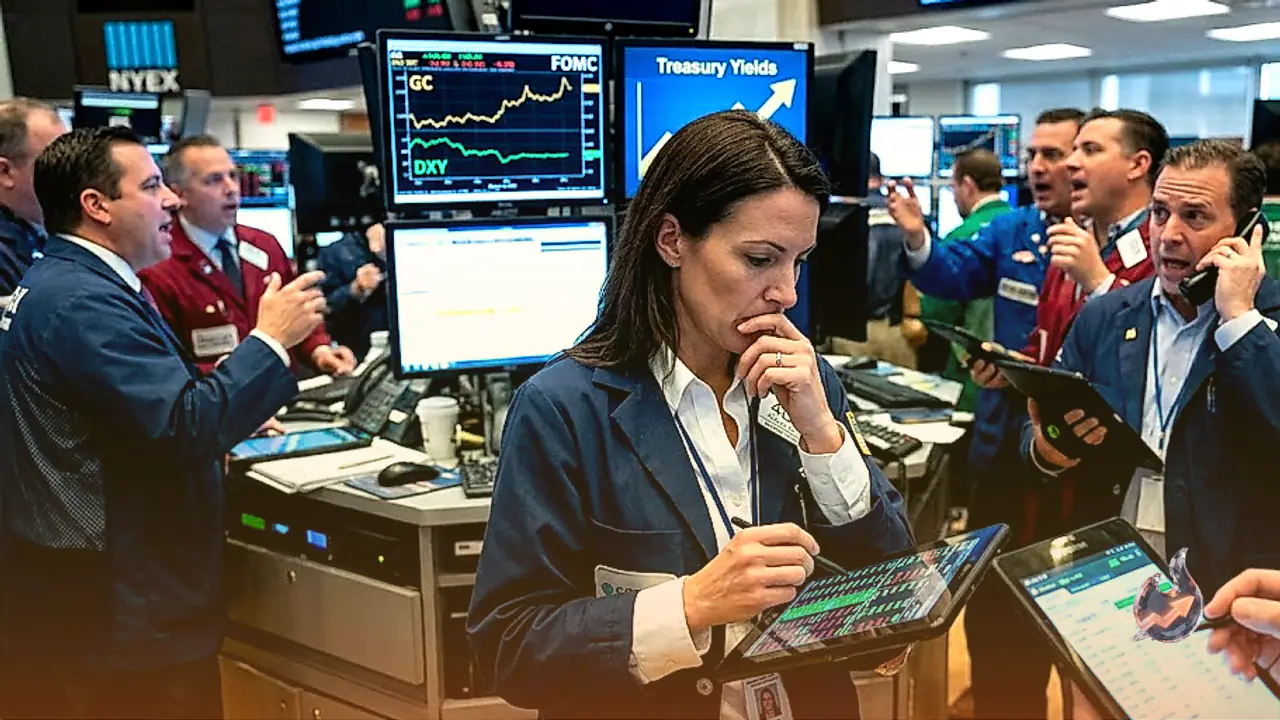

























Futures tied to major US equity benchmarks inched upward during European trading on Wednesday, offering a modest reprieve even as financial markets braced for an anticipated 25-basis-point interest rate increase from the Federal Reserve. Investors across the globe remained highly sensitive to the central bank's upcoming policy announcement, with participants weighing whether policymakers will signal additional monetary tightening in the near future.
European trading hours saw Dow Jones futures rise by 0.14 percent to hold near 52,190. At the same time, S&P 500 futures climbed 0.21 percent to hover around the 7,600 mark, while tech-heavy Nasdaq 100 futures advanced 0.42 percent to trade in the vicinity of 29,080. According to data tracked by the CME FedWatch tool, traders are pricing in nearly a 92.5 percent probability of this quarter-point hike, reflecting a firm consensus that borrowing costs will edge higher along with the potential for further restrictive guidance.
Wall Street Seeks Footing After Tuesday Sell-Off
The tentative recovery in index futures comes immediately after a difficult Tuesday session on Wall Street that saw broad declines across major averages. The Dow Jones Industrial Average dropped 0.3 percent, the S&P 500 declined 0.45 percent, and the Nasdaq Composite paced overall losses with a drop of 0.78 percent. Widespread selling emerged as a consequence of surging crude oil prices coupled with advancing US Treasury yields. The upward march in benchmark bond yields applied intense pressure to credit-dependent industries, with high-growth artificial intelligence hyperscalers bearing the heaviest burden as debt-financing costs increased.
Mounting regulatory and safety concerns surrounding the rapid development of artificial intelligence also contributed to investor hesitation. Addressing these emerging regulatory anxieties, Nvidia chief executive Jensen Huang pushed back against the push for stricter government oversight. Huang maintained that additional federal artificial intelligence safety regulations are unnecessary, emphasizing that natural market competition already provides sufficient incentives for technology firms to innovate safely without official intervention.
Structure and Drivers of the Dow Jones Industrial Average
The Dow Jones Industrial Average stands as one of the oldest and most closely watched equity gauges across global finance. Composed of 30 of the most actively traded large-cap corporate equities in the United States, the benchmark operates on a price-weighted methodology rather than weighting by overall market capitalization. Calculation involves summing the share prices of all 30 constituent enterprises and dividing that aggregate by a specific factor, which currently stands at 0.152. Originally created by Wall Street Journal founder Charles Dow, the index has drawn modern criticism for its relatively narrow scope compared to broader capitalization-weighted indices like the S&P 500.
A multitude of macroeconomic and corporate forces drive fluctuations in the index. Primary among these is corporate earnings performance revealed during quarterly reporting cycles across the 30 component firms. Broader US and international economic indicators also play a critical role by shaping investor risk appetite. Crucially, the policy stance and interest rate trajectory determined by the Federal Reserve wield tremendous influence over the benchmark, as the cost of credit directly dictates debt servicing expenses for capital-intensive corporate titans. Consequently, consumer price inflation, labor market metrics, and broader monetary indicators serve as pivotal drivers for overall price action.
Dow Theory Principles and Practical Trading Mechanisms
To determine the overarching trajectory of equity markets, Charles Dow established a foundational analytical approach known as Dow Theory. A central tenet of this method requires comparing the primary trend of the Dow Jones Industrial Average with that of the Dow Jones Transportation Average. Under the theory, an enduring trend can only be validated when both indices advance or decline in tandem, with trading volume serving as a vital confirming metric. Rooted in structural peak and trough analysis, Dow Theory delineates three consecutive market phases: accumulation, during which sophisticated participants initiate early positions; public participation, as broader retail and institutional investors enter the market; and distribution, when early capital begins unwinding holdings to lock in gains.
Market participants utilize several distinct investment vehicles to gain direct exposure to the Dow Jones Industrial Average. Exchange-traded funds allow traders to buy and sell the entire basket of 30 companies as a single liquid instrument, exemplified by the SPDR Dow Jones Industrial Average ETF (DIA). Derivatives represent another common route, with DJIA futures contracts enabling market participants to speculate on future index valuations. Options contracts offer holders the right, but not the legal obligation, to buy or sell the benchmark at a fixed strike price prior to expiration. In addition, actively managed mutual funds allocate capital across diversified portfolios mirroring the 30 component stocks, granting indirect exposure to retail and institutional portfolios.
Currency Fluctuations and Commodities React to Rate Expectations
Anticipation surrounding the Federal Reserve decision triggered noticeable ripples across global currency and commodity markets. The Australian Dollar struggled against the US Dollar (AUD/USD), extending its downward trajectory for a third consecutive trading session and defending the 0.7100 handle near a monthly low during Asian market activity on Wednesday. Elevated US Treasury yields, reinforced by crude-driven inflation anxieties and the 92.5 percent probability of a quarter-point rate hike, kept the greenback hovering near a two-week peak. Escalating geopolitical friction in the Middle East further enhanced demand for the safe-haven dollar while dampening sentiment toward risk-sensitive currencies like the Australian Dollar.
Concurrently, the US Dollar advanced against the Japanese Yen (USD/JPY), rising above the 155.00 threshold to touch a fresh one-week high. Surging bond yields and heightened tensions involving the United States and Iran reinforced the reserve status of the dollar. Even so, the pair remained capped beneath the mid-155.00 zone as bullish traders paused ahead of both the Federal Reserve announcement and the Bank of Japan policy meeting scheduled for Thursday. For more than ten years, Japan maintained ultra-low borrowing rates that financed trillions of dollars in worldwide investments, establishing the Japanese Yen as a premier global funding currency. With the Bank of Japan widely expected to implement further policy tightening, that longstanding dynamic appears poised for structural change.
In commodities, spot gold faced resistance, failing to sustain its intraday upward momentum and remaining below $4,350 per ounce in European trading. A temporary consolidation in the US Dollar index offered baseline support, but bullion traders largely refrained from aggressive positioning ahead of the Federal Reserve policy outcome. Prior economic data, including an upbeat August jobs print and subsequent August consumer price index readings, have firmly cemented monetary policy expectations as the dominant catalyst across asset classes.