






















When individuals receive financial assistance or cash payouts, the money is often consumed entirely by daily expenses and immediate household purchases. Aiming to transform this spending behavior into a structured saving habit, the Delhi government has introduced a welfare initiative known as the Lakshmi Yojana. Under this financial support program, eligible women will be provided with ₹2,500 every month. However, the overarching goal of the initiative extends beyond mere cash distribution; the government intends for a significant portion of this assistance to be funneled directly into savings and long-term investments, building a substantial financial reserve for beneficiaries over time.
Program Structure and Available Investment Options
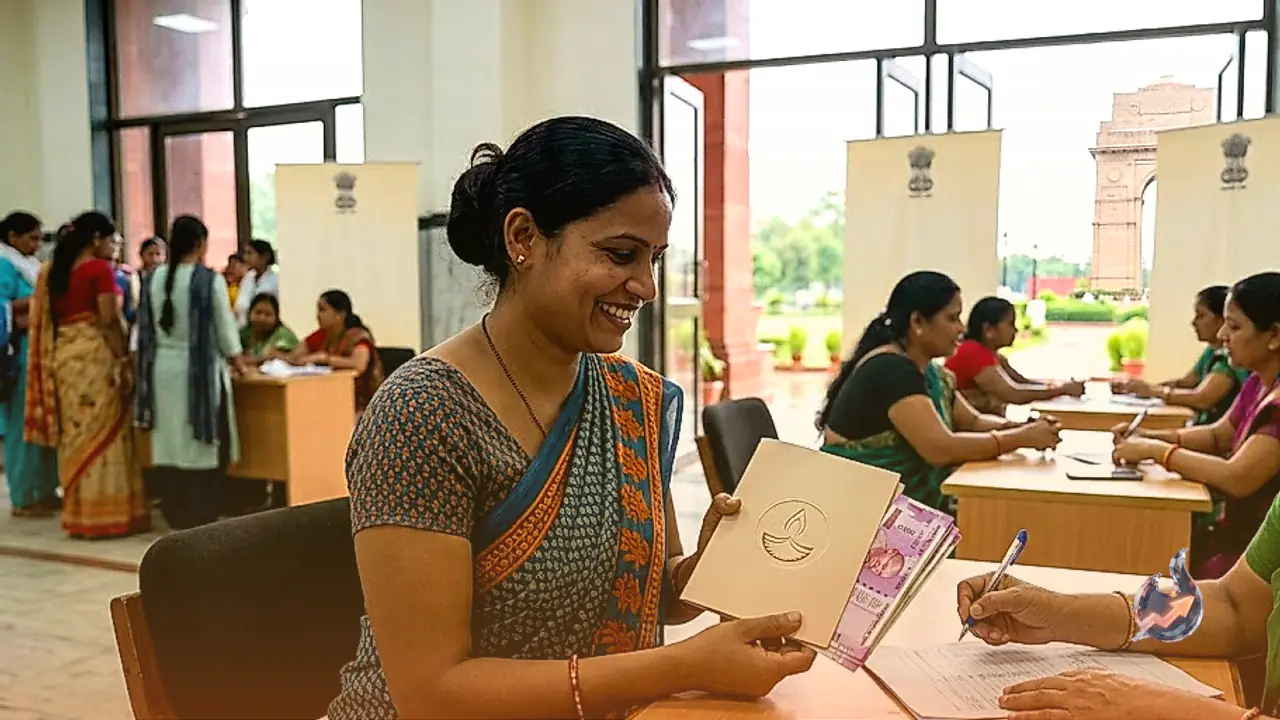
To ensure that the monthly assistance of ₹2,500 effectively contributes to both present needs and future financial stability, the government has designed two distinct options for beneficiaries. The first option is tailored for women who prefer a balance between immediate expenditure and long-term savings. Under this option, ₹1,500 of the monthly payout is automatically deposited into a Recurring Deposit (RD) or Fixed Deposit (FD) account. The remaining ₹1,000 is credited directly into the Reserve Bank of India (RBI) Central Bank Digital Currency (CBDC) digital wallet. CBDC is an official digital currency application developed by the RBI, allowing users to spend their funds conveniently on everyday expenses in digital form.
Alternatively, beneficiaries who wish to maximize their future savings rather than spending any money currently can select the second option. Under this setup, the complete monthly sum of ₹2,500 is routed into an RD or FD investment account. A mandatory lock-in period of 3 years is enforced on these savings accounts, meaning beneficiaries cannot withdraw the capital before the completion of the 3-year term. Once the three years elapse, women will be eligible to withdraw the entire accumulated principal along with the accrued interest.
Option 1 Breakdown: Expected Returns from ₹1,500 Monthly RD
For women choosing the first option of depositing ₹1,500 per month into a post office Recurring Deposit (RD) account, the current annual interest rate of 6.7% offers attractive compounded returns. Over the 3-year tenure (36 monthly installments), the total principal deposited by the beneficiary will amount to ₹54,000.
With the application of the 6.7% annual interest rate, the total maturity value at the end of the mandatory 3-year lock-in period will reach approximately ₹59,925. This yields an interest gain of about ₹5,925 on top of the ₹54,000 principal. Simultaneously, the beneficiary receives ₹1,000 every month in her CBDC digital wallet to handle ongoing day-to-day requirements, establishing a functional equilibrium between liquidity and capital accumulation.
Option 2 Breakdown: Reaching a ₹1 Lakh Corpus with ₹2,500 Monthly Savings
For beneficiaries opting for complete savings, the second option creates a substantial financial cushion. By allocating the entire ₹2,500 monthly grant into a post office RD account, the cumulative principal deposited over 3 years reaches ₹90,000.
Applying the post office RD interest rate of 6.7% per annum over the 3-year period, the maturity value grows to approximately ₹99,874. This generates roughly ₹9,874 purely in interest earnings without requiring any additional personal capital outlays. At the end of three years, the beneficiary acquires a lump-sum fund of nearly ₹1 lakh (₹99,874), which can be deployed toward major expenses, education, healthcare, or emergencies.
Post Office Time Deposit (FD) Rates and Investment Channels
In addition to Recurring Deposits, the Lakshmi Yojana framework allows investments in Post Office Time Deposits (FD). Post office fixed deposit accounts offer competitive yearly interest rates based on chosen tenures. The current interest rates for post office Time Deposits are as follows
- 1-Year Time Deposit (FD): 6.9% per annum
- 2-Year Time Deposit (FD): 7.0% per annum
- 3-Year Time Deposit (FD): 7.1% per annum
- 5-Year Time Deposit (FD): 7.5% per annum
Government guidelines indicate that scheme funds will be invested in authorized banks or post office instruments that comply with regulations to secure optimal returns, ensuring beneficiaries reap the maximum interest advantages possible.
Promoting Financial Inclusion and Disciplined Saving Habits
The core objective of the Lakshmi Yojana is not restricted to offering short-term monetary aid; it aims to integrate women into formal banking networks, digital financial tools, and disciplined investment avenues. Unstructured cash aid often disperses into routine consumption, leaving little long-term security. By imposing a mandatory 3-year lock-in period, the government encourages regular saving behavior. When beneficiaries receive a lump-sum payout containing accrued interest after three years, it not only boosts their financial independence but also empowers them to make sound, confident economic decisions for their families.