






















Once the harvesting and threshing of oilseed crops conclude, fields are routinely left scattered with dry plant stems. Across the Awadh region, including Sultanpur, these dried plant residues are locally referred to as pinji or mustard sticks. Most cultivators treat these leftover woody stalks as agricultural waste, either burning them, leaving them unattended, or tossing them away. With practical handling, this abundant agricultural residue can become a lucrative source of supplementary income. Rather than discarding these remains, growers can capitalize on several functional and commercial methods to turn them into cash.
Crafting Utility Brooms for Large Open Spaces
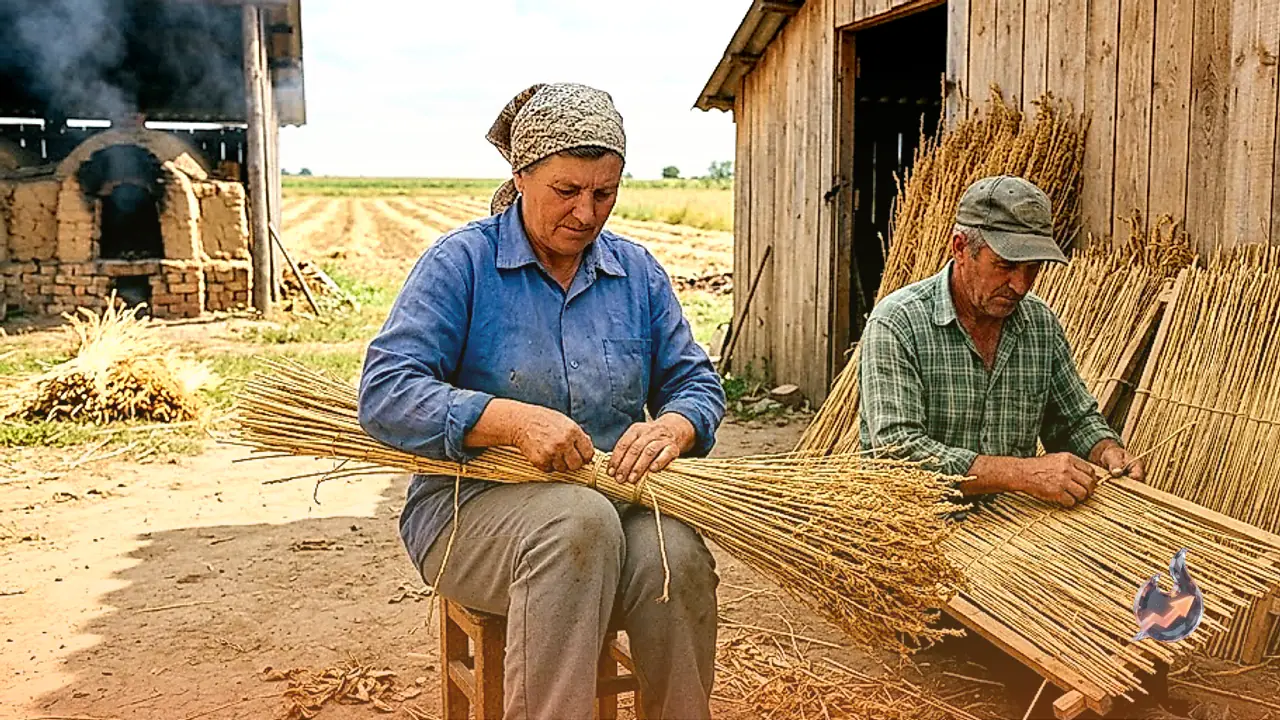
From a commercial perspective, dry mustard stalks offer practical value in everyday utility manufacturing. Farmer Anil Kumar explains that these stiff, branching stalks can be bundled together to create broad sweeping brooms. While such natural brooms are temporary and wear down after repeated use, they are exceptionally effective for clearing debris across threshing floors, large open courtyards, and expansive agricultural grounds. In rural and peri-urban markets, these utility brooms sell briskly at 25 to 30 rupees per piece, providing quick local liquidity without requiring any capital outlay.
Weaving Protective Thatched Screens for Livestock Shelters
In rural households, protective woven screens known as tatiya are widely utilized for storage and livestock management. Villagers depend on these thatched partitions to safeguard cattle from biting winter winds and severe chill, as well as to cover straw reserves and shield dried cow dung cakes from unpredictable weather. By weaving mustard stems together with pigeon pea stalks, farmers can produce firm, protective screens. A single well-constructed tatiya fetches roughly 1000 rupees in the local market, making it an attractive craft option during the post-harvest period.
Supplying Biomass Fuel to Commercial Brick Kilns
The brick-making sector presents a substantial and continuous demand for dry mustard residue. Stalks of this oilseed crop serve as an effective supplementary fuel in brick kilns because they catch fire quickly, helping ignite the primary coal charge and sustain intense, uniform combustion across the baking chambers. To be accepted by kiln operators, the material must be properly threshed and cut into smaller, manageable fragments. Threshed mustard stalks prepared in this manner command prices around 800 rupees per quintal, offering cultivators an easy route to bulk sales.
Producing Organic Compost for Sustainable Farming
For growers who prefer to enrich their own land rather than sell the material off-site, mustard stalks make exceptional raw material for compost. The process requires digging a wide, shallow pit on the farm or near the homestead. The stalks are layered evenly inside the pit and covered with an approximately 3-inch layer of ordinary topsoil. After applying light moisture, the pit is left undisturbed. Over a period of 2 to 3 months, microbiological decomposition breaks down the tough plant matter into rich organic compost, eliminating the need to spend on commercial soil conditioners.