

















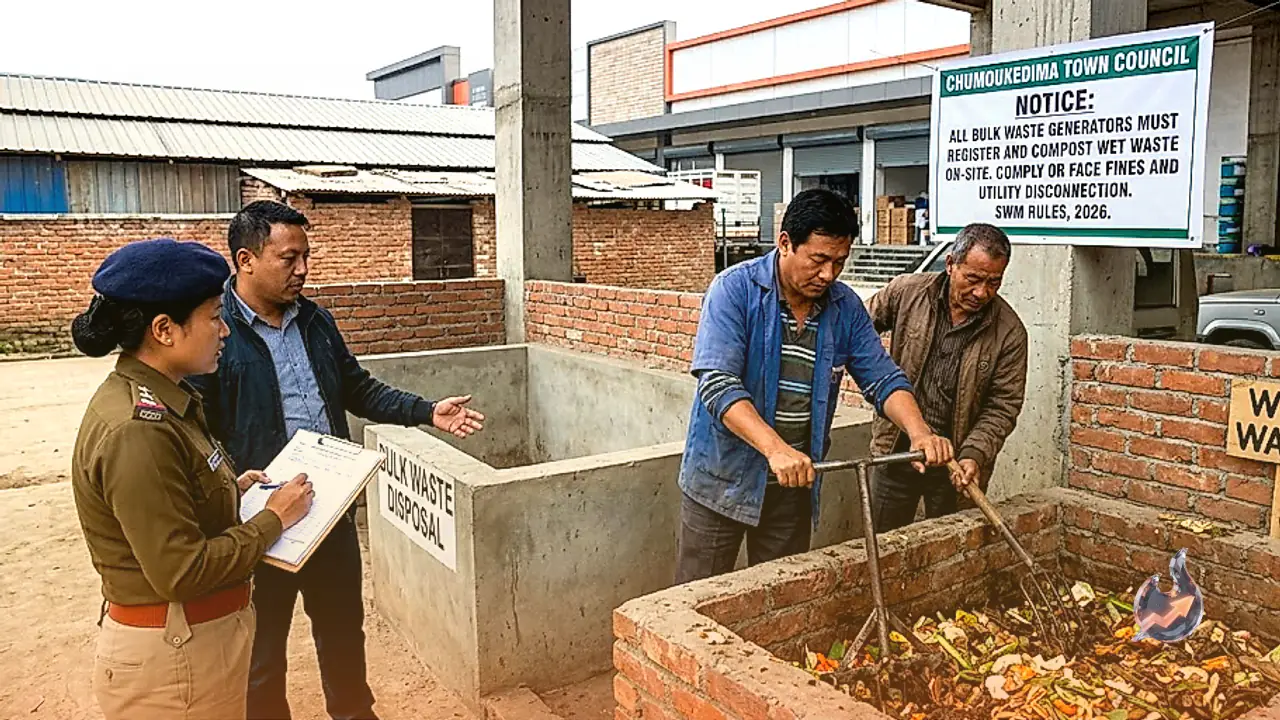

Bulk generators of garbage in Chumoukedima have been told to get their own house in order, with the district administration warning that the days of leaving waste disposal entirely to sanitation staff are over. At a one-day workshop held at the Deputy Commissioner's Office on Tuesday, Chumoukedima Deputy Commissioner Polan John, NCS, said every stakeholder, and Bulk Waste Generators (BWGs) in particular, must share responsibility for keeping the district compliant with the Supreme Court's time-bound orders and the Solid Waste Management Rules, 2026.
A workshop aimed at big waste producers
The session was chaired by SDO Chumoukedima Shreyansee Jain, IAS, and brought together institutions and establishments that generate large volumes of waste to discuss sustainable disposal practices. John used the platform to push back against the idea that garbage collection is purely a sanitation worker's job, telling participants that households, institutions and commercial establishments all carry a share of the burden.
The legal push behind the drive
John pointed to the Supreme Court's own observations on the subject, reminding attendees that Article 51A(g) of the Constitution makes it a fundamental duty of every citizen to protect the environment, and that the right to a clean and healthy environment flows from the right to life guaranteed under Article 21. He said the revised Solid Waste Management Rules, 2026 apply equally to urban and rural areas, and require individuals and institutions alike to segregate, store and hand over waste to designated authorities under prescribed norms.
Who counts as a Bulk Waste Generator
The DC laid out the yardsticks that place an establishment in the BWG category: a built-up area of roughly 20,000 square metres, daily water use of about 40,000 litres, or waste output of around 100 kg a day. Meeting even one of these three thresholds is enough to be classified as a BWG.
What compliance looks like
Once identified, BWGs are expected to set up waste-management infrastructure on their own premises, process and manage that waste properly, register themselves online and file regular compliance reports. Their sites will also be open to inspection by authorities checking on the ground reality.
Composting wet waste on site
John placed particular stress on wet waste, telling BWGs they must handle it within their own premises, including by setting up suitable composting facilities. He added that technical support for this can be sought from the relevant departments and from the Nagaland Pollution Control Board.
Penalties for those who don't comply
The DC also had a warning for holdouts: non-compliance can invite penalties under the "Polluter Pays" principle and other enforcement measures, and persistently defaulting establishments could even have their electricity and water connections cut off under the applicable directions. Calling the initiative a "whole-of-government, whole-of-society" effort, John urged every identified BWG and stakeholder to move quickly and fall in line with the time-bound orders on solid waste management.