





















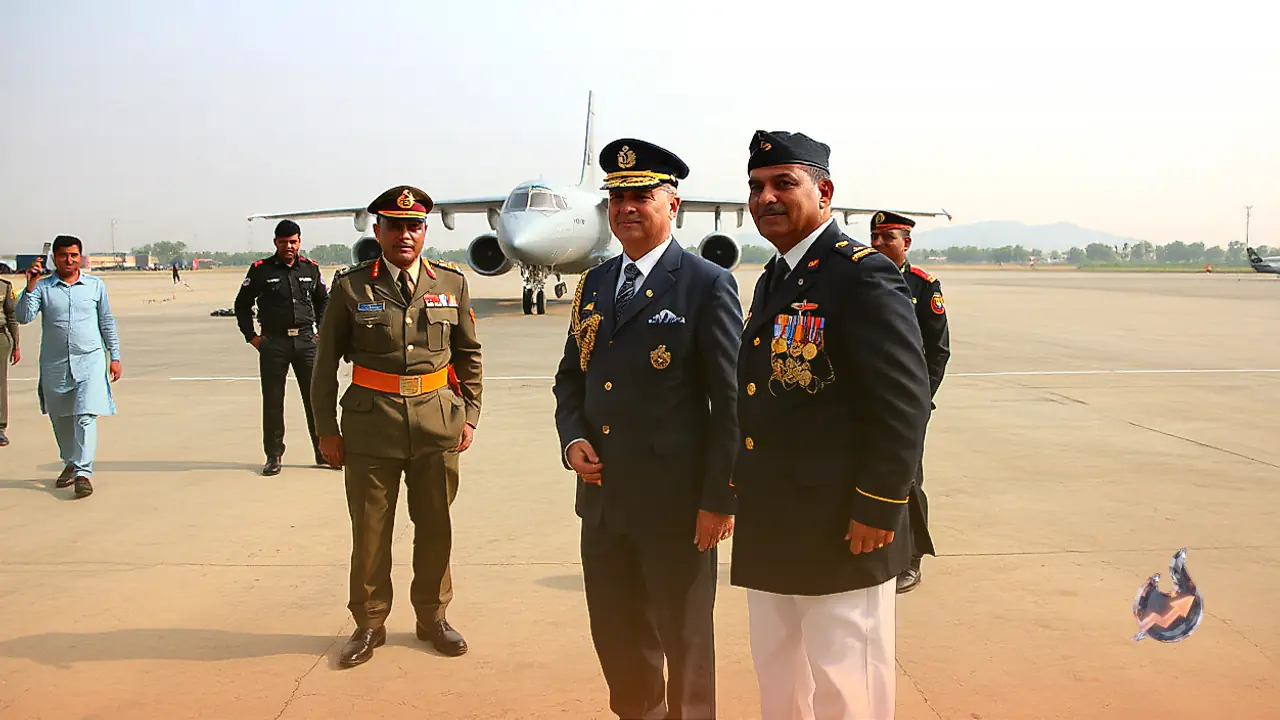

In an important transition within India's defense establishment, Air Chief Marshal Ashutosh Dixit officially took charge as the 29th Chief of the Air Staff. He was accorded a formal guard of honour in Delhi on Sunday, 1 November 2026. Stepping into the apex role amid complex geopolitical shifts and evolving security dynamics, the new Air Chief outlined a comprehensive roadmap designed to keep the Indian Air Force primed for future challenges. He succeeded Air Chief Marshal AP Singh, whose tenure he praised for demonstrating exceptional operational strength, precision strike capability, and military leadership.
Acknowledging Past Operational Successes
Commending the contributions of his predecessor, Air Chief Marshal Dixit reflected on the high benchmarks set during Air Chief Marshal AP Singh's leadership. He noted that the force showcased decisive precision strike capabilities and operational readiness during Operation Sindoor, an operation launched to eliminate terror networks in Pakistan following the Pahalgam terror attack. According to the incoming chief, such milestones established the swift offensive and defensive posture the force maintains to address cross-border threats.
Global Conflict Lessons and Strategic Realities
The leadership handover comes at a time marked by significant security challenges both near India's borders and across the globe. Regionally, India shares frontiers with two neighbors with whom it has engaged in past conflicts. Globally, strategic instability has intensified as the conflict involving Iran followed on the heels of the Russia-Ukraine war, shaking worldwide security architectures. A critical lesson emerging from both global conflicts is the decisive role of air power in determining the pace and outcome of modern combat. Without naming specific neighboring countries, Air Chief Marshal Dixit stated that preparing the air force for any eventuality remains his principal mission.
The Core Strategic Doctrine: The 'VAYU' Framework
To articulate the strategic direction and institutional focus of the air force, Air Chief Marshal Dixit introduced the VAYU framework, structured around four foundational pillars
- V for Vigilance and Readiness: Round-the-clock surveillance across all borders, paired with immediate operational preparedness to neutralize sudden threats.
- A for Aatmanirbharta (Self-Reliance): Accelerating defense indigenization to reduce dependence on external defense equipment and strengthen local production ecosystems.
- Y for Yukti (Innovation): Fostering innovative tactical thinking, cutting-edge engineering, and rapid adoption of contemporary technologies.
- U for Unity of Effort: Forging seamless operational coordination and jointness with the Army, Navy, and allied national security institutions.
Prioritizing Indigenous Fighter Jet Programs
A central pillar of the incoming chief's vision is fast-tracking domestic aviation programs. Air Chief Marshal Dixit stated that top priority will be accorded to the Tejas Mark-1A, Tejas Mark-2, and the next-generation Advanced Medium Combat Aircraft (AMCA). Alongside these fighter aircraft, indigenous sensor technologies and advanced weapon suites will receive focused support to build a robust, self-reliant defense ecosystem capable of sustaining extended operations.
Adapting to Emerging Technologies and Integrated Operations
Addressing the shifting character of military engagements, the Air Chief highlighted that modern battlefields are increasingly defined by asymmetric technologies. The proliferation of drones, precision-guided long-range munitions, artificial intelligence, cyber capabilities, and space assets has altered traditional doctrines. Adapting to these disruptions requires continuous technological upgrades and agile operational frameworks. He reiterated the absolute necessity of integrated joint operations, emphasizing that close institutional coordination among the Air Force, Army, Navy, and external security agencies is vital to modern national defense.
Commitment to Personnel Welfare and National Security
Balancing technological ambition with human readiness, the Air Chief affirmed that personnel welfare remains a core institutional responsibility. He stated that the well-being of airmen, Agniveer Vayu personnel, veterans, and military families will be actively addressed. Concluding his initial address, Air Chief Marshal Dixit assured the nation that the Indian Air Force stands vigilant, mission-ready, and resolute in safeguarding the country's sovereign airspace.