






















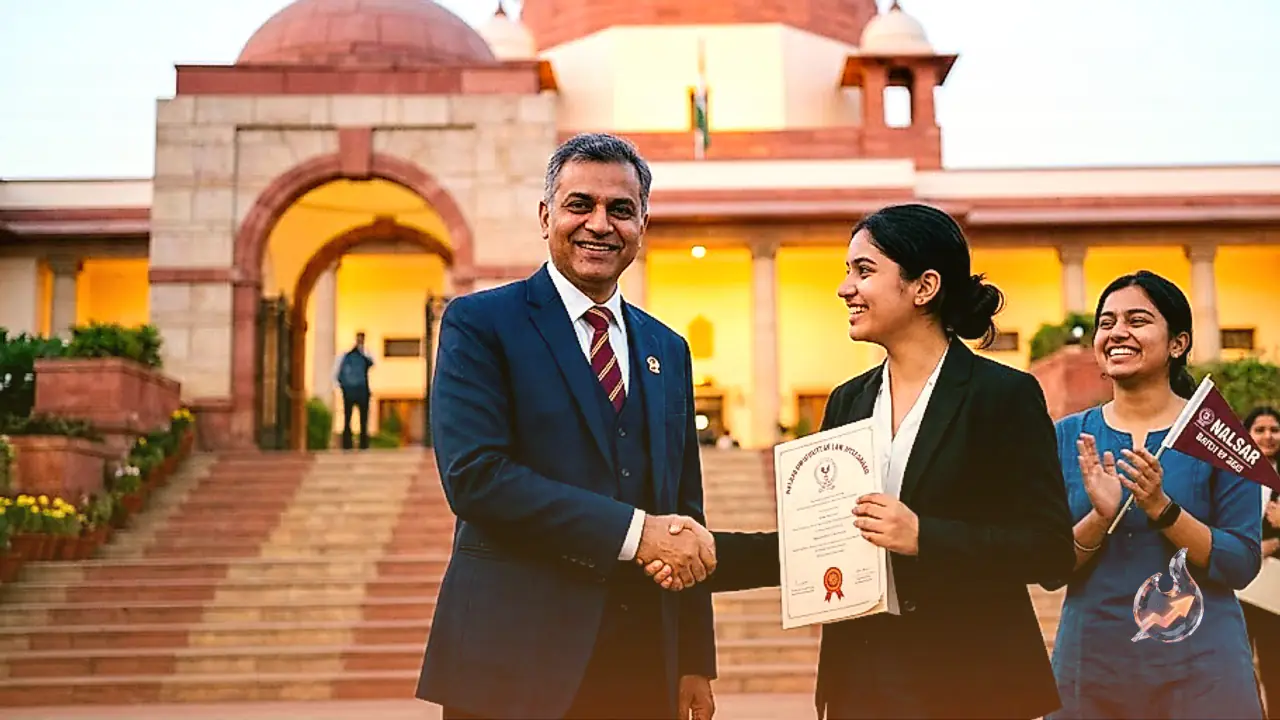

In a significant relief for law students at the prestigious NALSAR University of Law in Hyderabad, the Bar Council of India (BCI) has officially rescinded its controversial ban prohibiting 2026 graduates from registering as advocates. The regulatory body decided to backtrack after facing intense criticism from the Supreme Court Bar Association (SCBA), which condemned the directive as unlawful, arbitrary, and unconstitutional. The withdrawal of the mandate removes a major hurdle for hundreds of young law graduates whose professional careers had been plunged into uncertainty.
Convocation Demonstrations and the Initial BCI Directive
The controversy stems from events surrounding the convocation ceremony at NALSAR University of Law in Hyderabad. A section of students organized a demonstration opposing the presence of Chief Justice Surya Kant during the official event. Shortly after the protest, the Bar Council of India issued a nationwide directive targeted at the graduating class. The BCI instructed all state bar councils across the country not to enroll any student passing out of NALSAR University of Law in the year 2026 as an advocate until further orders. This blanket restriction effectively halted the professional career prospects of the entire 2026 graduating batch.
SCBA's Intervention and August 13 Letter
The regulatory order sparked widespread concern across the legal fraternity, leading to swift intervention by the Supreme Court Bar Association. On August 13, SCBA President Dr. Vikas Singh addressed a formal letter to the BCI leadership expressing strong condemnation of the decision. In his communication, Dr. Vikas Singh characterized the restriction as unprecedented, entirely arbitrary, illegal, and disproportionate. He emphasized that academic institutions like law universities are fundamentally designed to serve as spaces for independent thought, robust debate, and freedom of expression, stressing that student disagreement with a constitutional authority should never warrant denial of entry into the legal profession.
Dr. Vikas Singh noted in his communication that universities are "centers of independent thought, fearless debate, and freedom of expression." He maintained that employing collective disciplinary measures against students exercising basic expression undermines constitutional principles.
Statutory Limits Under Advocates Act and Article 19(1)(g)
In his legal critique, the SCBA president detailed the statutory framework governing advocate enrollment in India. He highlighted that the Advocates Act, 1961 explicitly defines the qualifications and regulations for registering practitioners across state bar councils. The statute contains no provision allowing the regulator to enforce collective bans or punitive suspensions on an entire graduating class of an educational institution.
Furthermore, Dr. Vikas Singh cited Article 19(1)(g) of the Constitution of India, which guarantees every citizen the fundamental right to practice any profession, trade, or business of their choosing. The letter pointed out that as the apex regulatory authority for the legal profession, the Bar Council of India carries a primary obligation to uphold constitutional values rather than resorting to collective penalties. He urged the regulator to immediately revoke the prohibition and permit the young graduates to enroll without impediment.
Reversal of the Order and Pathway Restored
Faced with strong opposition from the SCBA and legal scholars, the Bar Council of India reconsidered its stance and revoked the order affecting the 2026 NALSAR batch. The decision ensures that law graduates from the 2026 class can now proceed with their advocate registrations across all state bar councils without any restrictions, restoring their right to enter legal practice.