























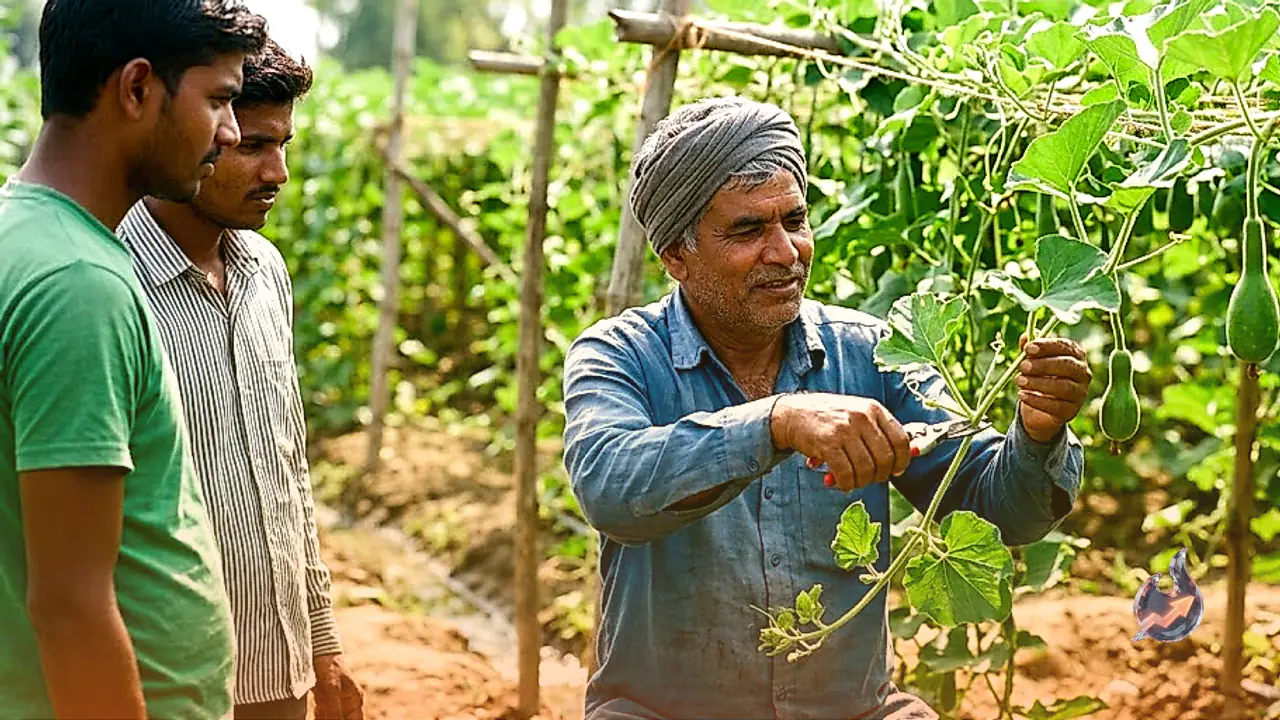

Farmers cultivating bottle gourd can significantly boost their agricultural yield by adopting scientific crop management practices. Implementing modern farming techniques allows growers to generate profits that are multiple times higher than their initial investment. However, managing uncontrolled vine growth remains one of the most critical challenges in bottle gourd cultivation. When unnecessary branches grow unchecked, a massive portion of the plant's absorbed nutrients gets expended solely on developing foliage and lengthening the main stem. This wasteful growth directly hinders fruit development. To resolve this problem, the 2G and 3G pruning technique has emerged as a highly effective method, redirecting the plant's vital resources toward high-yielding branches.
Why Vine Management is Crucial for Bottle Gourd Farming
If a bottle gourd vine is allowed to grow naturally without intervention, it predominantly produces male flowers along a lengthy main stem, resulting in sub-optimal fruit yield. Consequently, understanding proper vine management is essential for every cultivator. According to agriculture expert Bajrang Singh, pruning unwanted branch growth streamlines the plant's nutrient uptake system. By trimming excessive vines, the plant concentrates its energy on developing specific secondary and tertiary branches that carry a much higher proportion of fruit-bearing female flowers. This focus on managed growth makes systematic pruning an indispensable practice in modern horticulture.
Understanding 1G, 2G, and 3G Branch Generations
To execute the pruning technique effectively, farmers must understand the sequence of branch generations that develop on the vine. Agriculture expert Bajrang Singh outlined the structural hierarchy of these branches as follows
- 1G (First Generation): The primary main stem growing directly from the seed is classified as the 1G branch. It mainly bears male flowers, which do not develop into fruit.
- 2G (Second Generation): Lateral branches that emerge directly from the main 1G stem are designated as second-generation or 2G branches.
- 3G (Third Generation): Sub-branches that sprout from the 2G lateral branches are categorized as third-generation or 3G branches. These 3G branches carry the highest concentration of female flowers, maximizing potential fruit formation.
The Ideal Timing and Method for Pruning
Timing plays a pivotal role in achieving success with vine pruning. Generally, when the bottle gourd plant reaches approximately 30 to 35 days of growth, the primary stem and sprouting lateral branches become clearly distinguishable. According to the agriculture expert, farmers should regulate the early unwanted growth of the main stem to encourage the emergence of robust 2G branches. Once these 2G branches reach an adequate size, their tips are pruned to trigger the rapid expansion of 3G branches. Throughout this process, farmers must exercise care to avoid causing unnecessary physical damage to the main plant structure.
Essential Precautions: Tool Hygiene and Crop Care
Growers must exercise strict caution while carrying out pruning operations in the field. Cutting branches requires the use of clean, razor-sharp tools. Utilizing dirty or rusted implements greatly increases the vulnerability of the open cut surfaces to fungal or bacterial infections. Therefore, disinfecting or thoroughly cleaning tools prior to working on each individual plant is considered a critical best practice. Additionally, farmers should avoid over-pruning, as removing an excessive number of branches can stress the plant and heighten its susceptibility to crop diseases.
Major Benefits of 2G and 3G Pruning Techniques
The primary advantage of 2G and 3G pruning lies in its ability to restrict unproductive vegetative growth while optimizing the plant for maximum fruiting capacity. The proliferation of 3G branches creates significantly more surface area for flower initiation and fruit setting. This structural organization keeps the fruiting zone well-arranged, making routine tasks such as irrigation, fertilization, pest monitoring, and harvesting far simpler. By incorporating this strategic pruning methodology, farmers can secure multiple heavy harvests from a single bottle gourd vine across the season.