























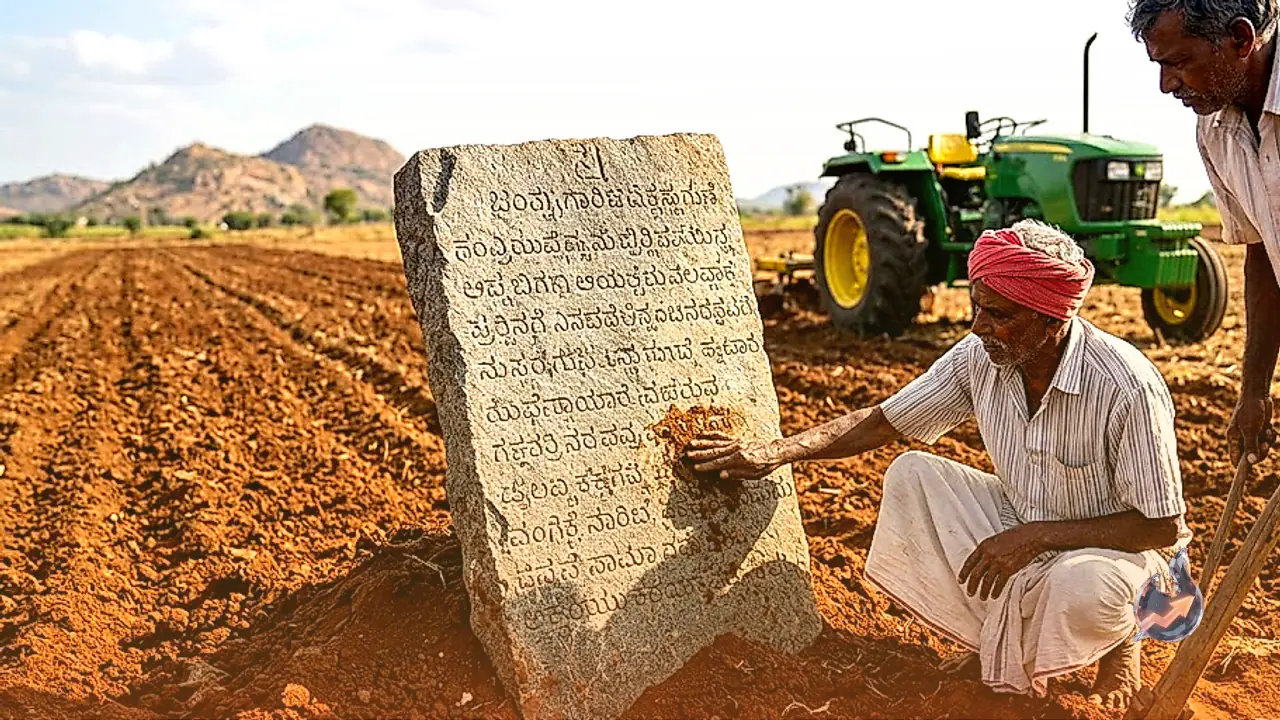

An extraordinary piece of medieval history surfaced unexpectedly in southern India when agricultural workers tilling a field discovered a heavily inscribed stone slab dating back roughly four and a half centuries. The incident unfolded at survey number 85 in Javagondanahalli village, situated within the Hiriyur taluk of Karnataka's Chitradurga district. While carrying out routine farmland preparation, local farmers struck the ancient artifact embedded beneath the soil. Beyond its physical rarity, the discovery has drawn immense attention due to a terrifying spiritual curse etched onto its surface, designed to deter land grabbers through religious dread.
Severe Religious Curse Etched on Stone
The artifact features 17 distinct lines written in the Old Kannada script, laying out an uncompromising warning for anyone who might attempt to encroach upon the land. According to the text, any individual who unlawfully seizes or usurps the property will be cursed with the grave spiritual sin equivalent to committing cow slaughter in the holy city of Kashi. Historians explain that during the 16th century, embedding severe religious penalties and spiritual curses into official land records was a standard administrative tactic. Because legal enforcement could be challenging across distant regions, rulers and local authorities relied heavily on deep-rooted religious beliefs and fear of divine retribution to safeguard land grants for future generations.
Public Welfare and Royal Land Grant Traditions
The detailed inscription sheds light on the civic contributions of a local administrator named Doddagouda, who was the son of Lakkajia. Serving as an official under King Immadi Chikkanna Nayaka of the Kamageti dynasty, who ruled between 1575 and 1586 AD, Doddagouda undertook a significant infrastructure project by constructing a public lake in Javagondanahalli village to assist the local community and support local agriculture. Deeply pleased by this community service and water management initiative, the monarch rewarded Doddagouda with a special grant of tax-free land, historically known as Umbali.
To guarantee that the reward remained within the family, the text explicitly mandates that the descendants of Doddagouda will maintain absolute ownership rights over this property for as long as the sun and moon remain in the sky. The severe curse was specifically directed at future trespassers, ambitious village rivals, or successor officials who might attempt to revoke the royal decree or strip Doddagouda's lineage of their granted holdings.
Archaeological Examination and Chronological Clues
Following the discovery, administrative and heritage authorities were notified to examine the site. Prahlad G, Assistant Director at the Department of Archaeology, Museums and Heritage in Chitradurga, shared preliminary observations regarding the artifact. Initial archaeological assessments indicate that the inscription likely dates around the year 1581 AD, though conclusive verification of the exact year is still underway.
Deciphering the precise date has presented a unique challenge for researchers. Although the text explicitly mentions that the decree was finalized on Karthika Shukla Dashami, which fell on a Thursday during that specific year, a critical section of the stone slab has broken off. The missing fragment contained the exact Shaka Samvat and Samvatsara year indicators, leaving historians to estimate the timeframe through paleographic style and historical context. Furthermore, experts noted that portions of the large stone show significant physical weathering caused by long-term exposure, along with several minor scribal errors committed by the original engraver.
Museum Transfer and Historical Significance
Recognizing the cultural and historical value of the find, officials promptly secured the slab from survey number 85 and transferred it to the government museum in Chitradurga for safe keeping and comprehensive academic study. Archeologists are currently conducting detailed field verifications to determine whether survey number 85 itself constitutes the exact plot of land originally gifted to Doddagouda's family by the Kamageti ruler.
Historians emphasize that this discovery provides invaluable material evidence regarding medieval governance, regional irrigation development, land tenure systems, and social customs under the Kamageti dynasty. It illustrates that medieval South Indian rulers did not merely bestow land rewards for public service; they actively implemented preventive measures using permanent stone records to protect the long-term rights of beneficiaries against future unlawful appropriation.