






















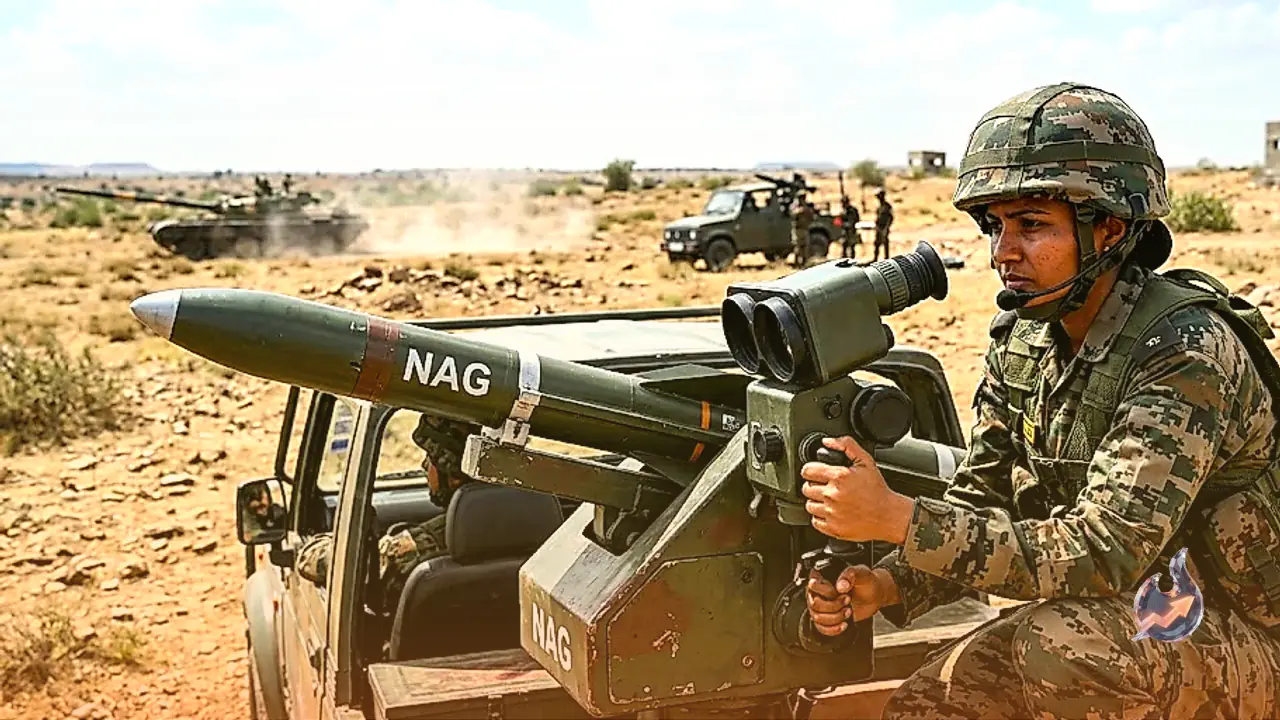

The journey of India's Nag missile system spans nearly four decades of rigorous technological advancement encompassing critical domains such as seekers, guidance, image processing, propulsion, warheads, and launchers. With the successful field evaluation trials of the Nag Mk-2 and its impending induction into the Indian Army, looking back reveals the extensive path traversed to achieve this milestone.
Origins in the 1983 IGMDP Framework
This narrative commenced in 1983 with the establishment of the Integrated Guided Missile Development Program. The primary objective of this initiative was to engineer indigenous guided missile technology tailored to various strategic needs. Five major missiles were conceptualized under this framework, including Prithvi, Agni, Akash, Trishul, and Nag. Specifically, the Nag was designated as an anti-tank missile engineered to neutralize heavy armored tanks belonging to adversaries on the battlefield.
Fire-and-Forget and Top-Attack Capabilities
During the early developmental phase, the primary challenge involved creating a weapon capable of autonomously identifying targets and locking onto them so that operators would not need to steer the projectile continuously after launch. This requirement solidified the fire-and-forget concept for the Nag. Unlike older generation anti-tank guided missiles requiring constant manual guidance, this third-generation system locks onto the target prior to launch. Furthermore, DRDO equipped the missile with top-attack capability, allowing it to traverse above a tank and strike its vulnerable upper armor.
The Role of the Imaging Infrared Seeker
A core component of the missile is its imaging infrared or IIR seeker. On a battlefield featuring desert terrain, heated ground, dust, and competing heat sources, distinguishing an actual tank from background noise presents a severe technical hurdle. The seeker and its accompanying image-processing apparatus perform this discrimination. DRDO subjected these capabilities to diverse environmental conditions to ensure reliability.
Namica as the Dedicated Carrier System
Deploying the missile required a dedicated launcher and carrier platform, leading to the development of Namica based on the BMP-2 platform. Namica transports the missiles to the combat zone, assists in target acquisition, and executes launches. According to the Ministry of Defence, Namica can carry up to six combat-ready missiles, transforming the project into a comprehensive weapon system.
Extensive Testing and Technical Milestones
The development timeline of the Nag program involved prolonged testing across day and night, extreme temperatures, varying ranges, and diverse target conditions. Trials conducted during 2016 and 2017 provided fresh momentum to the project. Flight tests executed on September 8 and 9, 2017, in the ranges of Rajasthan successfully demonstrated the complete functionality of the anti-tank guided missile and the Namica launcher, marking the culmination of development trials.