




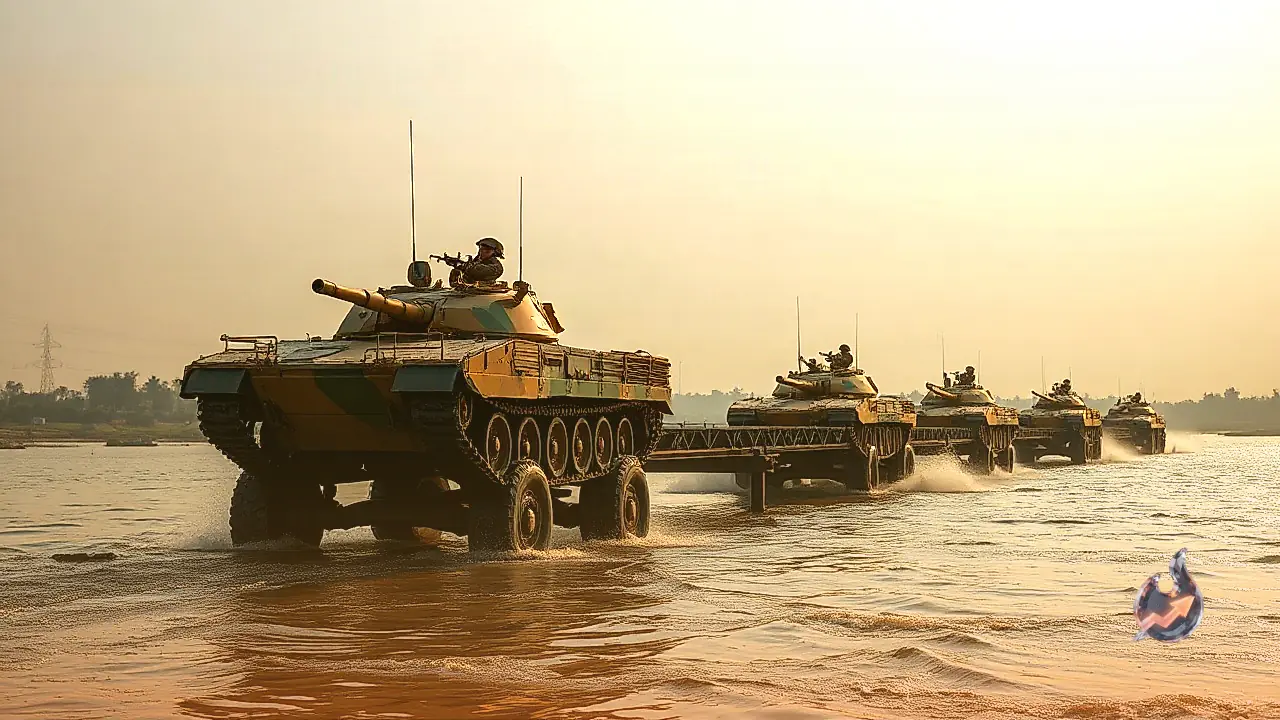
















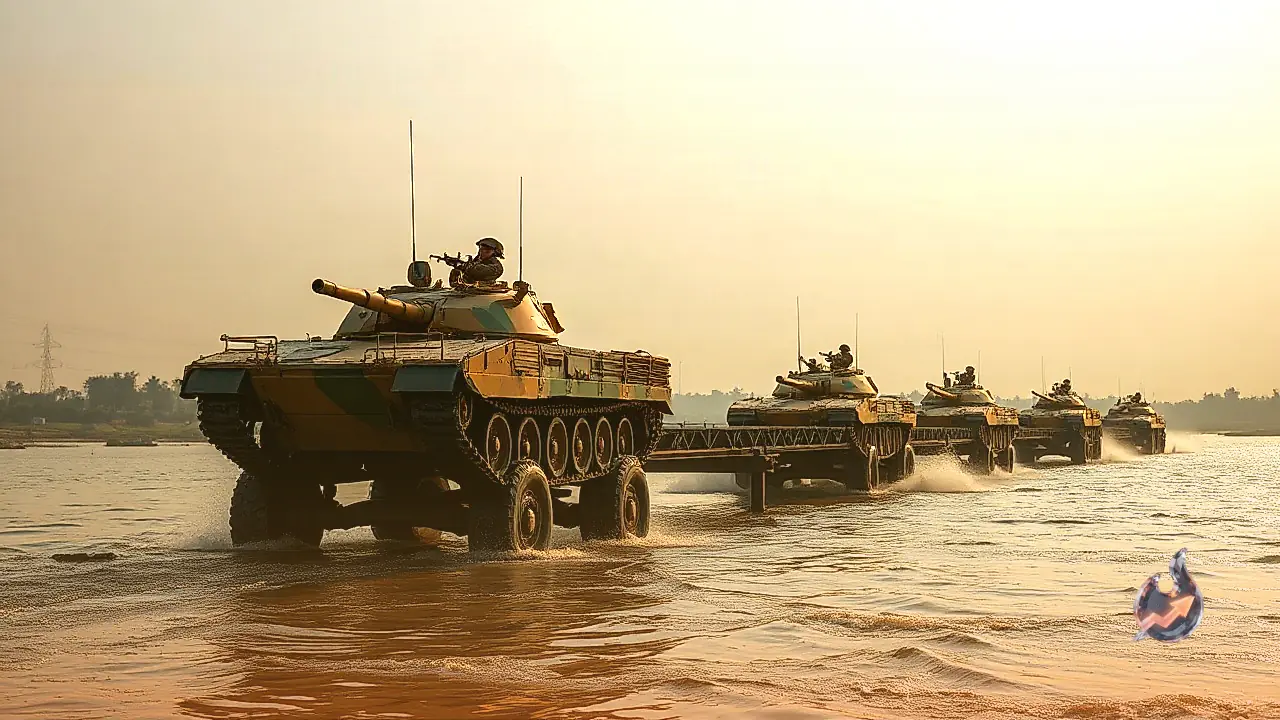

A well-known axiom in military warfare states that geography dictates strategy. When an army's armored formations advance into enemy territory, deep rivers, unfordable streams, and wide concrete canals pose the most formidable physical hurdles. These water obstacles severely impede the speed of heavy main battle tanks. Defending forces routinely set up fortified artillery positions and anti-tank bunkers behind these water barriers. If advancing armored columns get stalled at the water's edge, they become vulnerable to devastating enemy shelling. To neutralize this strategic vulnerability and maintain the momentum of its armored brigades, the Indian Army has integrated the 'Sarvatra' bridging system into its assault engineers' arsenal. This advanced mobile system can bridge wide rivers and artificial canals within minutes, enabling 70-ton main battle tanks like the T-90 and Arjun to cross seamlessly without losing operational momentum.
Geography and Military Strategy: How Water Obstacles Halt Armored Advances
Military history demonstrates that terrain has repeatedly dictated the outcome of major campaigns. During the 1971 Liberation War on the Eastern Front, the geography of Bangladesh presented extraordinary challenges to the advancing Indian Army. The region's dense network of wide rivers and marshlands acted as formidable natural moat lines for the defending forces. Crossing these water bodies under enemy fire was extremely hazardous. However, through meticulous planning, vertical envelopment using helicopters, and rapid amphibious maneuvers, Indian forces reached Dhaka in record time. During that campaign, PT-76 amphibious light tanks swam across deep rivers, surprising enemy positions and neutralizing their defensive lines.
Natural geography is traditionally regarded as a 'force multiplier' in defensive military operations. In ancient history, when King Leonidas of Sparta defended the narrow pass at Thermopylae, his small force effectively delayed a massive Persian army numbering in the hundreds of thousands. That tactical feat was made possible entirely by the constrained physical bottleneck of the terrain. For this reason, modern armed forces maintain specialized combat engineer units, known as Sappers. These engineers are tasked with erecting obstacles to stall enemy advances while breaching barriers to keep their own military formations moving forward.
Armored Velocity: Lessons from Blitzkrieg to the Gulf War
In mechanized warfare, speed and maneuverability are paramount. Modern main battle tanks and infantry fighting vehicles fulfill the operational role historically carried out by cavalry charges. When armored formations breach enemy territory at high speed, defending commanders are deprived of the time needed to reorganize their forces or execute countermeasures. During the opening phases of World War II, the German military's Blitzkrieg doctrine demonstrated the devastating impact of armored speed, capturing vast areas of Poland and France in a matter of weeks.
Similarly, during the Gulf War, coalition armored columns executed rapid maneuvers across open desert terrain, completely bypassing and destroying Iraqi defensive positions. When tanks breach defensive lines rapidly, they sever enemy supply and communication channels. This isolates forward troops and undermines their capacity to maintain a coherent defense, often compelling them to surrender.
Four Tactical Purposes of Military Obstacles
Combat engineers classify military obstacles into two broad categories: natural obstacles (such as rivers, swamps, and mountain ranges) and artificial obstacles (such as minefields, anti-tank ditches, and wire entanglements). Sappers design these obstacles in coordination with infantry and artillery units to funnel opposing forces into targeted engagement zones.
Tactically, combat obstacles serve four primary objectives
- Disrupt: To break up the tactical formation of advancing enemy forces, splitting them into isolated groups that can be destroyed piecemeal.
- Fix: To slow down or completely halt enemy movement in a specific area, allowing defensive artillery to fire upon them with high precision.
- Turn: To force the enemy away from their preferred axis of advance and drive them toward pre-selected kill zones where heavy firepower is waiting.
- Block: To completely deny access along a specific route, compelling the enemy to halt or attempt a costly alternate route.
When combined effectively, these four obstacle functions form an integrated barrier system that is extremely difficult to breach without specialized engineering equipment.
Water Crossing Challenges: From Operation Market Garden to Yom Kippur
Water barriers have historically frustrated even the most ambitious military operations. In World War II, Allied forces launched 'Operation Market Garden' to capture strategic bridges over the Rhine River in the Netherlands. Securing those crossings could have shortened the war by several months. However, the failure to secure the final bridge at Arnhem delayed the Allied crossing of the Rhine by six months, giving defending forces time to regroup.
Conversely, during the 1973 Yom Kippur War, Egyptian forces achieved a legendary water crossing. Israel had constructed the Bar-Lev Line, a massive sand rampart along the eastern bank of the Suez Canal, considered virtually impenetrable. Egyptian combat engineers deployed high-pressure water cannons to blast through the sand wall within hours, allowing armored vehicles to cross the canal in one of the most audacious assault crossings in modern history. The Indian Army's heliborne crossing of the Meghna River in 1971 remains another historic example of bypassing formidable water barriers to disarm enemy defensive plans.
Terrain Realities along the Punjab and Jammu Borders
Along India's western borders in the Punjab and Jammu sectors, the operational landscape is crisscrossed by numerous rivers, streams, and heavy irrigation canals. Potential adversaries have constructed deep defensive networks anchored by these water obstacles. A prominent example is the Bambanwala-Ravi-Bedian (BRB) Canal, also known as the Ichhogil Canal, located inside Pakistani territory. Stretching approximately 45 meters in width, this concrete-lined waterway acts as a primary defensive shield for Lahore.
To reach such canal systems during combat operations, advancing armored units must first navigate dense minefields. Once through the minefields, troops face the wide water barrier itself. On the opposing bank, enemy troops occupy fortified concrete bunkers equipped with anti-tank guided missiles and heavy artillery. When an advancing army attempts to cross such water obstacles, vehicles are forced to concentrate at narrow bridging points—known as choke points—making them highly vulnerable to concentrated enemy artillery fire.
Capabilities of the 'Sarvatra' Mobile Bridging System
The 'Sarvatra' bridging system directly addresses the challenge posed by these strategic choke points. Developed indigenously by DRDO's Research and Development Establishment (Engineers) in collaboration with Bharat Earth Movers Limited (BEML) and industrial partners, Sarvatra is a multi-span mobile bridging vehicle system mounted on 8x8 Tatra truck chassis.
When armored columns encounter a wide canal or river, a set of five Sarvatra vehicles deploys to construct a continuous span. Key features of the system include
- Modular Span Range: Each Sarvatra vehicle carries a 15-metre scissor-launch bridge section. When five units are joined sequentially, they form a continuous 75-metre bridge across wide water obstacles.
- High Load Capacity: Rated at Military Load Class 70 (MLC 70), the bridge can easily support 70-ton armored vehicles. India's T-90 Bhishma main battle tanks (approx. 48 tons) and heavy Arjun main battle tanks (approx. 62–68 tons) can cross the structure at speed.
- Rapid Setup Time: Combat engineering crews can deploy and fully assemble the complete 75-metre bridge in under 100 minutes, leaving defending forces insufficient time to retarget their artillery.
- Automated Operation: Fully hydraulic and computer-controlled deployment mechanisms allow soldiers to launch the bridge with minimal exposure to incoming enemy fire.
By providing rapid gap-crossing capabilities across the canals and rivers of the western front, the Sarvatra system ensures that India's armored formations maintain their offensive speed and operational flexibility in any combat scenario.