



















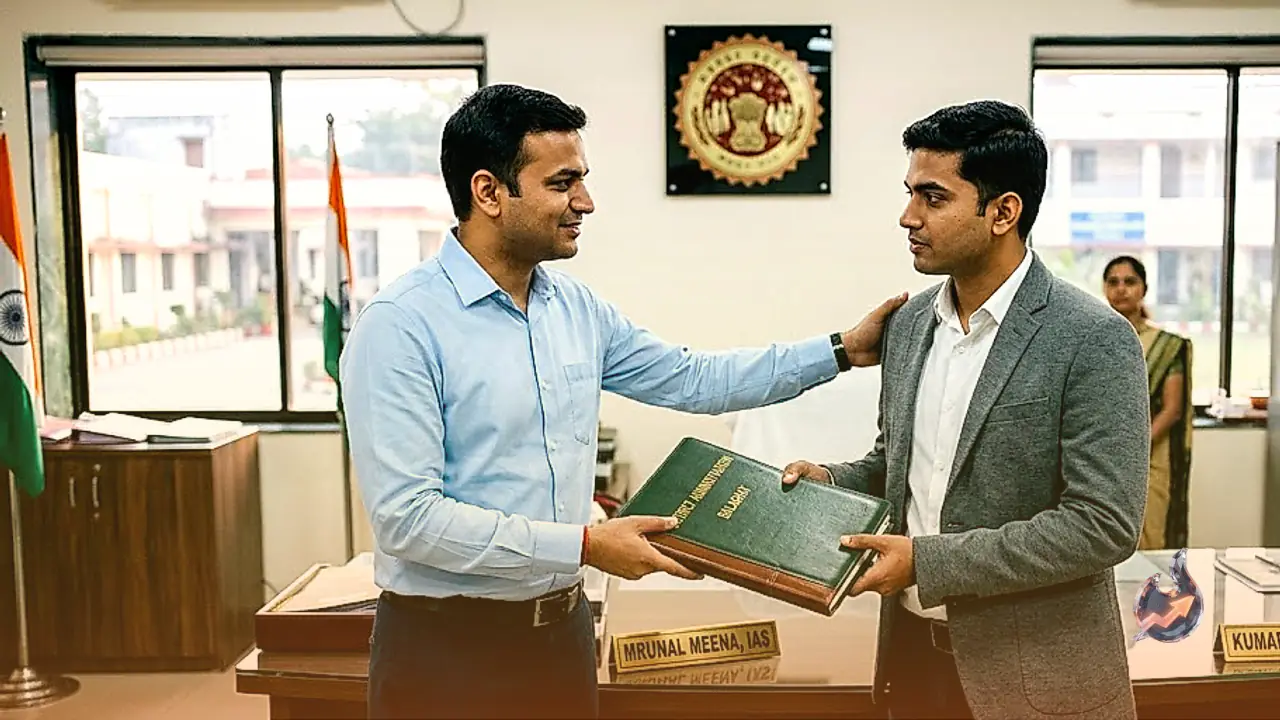

The government of Madhya Pradesh announced a major administrative reshuffle on July 28, reassigning duties for 8 IAS officers across the state. Under the new posting orders, two key districts—Balaghat and Chhatarpur—received new Collectors. Outgoing Balaghat Collector Mrunal Meena has been transferred to assume charge of Chhatarpur district, while Kumar Satyam has been designated as the new Collector of Balaghat. Notably, Mrunal Meena had assumed charge when Balaghat carried a heavy Naxal-affected designation, and he departs as the region enters a Naxal-free phase, prompting a reflection on the district's developmental transformation.
Administrative Reshuffle and Leadership Transition
The official notification issued on July 28 reflects strategic reallocations within the state's bureaucracy. Among the 8 IAS officers transferred, the postings in Balaghat and Chhatarpur stand out due to the administrative complexity of these regions. Kumar Satyam steps into the leadership role in Balaghat to oversee ongoing welfare and infrastructure projects. Simultaneously, Mrunal Meena takes charge of Chhatarpur, bringing his administrative experience from managing a sensitive border district.
Overcoming Preconceptions to Drive Regional Progress
Balaghat was historically perceived as a backward and security-sensitive region impacted by Left Wing Extremism. Due to these persistent safety concerns, administrative personnel previously displayed hesitation regarding postings in the district. Addressing this aspect, Mrunal Meena noted that he assumed his posting without bringing any preconceived notions about the area, maintaining that an open approach remains essential for effective governance.
Describing the local population as peace-loving, he acknowledged that while Naxalism posed a severe challenge, the administration achieved the target of eliminating extremist influence well before the official government deadlines. He remarked, "बिना किसी धारणा के बालाघाट आया था।" With security conditions stabilized, the focus in Balaghat has shifted entirely toward expansive infrastructure development and socio-economic growth.
Navigating Security Hazards to Build Infrastructure
Extremist interference served as a primary bottleneck for developmental projects in Balaghat for decades. Naxal groups routinely targeted construction equipment, setting machinery ablaze and issuing threats to contractors and labourers to stall civil works. Consequently, vital road networks and connectivity projects remained incomplete for years in remote forest belts.
To counter these security obstacles, the district administration established close coordination with the Madhya Pradesh Police and central paramilitary forces. Under the Road Connectivity Project for Left Wing Extremism Affected Areas (RCPL), infrastructure execution was prioritized alongside daily monitoring of civil work progress. This coordinated effort enabled the successful construction of 30 high-level bridges and over 30 major roads, effectively establishing crucial transport corridors for previously isolated rural and tribal communities.
Top Rankings in State and Central Welfare Initiatives
Sustained administrative oversight positioned Balaghat at the forefront of several key public welfare programs. The district secured the top position across Madhya Pradesh in executing target benchmarks for the Ganga Jal Samvardhan campaign, Pradhan Mantri Awas Yojana, and the Pradhan Mantri Shram Yogi Maandhan Yojana.
Furthermore, Balaghat achieved leading rankings in resolving public grievances submitted through the Chief Minister Helpline (CM Helpline) and weekly Jan Sunwai hearings. To ensure governance reached remote habitations, the administration organized root-level outreach camps, including overnight camps in villages. These initiatives enabled rural residents to resolve administrative issues directly with district officials.
Five Key Administrative Innovations of IAS Mrunal Meena
Following his appointment as Balaghat Collector on August 13, 2024, Mrunal Meena implemented distinct development strategies tailored separately for the district's plain and hilly terrains. Five major governance initiatives marked his tenure
- 1. Distribution of Forest Rights Titles: Over 6,800 beneficiaries received agricultural land titles under the Individual Forest Rights Act within a single year. A collaborative push involving the district administration, forest department, and Panchayat secretaries ensured tribal farmers could cultivate land securely.
- 2. Rise Bal Ginti App for Anganwadi Transparency: To eliminate leakages in food ration distribution and track child attendance, a dedicated mobile application named 'Rise Bal Ginti App' was deployed. The digital tool introduced real-time transparency in monitoring child malnutrition, daily attendance, and hot cooked meal preparation across Anganwadi centers.
- 3. Digital Youth Registry and Corporate Employment: The administration compiled a digital registry of unemployed youth in Naxal-affected belts using a centralized Google Sheet framework. By mapping candidates' educational profiles against industry requirements, the administration invited leading companies from the automobile and electronics sectors to Balaghat. Bi-monthly job fairs provided direct employment opportunities for local youth.
- 4. Targeted Surrender Drives and Naxal Eradication: Joint outreach camps conducted alongside security agencies encouraged active dialogue with local communities. Personal video appeals issued by Collector Mrunal Meena urged extremists to lay down arms. In one notable instance, a Naxal division head decided to surrender after repeatedly reviewing the appeal video.
- 5. Implementation of e-Office Systems: To modernize public administration and accelerate file processing, the e-Office workflow system was fully integrated into the district collectorate, significantly reducing paperwork delays.
Educational Background and Career Trajectory
Hailing from Bharatpur in Rajasthan, IAS officer Mrunal Meena comes from a family with a background in public administration. He completed his undergraduate law degree from NALSAR University of Law, Hyderabad, followed by practical legal internships.
In 2015, he cleared the UPSC Civil Services Examination in his very first attempt, securing an All India Rank of 174. As an officer of the 2015 IAS batch, his initial posting was as Assistant Collector in Rewa district, Madhya Pradesh. He subsequently served as SDM in Sabalgarh and as Municipal Corporation Commissioner prior to his collectorate assignments.