























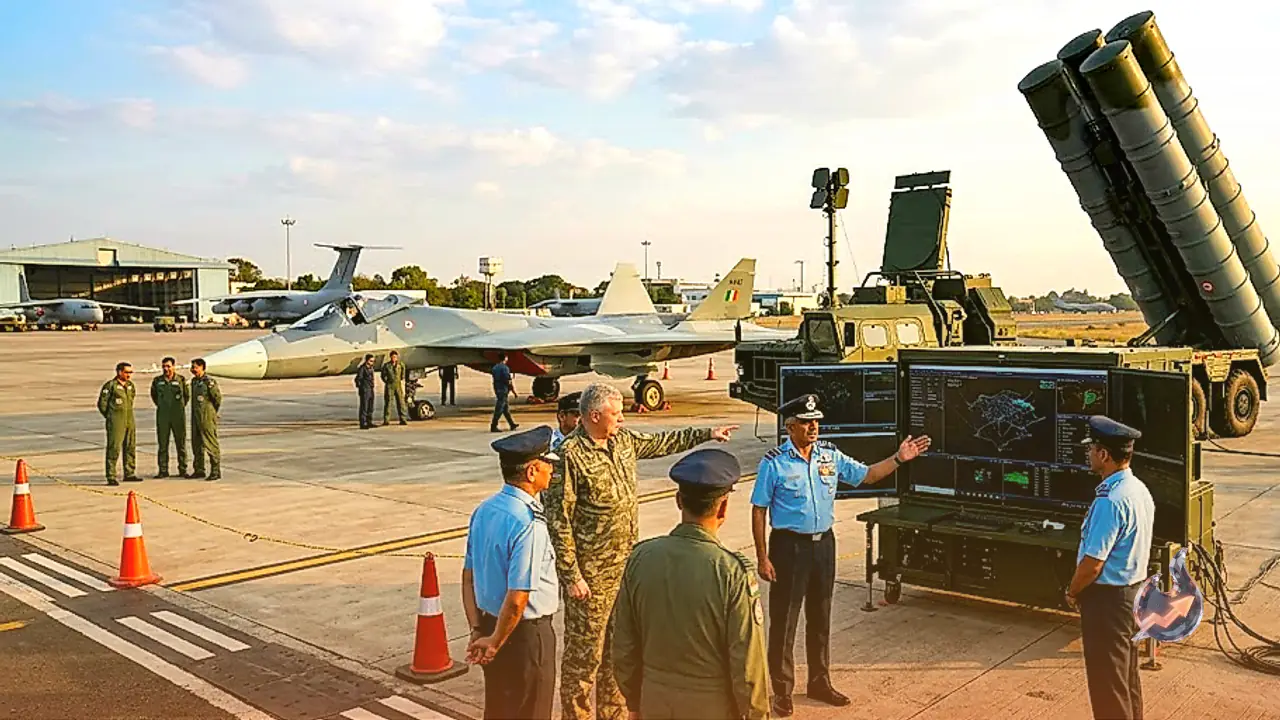

The Indian Air Force is standing on the precipice of a monumental technological transformation in its aerial defense capabilities, driven by the potential integration of Russia's fifth-generation Su-57 stealth fighter jet with the already deployed S-400 Triumf air defense system. As regional security dynamics grow increasingly complex, Indian defense planners are evaluating strategies to establish an ultra-modern, integrated sensor-to-shooter network that could fundamentally redefine the mechanics of sky combat. This prospective synergy aims to drastically enhance the ability of the armed forces to detect, track, and neutralize sophisticated airborne threats, including enemy stealth fighters, long before they breach Indian airspace. By combining advanced ground-based surveillance with cutting-edge airborne strike capabilities, New Delhi is actively working to construct an impenetrable defensive shield that perfectly aligns with the realities of modern network-centric warfare.
The Two-Front Challenge and Border Sensitivities
India’s geographic positioning renders it uniquely sensitive from a strategic standpoint, flanked by adversaries that pose persistent and severe security challenges. On one border lies Pakistan, a nation characterized in security discourse by its terror-sponsoring activities, while the other border is shared with China, recognized for its deceitful and aggressive geopolitical posturing. The historical context of India having fought full-scale wars with both of these neighboring countries ensures that the fragile and tense relationships shared with Islamabad and Beijing remain an open secret on the global stage. Given this volatile and unpredictable environment, it is an absolute necessity for India to maintain perpetual combat readiness for a potential two-front war scenario. This demanding security imperative requires a holistic and continuous strengthening not only of the Air Force but equally of the Army and the Navy to ensure comprehensive national defense.
A Comprehensive Military Modernization Drive
Over the past several years, the Indian government has aggressively accelerated its efforts to modernize and indigenize its military apparatus across all defense branches. For the Army, this has translated into a continuous procurement and domestic production pipeline encompassing heavy artillery, main battle tanks, assault rifles, and advanced rocket systems. Simultaneously, the maritime domain is witnessing rapid expansion, with the Navy consistently adding new, formidable warships to its fleet while actively pushing forward projects designed to acquire and develop submarines equipped with cutting-edge underwater technology. The aviation sector has also seen critical movement. Just months ago, the government greenlit a massive procurement proposal for 114 Rafale fighter jets, a high-stakes deal that has now formally entered its next developmental phase to significantly bolster aerial strike capabilities.
Addressing the Alarming Squadron Depletion
Despite these sweeping modernizations, the immediate focus of Indian policymakers remains sharply fixed on urgently revitalizing the striking power of the Indian Air Force. The IAF is currently grappling with a severe depletion in its combat strength, with its fighter jet fleet dwindling to an alarming low of just 29 active squadrons, sitting far below the officially sanctioned operational requirement of 42 squadrons. To bridge this massive capability gap and address the pressing need for a fifth-generation fighter jet, India is actively exploring various importation options. The primary contenders in this high-stakes race are the Russian Su-57 and the American F-35. However, given the significant logistical and diplomatic hurdles associated with the procurement of the F-35, the Russian Su-57 is increasingly being viewed as the natural and most viable choice for the Indian Air Force, even though a final binding decision has not yet been formalized.
Forging an Unbreakable Sensor-to-Shooter Network
If the Su-57 does join the Indian inventory, it promises to forge an unprecedented operational architecture alongside the existing S-400 systems. According to a report by the Indian Defence Research Wing, Russian officials have formally assured India that real-time, instantaneous target data exchange between the S-400 networks and the prospective Su-57 fighters is entirely feasible. Instead of operating as isolated assets in the battlefield, these two highly advanced platforms will seamlessly fuse to function as a highly coordinated and lethal kill chain. In the realm of modern, network-centric combat, this specific type of advanced sensor fusion technology is regarded as a decisive, game-changing advantage. It allows disparate military platforms to continuously pool and share critical telemetry, thereby painting a highly accurate, unified picture of the entire battlefield for commanders and pilots alike.
The Eye in the Sky: Capabilities of the 96L6E Radar
At the very heart of this proposed integrated network lies the S-400 air defense system's formidable 96L6E surveillance radar. The S-400 system has already proven its massive operational mettle globally, having famously showcased its capabilities during Operation Sindoor, an event that sparked widespread international discussion regarding its immense effectiveness. Operating on the highly efficient C-Band frequency, the 96L6E radar is globally recognized for its exceptional capability to detect aerial targets at massive distances of up to 350 kilometers. This powerful ground-based sensor specializes in continuously scanning the skies to identify and precisely track a wide variety of threats, ranging from high-altitude fighter jets to low-flying cruise missiles, as well as targets intentionally designed with limited radar cross-sections.
Silent Approach: Preserving the Stealth Advantage
Once the S-400's surveillance radar identifies a threat, this critical tracking data is rapidly disseminated through the system's robust command and control network. Russian defense experts confirm that this precise telemetry from the 96L6E radar can be beamed directly to the Su-57’s onboard N036 Belka Active Electronically Scanned Array (AESA) radar system. The strategic advantage of this data link is immense. The Su-57 will no longer have to rely exclusively on its own active sensors to hunt for enemy aircraft. Armed with prior knowledge of the enemy's exact position, altitude, and trajectory provided by the S-400, the Su-57 can execute its approach without ever activating its own radar. By maintaining strict radio silence, the fighter preserves its critical stealth characteristics, allowing it to close the distance undetected before unleashing its long-range air-to-air missiles.
Unmatched Situational Awareness in Combat
This integrated arrangement provides the Indian Air Force with a series of overwhelming tactical advantages. While the S-400’s massive ground-based radar maintains relentless overwatch over vast expanses of airspace, the Su-57 can stalk its prey with limited or zero radar emission. The Su-57 itself boasts highly advanced sensor technology. Its Belka system utilizes multiple AESA radar arrays mounted on the front and along both sides of the fuselage, granting it exceptional wide-area surveillance and multi-target tracking capabilities. When this already potent onboard radar is supplemented by the S-400 network, the pilot’s situational awareness reaches unprecedented levels. Tracking enemy fighters from both a terrestrial vantage point and an elevated airborne position simultaneously creates a cross-referencing matrix that makes it virtually impossible for hostile aircraft to hide in radar blind spots.
Neutralizing Advanced Fifth-Generation Threats
The integration of these two formidable Russian platforms is not occurring in a strategic vacuum. It is a direct and calculated response to the rapidly proliferating threat of fifth-generation stealth fighters in India's immediate neighborhood. While the S-400's powerful radar networks provide a robust defensive shield, intercepting a highly advanced, low-observable fighter jet requires more than just ground-based tracking. Adversary stealth fighters are explicitly designed to evade traditional radar detection by minimizing their radar cross-sections and utilizing advanced electronic warfare suites to jam incoming signals. By synthesizing the expansive ground tracking data of the S-400 with the agile, high-altitude interception capabilities of the Su-57, the Indian Air Force can effectively nullify the stealth advantage of these hostile fifth-generation aircraft. The terrestrial radar and the airborne fighter create a multi-dimensional surveillance web, scanning the airspace from multiple, disparate angles and altitudes simultaneously. This cross-layered approach ensures that even the most sophisticated enemy stealth platforms can be painted, tracked, and neutralized before they ever pose a credible threat to Indian strategic assets or population centers.