






















Environmental activist Surender Singh Choudhary, widely known across social media as Bittu Tabahi, has brought his citizen-led cleanup drive to the national capital. After leading major sanitation campaigns across rivers in Madhya Pradesh and woodland reserves in Karnataka, his latest initiative focuses on restoring the banks of the Yamuna in Delhi. Mobilizing for a scheduled three-day cleanup, Choudhary and his volunteer contingent dedicated approximately four and a half hours on their very first day, clearing a massive 585 kg of accumulated refuse directly from the riverbank.
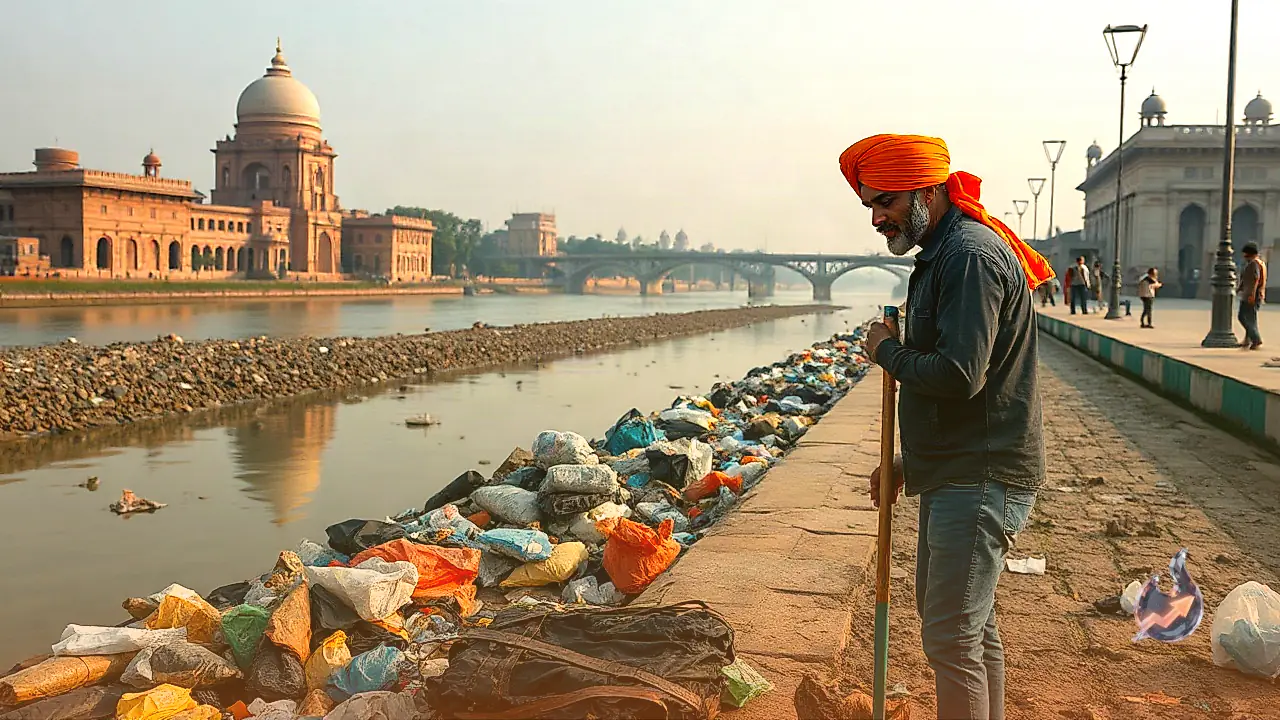
The Yamuna riverbank initiative commenced on September 20 with a dedicated band of volunteers joining the effort. The team systematically combed the shoreline, gathering plastic discards, decayed floral garlands, discarded ceremonial items, and assorted debris left along the water. In a social media post detailing the operation, Choudhary explained that the intensive cleanup spanned four and a half hours, during which the collected solid waste totaled 585 kg. He pointed out that the specific ghat chosen for the drive was heavily choked with post-worship offerings, polythene wrappings, and ceremonial litter scattered in large volumes across the embankment.
Local Community Joins the Sanitation Drive
As the volunteer team worked through the piles of garbage along the riverfront, several nearby residents noticed the effort and stepped forward to offer manual assistance. Local citizens picked up tools and bags alongside the core team to help restore the riverside. Expressing heartfelt gratitude to everyone who turned up, Choudhary noted that direct community involvement magnifies the impact of any environmental action beyond a single location. When ordinary people actively clean up public spaces themselves, it fosters broad awareness and motivates surrounding neighborhoods to care for their civic surroundings.
Upcoming Leg Slated for Kherki Daula in Gurugram
The ongoing Yamuna initiative is scheduled to run for two more days, with volunteer teams anticipating the removal of several additional quintals of riverbank debris over the coming sessions. Once the three-day Delhi phase concludes, Choudhary plans to take his sanitation drive to Kherki Daula in Gurugram. This move marks the expansion of his hands-on environmental mission into other vital hubs across the wider National Capital Region.
Track Record from the Ajnar River to Turahalli Forest
Choudhary first captured widespread public attention through his massive revitalization drive on the Ajnar River in Madhya Pradesh. During that intervention, he assembled a dedicated squad of around 100 individuals to purge choked stretches of the riverbed. Building on that momentum, he spearheaded another extensive campaign in Karnataka at the Turahalli forest, situated about 20 kilometers outside Bengaluru, where his team cleared dense deposits of discarded waste littering the forest floor. His trajectory demonstrates a sustained mission connecting inland rivers, natural woodlands, and now urban waterways.
Global Recognition and Corporate Commendation
These grassroots cleanup initiatives have earned widespread visibility across digital platforms. Leading industrialist Anand Mahindra previously shared footage of Choudhary's river restoration efforts on social media, amplifying the campaign to millions of viewers. Following the successful transformation of the Ajnar River, his work resonated internationally as well. Boyan Slat, the founder and CEO of the prominent global environmental organization The Ocean Cleanup, recognized Choudhary's dedication and extended a formal employment offer to him.
Why Riverbank Interventions Matter for the Yamuna
The Yamuna in Delhi has suffered from chronic contamination, untreated runoff, and floating plastic waste for decades. While a few hours of physical cleanup cannot single-handedly solve the structural industrial pollution impacting the waterway, initiatives of this nature serve an indispensable public purpose by curbing surface plastic and altering citizen behavior. By demonstrating that ordinary individuals can physically intervene where litter accumulates, Choudhary promotes a straightforward principle: whenever public places face neglect, proactive civic responsibility must lead the way.