





















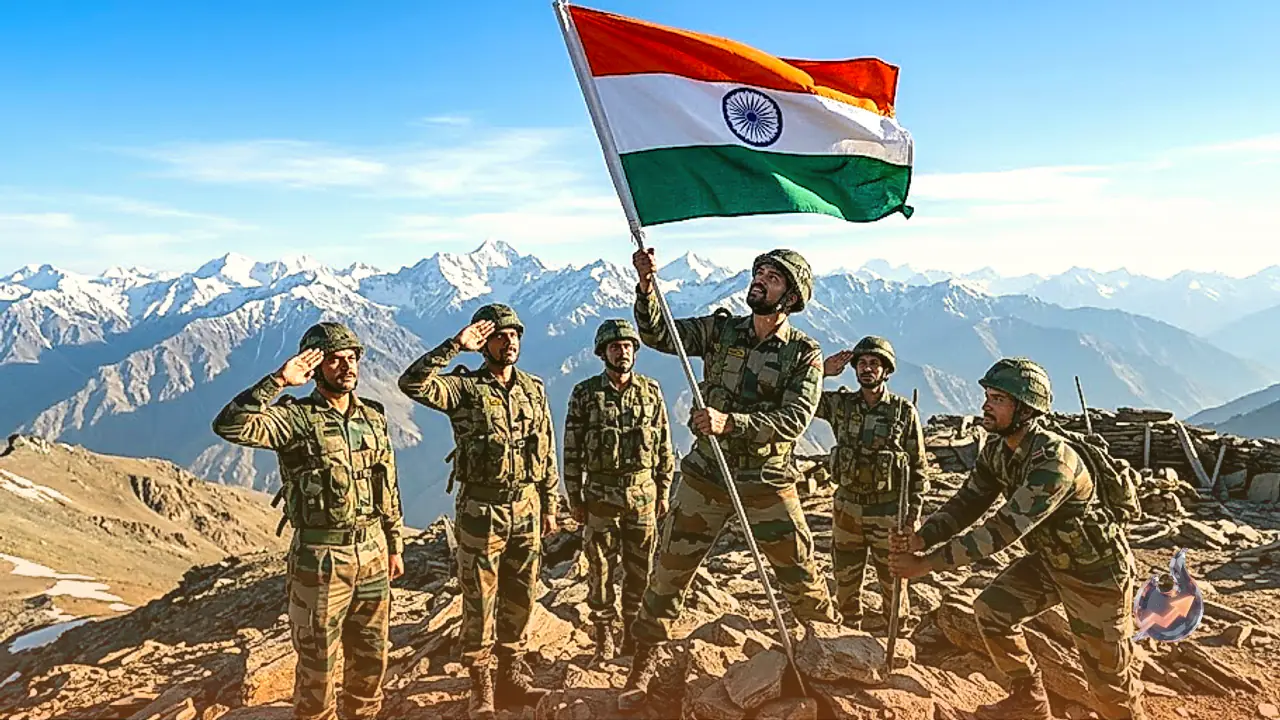

Throughout the Kargil War, numerous battles fought on the icy peaks of the Himalayas left an indelible mark on Indian military history. Among these, the fight for Point 5140 stands out as a pivotal engagement that fundamentally shifted the momentum of the war and established a new paradigm for combat in rugged, high-altitude terrain. Today, the entire nation knows this peak as Gun Hill. To mark the 27th anniversary of Operation Vijay, the Indian Army organized a special expedition to this historic site, paying tribute to the brave soldiers whose grit and valor led to the hoisting of the tricolor on the heights of Kargil in 1999.
Strategic Importance and Challenges
Situated at an altitude of approximately 17,000 feet, Point 5140 was a formidable obstacle. At the time, it served as a vital observation post, allowing the enemy to monitor every movement of the Indian forces and provide support to other illegally occupied peaks nearby. For the Indian military leadership, liberating this peak was not merely a tactical necessity but an absolute prerequisite for victory. The story of this conquest is not just about the bravery of the infantry soldiers, but also a testament to the remarkable capabilities of the Indian Artillery, which systematically dismantled the enemy's defenses.
Strategy and Artillery Supremacy
Before the final assault in June 1999, the Indian Army secured its position by capturing surrounding heights. On the night of June 13 and 14, 18 Grenadiers captured the 'Hump,' while 13 Jammu and Kashmir Rifles took control of 'Rocky Knob.' During this phase, Bofors guns played a crucial role by firing directly at enemy bunkers. The precision of the artillery was so devastating that the enemy's defensive structure began to crumble under the relentless fire.
The Decisive Campaign
The decisive operation commenced on the night of June 19 and 20, 1999. Under a comprehensive artillery plan named 'Shatrunash,' Bofors guns and Multi-Barrel Rocket Launcher systems rained fire continuously on enemy positions. The coordinated shelling from both the east and west directions effectively neutralized the enemy's combat capability. Following this intense bombardment, the Indian infantry moved in. At 5:00 AM on June 20, the 13 Jammu and Kashmir Rifles successfully captured Point 5140. This achievement resulted in the collapse of a key forward line for the enemy in the Dras sector, providing the Indian Army with a decisive lead in the Kargil War.
A Rare Achievement in Military History
What makes this victory truly exceptional is a feat that remains rare in the history of warfare. Despite capturing a heavily fortified enemy position at nearly 17,000 feet, the Indian Army did not lose a single soldier during the operation. In the history of high-altitude Himalayan warfare, this was the first instance where such a challenging military objective was achieved without any own-side casualties. In recognition of this extraordinary success and the decisive role played by the Artillery Regiment during the Kargil conflict, Point 5140 was officially renamed 'Gun Hill' in 2023.
Honoring the Legacy
The expedition organized this year included 126 soldiers, of which 25 had participated directly in the 1999 war, accompanied by 101 soldiers from local military units. This was more than just a military trek; it served as a living bridge between the past and the present, connecting the heritage of honor, tradition, and sacrifice. Today, as soldiers stand at the summit of Gun Hill watching the tricolor flutter, they see more than just a mountain. They witness the courage, determination, and ultimate sacrifice that paved the way for India's triumph on the frozen peaks of Kargil. Gun Hill continues to echo the saga of heroes who turned the impossible into reality.