



















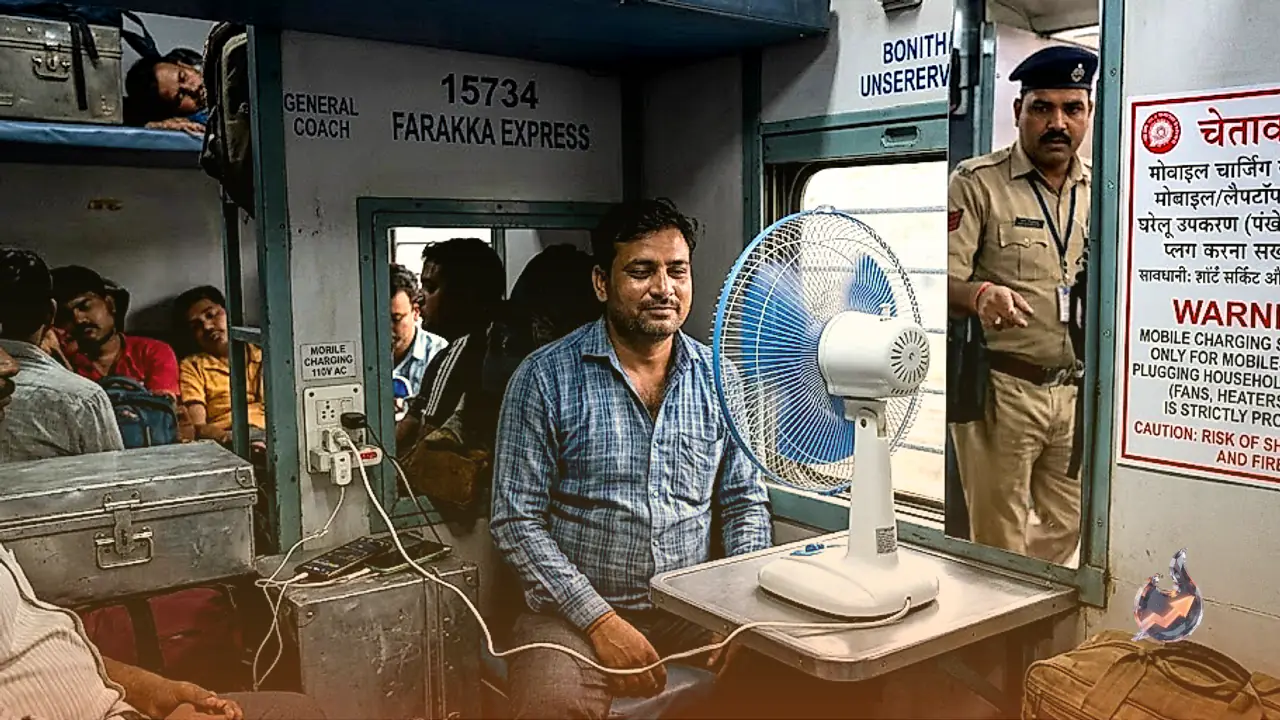

A grainy clip from an ordinary Indian train has turned into a lesson on electrical safety after it started circulating widely online. The video, filmed inside the general coach of the Farakka Express, shows a passenger plugging a small fan directly into a mobile charging socket to beat the heat, a workaround that railway officials say could have ended in disaster.
What the viral clip shows
According to the video, the incident took place at around 8:30 am, with the passenger seated directly in front of seat number 75 in the general coach. Struggling with the heat and the overcrowding typical of general coaches, the passenger had connected a small fan's plug to the mobile charging socket meant for phones. While the intent was simply to get some relief from the heat, the makeshift setup put both the passenger and fellow travellers at risk. Heat and crowding in general coaches during summer are common complaints, and it is this discomfort that pushes some passengers to find their own, often risky, ways of coping.
A passenger alerted the railway on X
The matter first came to wider attention after a passenger named Kapil Shukla posted about it on X, tagging the Railway Ministry's official handle. He wrote that a passenger travelling on the Farakka Express, which was headed to Balurghat, was running a fan off a mobile charging point. Shukla warned, "this could lead to a major incident." He added that the passenger was seated in front of seat number 75 in the general coach, right at the front of the train, and that the photos accompanying his post were taken at around 8:30 am.
Northern Railway issues a warning
Once the video began doing the rounds, Northern Railway stepped in with a clear warning for passengers. It said "the charging ports available in coaches are meant only for mobile phones and small electronic devices." The railway appealed to passengers not to plug fans, heaters, irons or any other household electrical appliances into these sockets, warning that doing so puts extra strain on the wiring, which can overheat and lead to a short circuit or fire. Northern Railway urged all passengers to follow safety rules and avoid any activity that could endanger their own life as well as that of other passengers.
Why plugging a fan into a charging socket is risky
The charging sockets installed in train coaches are designed for a limited electrical load, meant to comfortably charge small devices such as mobile phones and tablets. A fan, however, draws considerably more current than a phone charger. When such an appliance is connected, it puts additional strain on the socket and the wiring connected to it. If that strain continues for long enough, the wires can heat up, significantly raising the risk of a short circuit and a fire breaking out. In an enclosed, crowded space like a train coach, even a small spark can escalate into a major accident, which is why the railway has repeatedly cautioned passengers against such improvised fixes.
Mixed reactions, and demands for better coach facilities
Reactions on social media after the video went viral were divided. A number of users criticised the passenger's carelessness and called for action to be taken against him. Others pointed out that the heat and overcrowding in general coaches are severe enough that passengers often feel forced into taking such risky measures just to cope with the conditions. Several users used the moment to demand that the railway improve facilities in general coaches, arguing that if coaches had adequate ventilation and properly functioning fans to begin with, passengers would not need to resort to dangerous jugaad of this kind just to stay comfortable during their journey.
What the rules say, and the railway's appeal
Under railway rules, the use of any unauthorised electronic device on trains is strictly prohibited, and passengers are advised to use only those devices the railway has permitted. The episode is a reminder that even a small lapse during a journey can spiral into a serious problem for everyone on board. The railway has appealed to passengers to immediately report any suspicious activity they notice during their journey to the TTE, the Railway Protection Force, or the railway helpline, so that a bigger accident can be averted in time.