






















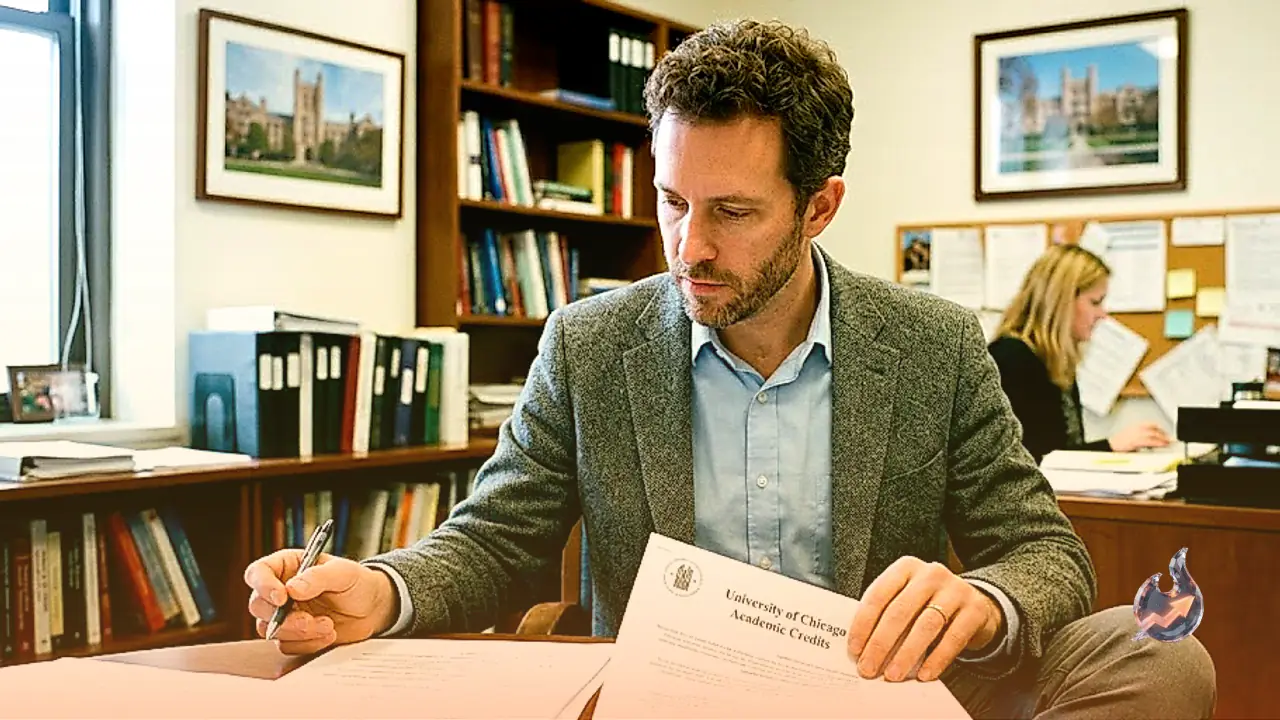

Sweet, an affiliate of the Department of Government Efficiency (DOGE) stationed at the Department of Housing and Urban Development (HUD), attempted to structure his government work as an independent study project to earn three college credits. Having joined HUD in the spring of 2025 while still an undergraduate student at the University of Chicago, Sweet was tasked with constructing an artificial intelligence tool called SweetRex. The application was designed to scour agency rules, regulatory codes, and federal contracts to flag them for rescission, with plans for a broader deployment across the federal government.
The Proposed Four-Course Framework and SweetRex AI Tool
Internal communications demonstrate how Sweet's government assignments were framed to satisfy academic requirements. In an email dated August 26, 2025, titled "which of these should go to U Chicago," fellow DOGE affiliate Scott Langmack wrote to Sweet explaining, "I need to send them something that has specific framework of the different courses/credits we want them to give you."
Attachments to the correspondence revealed that Sweet's work was mapped onto four distinct proposed course titles: "Advanced AI Prompt Engineering for Legal Reasoning," "Applied Data Science for Federal Regulatory Analysis," "Computer Programming for Scalable Al-Legal Systems," and "Legislative & Regulatory Authority in AI-Driven Reform." These modules were intended to culminate in a proposed thesis exploring how integrated data science, software engineering, and AI legal analysis could modernize outdated federal regulations. The documentation explicitly emphasized that Sweet's project was not a standard internship but graduate-level research yielding real-world regulatory impacts.
Use of ChatGPT for Academic Outlines and Graduation Status
The formal course proposal drafted for submission to the University of Chicago was generated using generative artificial intelligence tools. On August 27, 2025, Langmack admitted in a follow-up email to Sweet, "I did the outline on ChatGPT."
Academic records confirm that Sweet completed his undergraduate studies and graduated from the University of Chicago in June 2025 with a bachelor's degree in economics. However, it remains unverified whether any academic credits derived from his DOGE activities counted toward his degree completion requirements. Neither HUD nor the University of Chicago responded to inquiries concerning the arrangement.
Scott Langmack's Background and Legal Criticisms
Scott Langmack, who assisted Sweet in framing the academic credit application, transitioned into HUD from Kukun, a property technology company whose public site states a mission focused on aggregating hard-to-find data. Langmack possessed no prior background or experience within federal government agencies. According to his professional credentials, he now serves as executive director of deregulation AI within the Office of Management and Budget (OMB). Langmack did not respond to requests for comment.
Legal oversight advocates raised strong objections to the arrangement. Daniel McGrath, special counsel for oversight at Democracy Forward, indicated that placing uncredentialed personnel in charge of rewriting regulatory rules that impact millions of citizens while attempting to leverage the work for college credit presents serious ethical and governance issues. McGrath characterized the episode as part of the "Trump-Vance administration’s relentless pursuit to cripple the important work of the federal government."